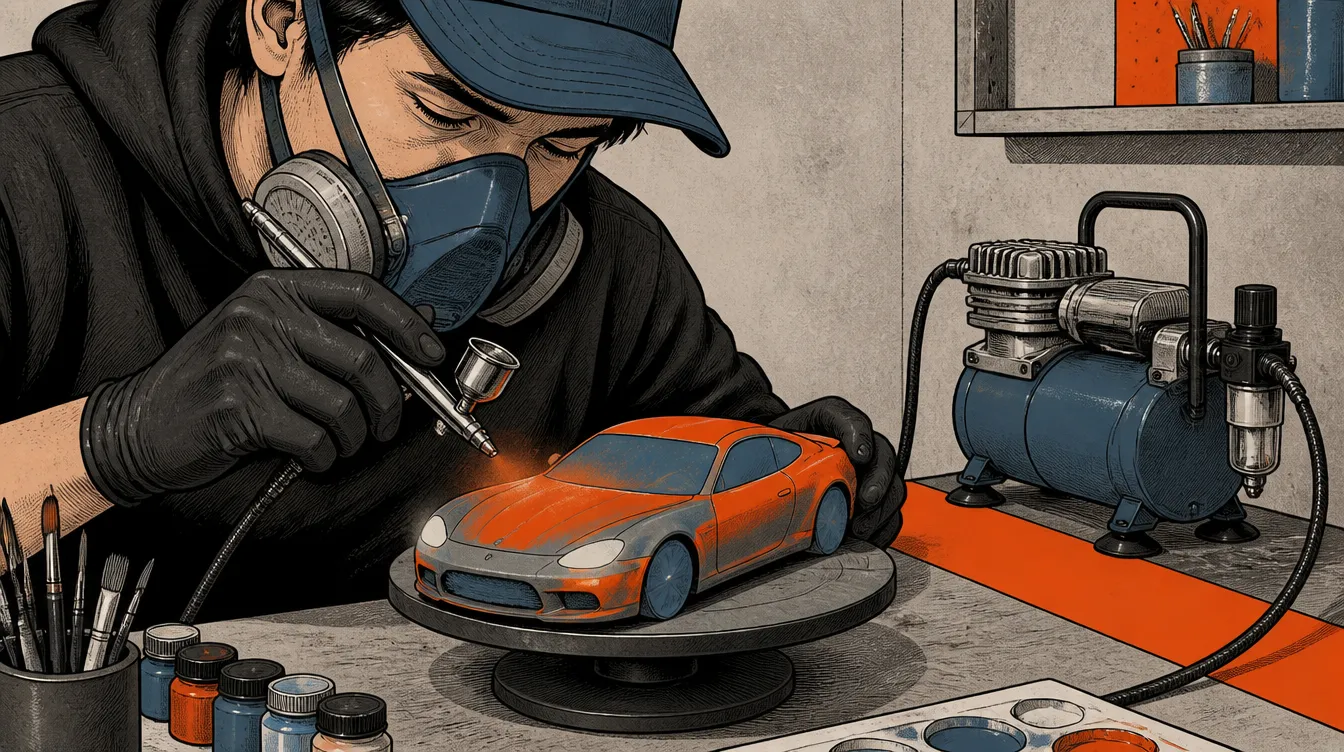
Airbrushing needs the opposite of what most air compressors are built for. Instead of maximum CFM and PSI, an airbrush wants steady, low-volume airflow, minimal noise for long detail sessions, and a compact footprint on a hobby bench. No dedicated airbrush compressor shootout exists in the testing corpus behind this guide, but a real, hands-on comparison of 13 general-purpose portable compressors does exist, and several of the smaller, quieter units in that lineup are a genuinely useful reference point for exactly the specs an airbrush user cares about.
What the testing showed
The numbers below come from Project Farm's air compressor comparison, a 13-unit test. None of these compressors are marketed specifically for airbrushing, but the noise, weight, and low-CFM data on the smallest units in the field maps closely to what an airbrush setup actually requires.
DeWalt finished as the overall winner on raw performance at 279 dollars, with claims of 3 CFM at 90 PSI, far more output than an airbrush needs, and Husky was the runner-up. Those top performers are the wrong tool for this specific job, oversized for airbrush work. The more relevant data for an airbrush buyer sits at the small, low-output end of the same test.

Winner
DeWalt
Price shown in test: $279
Affiliate link. We may earn a commission at no extra cost to you.

Runner-up
Husky
Price shown in test: $159
Affiliate link. We may earn a commission at no extra cost to you.
The lightest and lowest-output units in the field
Eastwood was the lightest compressor of all 13 tested, at just under 18 lb, built in a pancake style with a 3 gallon tank, larger than most competitors' 2 gallon tanks despite the light weight. It claimed a low 0.6 CFM at 90 PSI and a maximum 100 PSI rating, both figures well suited to airbrush work rather than running power tools.
Craftsman, at 142 dollars, posted the lowest CFM output of the entire field at just 0.5 CFM at 90 PSI, with a small 1/3 HP "hot dog" style motor and a claimed weight of about 19 lb. That low output, a real disadvantage for running an impact wrench or nail gun, is close to the steady, gentle airflow an airbrush setup actually wants.
Noise claims across the small units
Several of the smaller units in the test claimed low decibel ratings aimed at quiet operation, a genuinely important spec for long airbrushing sessions. Fornax, at 135 dollars, claimed a maximum 65 dB noise level with a 1.2 HP motor in a 2 gallon oil-free "silent" design. Stealth and Limodot, both at 160 dollars, claimed 60 dB "ultra quiet" ratings, though the test data does not include an independently measured decibel figure to confirm these claims against each other, a gap worth remembering before choosing based on a noise claim alone.

Budget pick
Fornax
Price shown in test: $135
Affiliate link. We may earn a commission at no extra cost to you.
How to read this for your own purchase
Since no airbrush-specific compressor was part of any cited test, use the low-CFM, lightweight units in this comparison as reference points for the kind of specs that matter, while sourcing an actual dedicated airbrush compressor built around continuous, regulated low-pressure output.
Prioritize a steady, adjustable low-PSI output over raw CFM. The winning DeWalt's high CFM and 200 max PSI rating are wasted on airbrush work, which typically runs in the 15 to 30 PSI range with a regulator. The small, low-output units in this test, like the Craftsman at 0.5 CFM, are closer in spirit to what an airbrush actually draws.
A tankless or small-tank design causes pulsing that shows up in your paint finish. A larger tank, even a modest 2 to 3 gallon size like several units in this test, smooths out the compressor's on-off cycling, which matters more for airbrush work than for a tool that just needs a quick burst of air.
Consider the compressor's duty cycle for long painting sessions. A small-tank unit like the Craftsman or Eastwood tested here will cycle on and off more frequently to keep pace with continuous airbrush draw, which can introduce subtle pressure fluctuations mid-stroke. A slightly larger tank, even within the compact range tested, smooths that cycling out and is worth the small increase in footprint for detail work where consistent pressure across a long pass matters.
A few universal rules the data supports for choosing any low-flow, quiet compressor:
- Weight and portability trade off against tank size, exactly as the lightest unit in this test (Eastwood, under 18 lb) still managed a larger-than-average 3 gallon tank, a useful combination for a hobby bench setup.
- Noise claims without an independent decibel measurement are unverified. Several units in this field claimed similar "ultra quiet" ratings without a common, independently measured benchmark to compare them against.
- A dedicated airbrush compressor typically includes a built-in regulator and moisture trap that a general-purpose shop compressor may not, a feature worth checking for specifically regardless of CFM or noise specs.
Think about where you will actually use the compressor before prioritizing weight. Eastwood's near-18 lb weight in this test matters a lot for a hobbyist who moves the compressor between a workbench and a garage shelf, but matters less for someone with a dedicated, permanent airbrush station. Decide which factor, portability or tank size for smoother output, actually applies to your setup before choosing based on this test's lightest or lowest-CFM units alone.
Browse the rest of the power tools tests for more compressed-air equipment measured against its own claims.