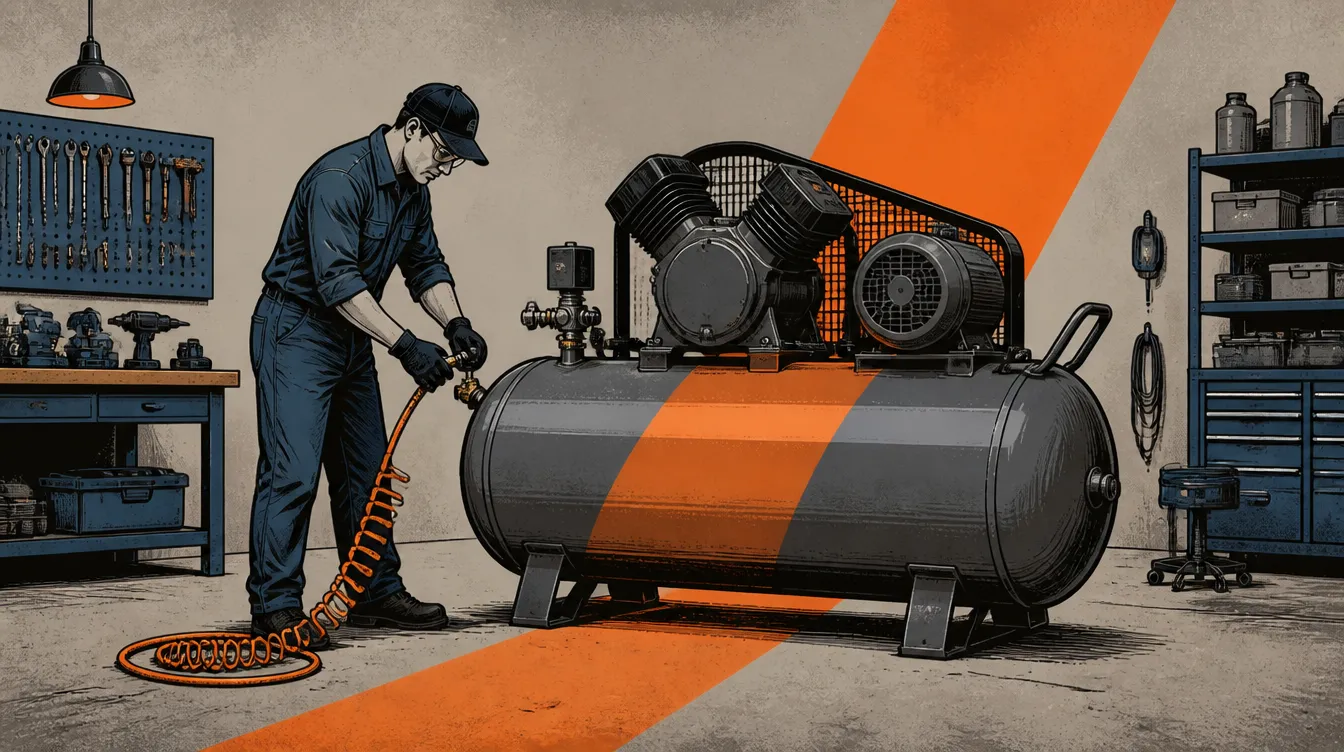
A 60-gallon air compressor is a garage-defining purchase, the kind of thing that runs an impact wrench, a framing nailer, and a sandblaster without ever running out of air. It is also expensive enough that most buyers make the decision almost entirely off a spec sheet, comparing CFM and PSI numbers that manufacturers write themselves.
No dedicated 60-gallon or industrial-scale shootout exists in the testing corpus behind this guide. What does exist is a real, hands-on comparison of 13 portable compressors, much smaller units in the 2 to 3 gallon range, but tested on the exact same specs that matter at any tank size: claimed versus real CFM, noise level, and weight. The gap between the box and reality on those smaller units is the clearest available warning for anyone about to spend real money on a 60-gallon unit based on a spec sheet alone.
What the testing showed
The numbers below come from Project Farm's air compressor comparison, which tested 13 units. This is not a 60-gallon or industrial compressor test, the units tested were compact 2 to 3 gallon portable compressors priced from 104 to 279 dollars, but the claimed-versus-measured performance gap it exposes applies to any compressor regardless of tank size.
DeWalt finished as the overall winner, with the test's own summary calling out its performance directly: "when it comes to raw performance, it ran circles around the competition. It is pretty expensive, but it would definitely be my choice if the budget allows." At 279 dollars, the DeWalt claimed 200 max PSI, far higher than the 100-135 PSI typical of the rest of the field, along with 3 CFM at 90 PSI and a 2.5 gallon tank, larger than most of its competitors.

Winner
DeWalt
Price shown in test: $279
Affiliate link. We may earn a commission at no extra cost to you.
Noise claims were frequently unrealistic
Several budget units in the test claimed "ultra quiet" ratings of 60 dB, a figure that is genuinely quiet for a compressor, and those claims did not always hold up under scrutiny. The Vevor, the least expensive unit tested at 104 dollars, claimed an "ultra quiet 81 dB" rating, itself a much louder figure than its competitors' 60 dB claims, an inconsistency worth noticing since 81 dB is not commonly described as ultra quiet by any real standard. Campbell Hausfeld's own packaging contained a direct internal contradiction the test called out by name: the marketing material claimed 2 HP while the box itself claimed 1 HP for the same unit.
CFM claims varied by unit, and matter more than PSI for actual tool use
CFM at 90 PSI, the figure that actually determines whether a compressor can keep up with a tool like an impact wrench or sander, ranged widely across the tested field: from 0.5 CFM on the Craftsman up to 3 CFM on the winning DeWalt. Husky, the runner-up, claimed 2.44 CFM at 90 PSI and "80 percent quieter" operation, with a metal silencer the test noted was unlike the plastic silencers used by most other brands in the lineup.

Runner-up
Husky
Price shown in test: $159
Affiliate link. We may earn a commission at no extra cost to you.
Fornax was named the budget pick at 135 dollars, claiming a 2.1 CFM oil-free "silent" design with a 65 dB maximum noise claim.

Budget pick
Fornax
Price shown in test: $135
Affiliate link. We may earn a commission at no extra cost to you.
How to read this for your own purchase
Since no 60-gallon or shop-scale unit was part of any cited test, use the lessons this portable compressor comparison surfaces about how compressor marketing works at any size, and apply extra scrutiny at the 60-gallon price point where the stakes are higher.
Verify CFM at your actual working pressure, not just the peak PSI number. The tested field showed CFM at 90 PSI varying by six times across similarly priced units, and CFM at your tool's actual operating pressure is what determines whether a compressor can keep up, not the maximum PSI printed in bold on the box.
Treat noise claims with real skepticism. The tested field showed both wildly optimistic and internally inconsistent noise claims on unit specs, including one brand's own packaging quoting different horsepower ratings on different parts of the box for the same product. Look for an independent decibel measurement or a specific test rather than trusting a single "ultra quiet" label.
Factor in the motor's actual rated duty cycle, not just its horsepower label. A 60-gallon compressor is typically expected to run longer cycles under heavier sustained load than the small portable units in this test, and a motor that is not rated for that duty cycle will overheat or wear out faster regardless of how strong its headline CFM and PSI numbers look on the box.
A few universal rules the smaller-unit data supports at any tank size:
- A recognizable, established brand tends to have claims that hold up better under scrutiny, as the DeWalt's performance in this test demonstrated relative to several unfamiliar import brands.
- Duty cycle and recovery time matter as much as tank size. A 60-gallon tank with a weak motor still runs out of air on a sustained job; check the CFM output relative to your tool's continuous air draw, not just the tank's capacity.
- Internally inconsistent specs on the packaging are a real warning sign. If a compressor's box and marketing materials disagree with each other, as happened in this test, that is a signal worth taking seriously before you buy.
Browse the rest of the power tools tests for more shop equipment measured against its own claims.