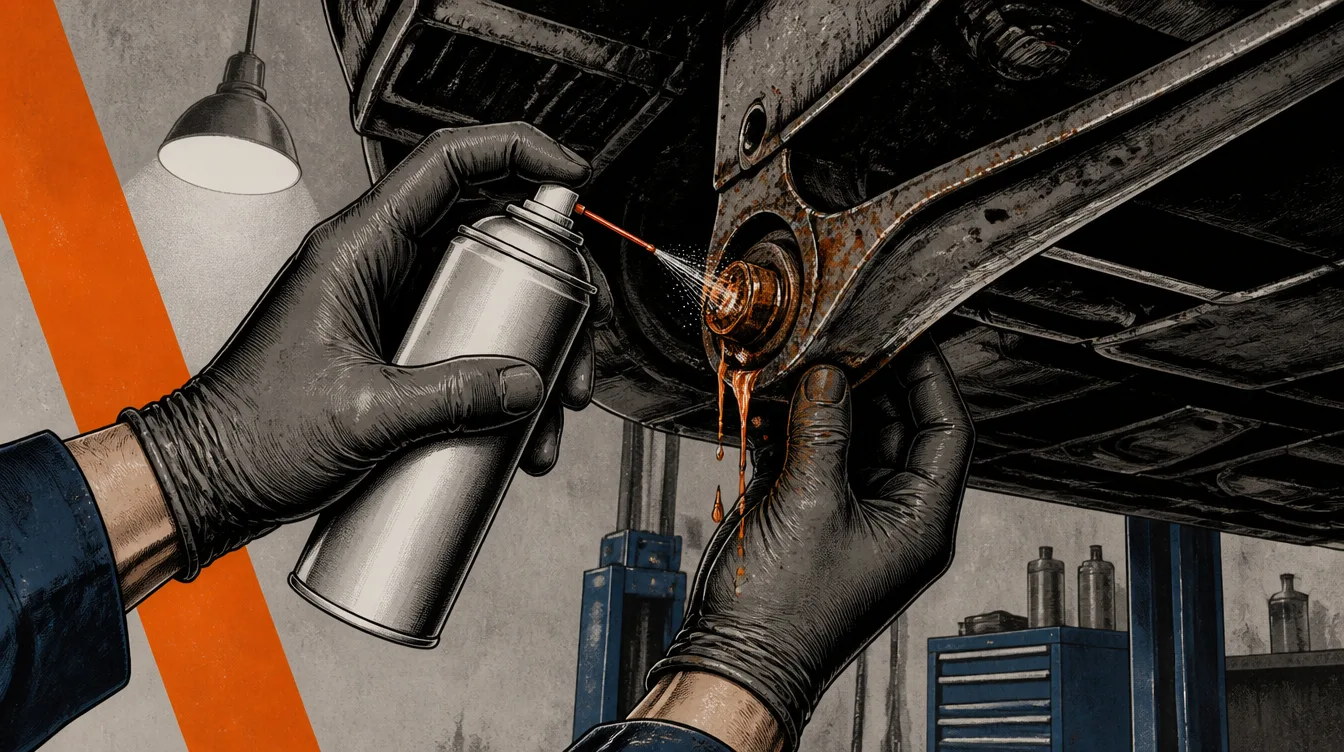
Every mechanic has a favorite penetrating oil, and every favorite comes with a strong opinion attached. Some swear by name-brand sprays, some swear by an old can of diesel fuel splashed on a seized bolt, and a persistent internet claim insists plain water works just as well as anything you can buy. That last claim is testable, and one hands-on comparison actually tested it directly, alongside five real penetrating oil products, on genuinely rusted bolts.
The test measured what actually matters when you are underneath a car with a stuck bolt: how fast a fluid climbs a vertical rusted surface, how far it actually penetrates into corroded threads, and, in a bonus test, real breakaway torque numbers on rusted lug nuts.
What the testing showed
The numbers below come from Project Farm, who tested Gibbs, FreeAll, Mouse Milk, and 3-in-One Oil as real penetrating oils, alongside diesel fuel and plain water as reference substances, on the exact same rusted bolts and nuts. You can watch the full breakdown on the penetrating oil test. Gibbs was named the outright winner, with FreeAll as runner-up and Mouse Milk in third.

Runner-up
FreeAll
Affiliate link. We may earn a commission at no extra cost to you.
Gibbs won by combining fast vertical climb with real thread penetration

Gibbs climbed all the way up to the top of a rusted steel pin within about 5 minutes, the fastest of any product tested, and after 24 hours had climbed about an inch and a half up the pin, the most of the four real penetrating oils. It also penetrated about a quarter inch into the rusted threads and did a slightly better job than FreeAll at penetrating both ends of a rusted nut. The video's verdict: "Gibbs did a terrific job winning this showdown, and of course FreeAll came in a second place, as well as Mouse Milk third."
Diesel fuel climbed the farthest, but that alone did not make it a winner
This is the test's most interesting finding for the DIY crowd who reach for diesel out of habit. Diesel actually climbed nearly 2 inches up the rusted pin after 24 hours, more distance than any product tested including the four real penetrating oils. But the test explicitly notes that climbing ability alone does not make a good penetrating oil: diesel left an oily film over the rusted nuts and bolts with no visible sign it actually penetrated the rust itself, and it was not ranked among the winning products.
Water performed worst overall, settling the internet debate
Water was tested specifically as the baseline to answer a viewer claim that it works as well as penetrating oil. It did not climb well in the 5-minute test, reached only about a quarter inch after 24 hours (never making it to the top of the test rig), and showed no evidence of any thread penetration. The video's explicit conclusion: it recommends a real penetrating oil over water.
3-in-One Oil produced real breakaway torque numbers
3-in-One Oil, the one product with numeric breakaway torque figures recorded in the video's chapter markers, measured 117.5 ft-lbs on one bolt and 148.2 ft-lbs on another during the loosening test, giving a concrete sense of the force still required to break a rusted fastener free even after treatment. It was not named among the top three finishers, finishing behind Gibbs, FreeAll, and Mouse Milk on the overall penetration and climb tests.
How to read this for your own purchase
The test's core lesson is that speed of vertical climb, thread penetration, and actual rust-loosening are three related but distinct properties, and the best product needs to be good at all three, not just the flashiest one.
If you are choosing a dedicated penetrating oil for a genuinely seized, rusted fastener, Gibbs is the test's clear top pick, backed by the fastest climb and the strongest combined result across every measured category.
If you are tempted to reach for diesel fuel out of habit or folklore, know that the test data does support diesel's climbing speed, but explicitly does not support the idea that climbing speed alone equals effective penetration; the test's own notes flag this as a myth worth retiring.
If you have heard that water works just as well as a real penetrating oil, this test directly refutes that claim: water was the worst performer of everything tested, on every measured property.
It is also worth understanding why creep speed and actual penetration are different physical processes, since that explains why diesel's fast climb did not translate into loosening power. A thin fluid climbs a vertical surface quickly through simple capillary action, following any tiny gap or scratch upward regardless of what it is actually made of. Breaking a rusted bond apart, however, requires the fluid to work its way between corroded metal surfaces and chemically or physically loosen the rust bridging them together, a slower process that depends on the specific additive package in a real penetrating oil, not just how thin and fast-spreading the base fluid is. That is the real distinction this test's diesel result exposes: fast climbing looks impressive in a demonstration, but it is not the same property as breaking a seized bolt free.
A few universal rules the data supports for any rusted fastener:
- Give penetrating oil time to work. The climb tests showed real, continued progress between the 5-minute and 24-hour checkpoints; do not judge a product by its first few minutes alone.
- Vertical climb speed is not the same as loosening power. Diesel's fast climb did not translate into visible thread penetration, a distinction worth remembering before assuming a fast-spreading product is automatically effective.
- Real breakaway torque still takes real force. Even a treated bolt in this test needed over 100 ft-lbs of torque to break free, so a penetrating oil is an aid, not a substitute for proper technique.
Looking for more shop chemicals tested the same hands-on way? Browse the rest of the shop chemicals and lubricants tests for degreasers, greases, and rust removers.