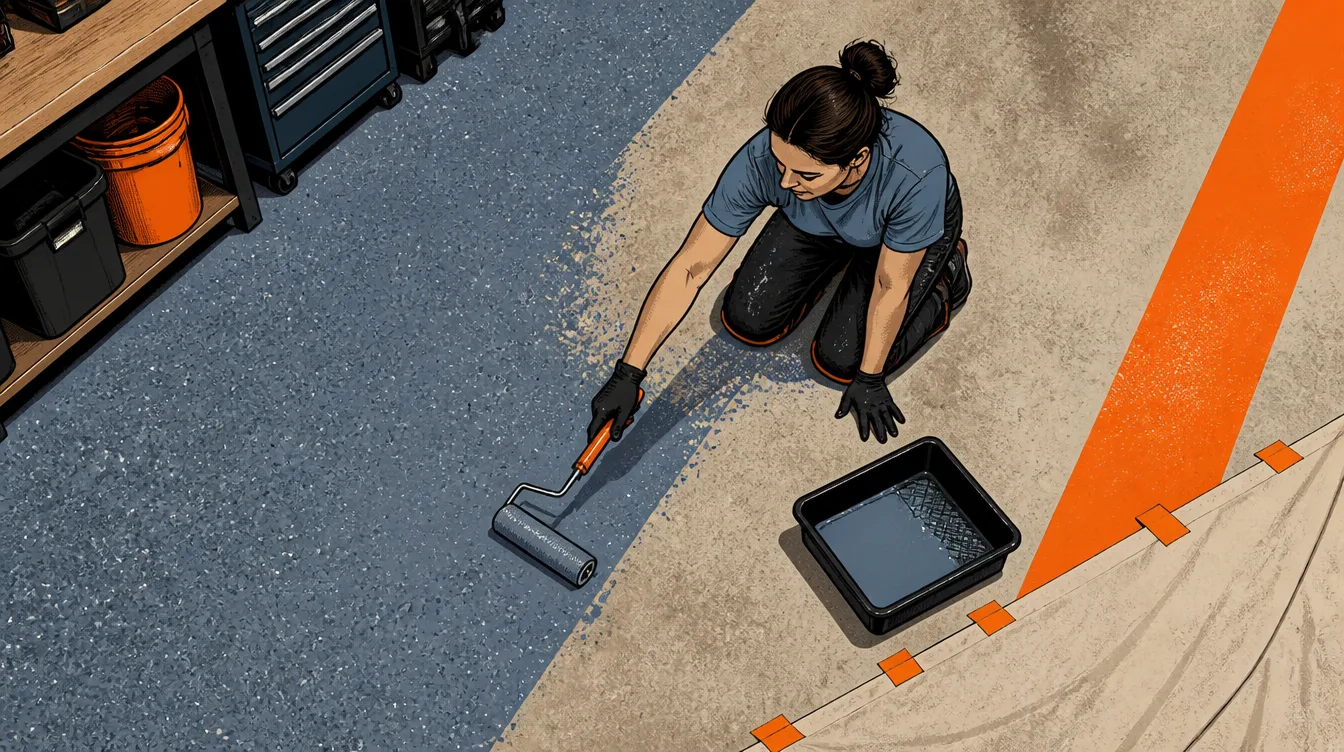
Garage floor epoxy is sold on the promise that it will outlast plain concrete paint by years, resist hot tire pickup, and shrug off oil drips and de-icing salt. Kits range from a basic single-part paint to full two-part epoxy systems costing several hundred dollars for a two-car garage, and it is genuinely hard to know from the marketing which chemistry is actually doing the work in a "professional grade" claim.
Here is the honest scope of this guide: there is no dedicated garage floor coating shootout in the testing data this site indexes. What does exist is a detailed, hands-on strength test of epoxy putty products, a different application (repair and bonding, not floor coating) but the same core two-part epoxy resin chemistry that underlies most premium floor coating systems. The numbers below are the closest real bonding-strength data available, and they are genuinely useful for understanding what "epoxy" as a material category can and cannot deliver, even though no product here was tested as a floor coating.
What the testing showed
The numbers below come from Project Farm, who tested twelve brands of epoxy putty for pull-out (tap) strength, compressive strength, and pipe repair burst pressure. This is not a garage floor coating test. You can watch the full breakdown on the epoxy putty test. JB Weld was named the overall winner.

Winner
JB Weld
Price shown in test: $4.98 for 2 oz, $2.49 per oz
Affiliate link. We may earn a commission at no extra cost to you.
The cheapest epoxy in the test won on overall value
JB Weld Steel Stick, at $4.98 for 2 oz ($2.49 per oz), the cheapest product tested, won the compressive strength test outright at 1,250 PSI (equivalent to 3,925 lb on a 1-inch cube) and finished a close second on pull-out strength (about 1,264 lb average) behind a specialty product. The narrator's own verdict: "really impressed with some of these brands including JB Weld, which definitely came out on top overall, especially when you consider the value price."
The strongest bonding product was not the cheapest or the most expensive
KBS NuMetal, at $1.43 per oz, posted the best pull-out (tap) strength of all twelve products at roughly 1,615 lb average, clearly ahead of JB Weld's 1,264 lb, though its compressive strength (850 PSI) trailed JB Weld's result. The narrator called it out separately: "KBS NuMetal is also a great product if you're looking to buy in bulk."
Price did not track cleanly with performance
Hercules, the most expensive product tested at $4.54 per oz, finished third on both pull-out and compressive strength, behind two considerably cheaper products. PC-7, priced at just $0.79 per oz, the cheapest product in the whole test, posted the best pipe repair burst result, beginning to leak only at 4,000 PSI and not catastrophically failing until just over 5,000 PSI, the strongest single result in that specific category.
How to read this for your own purchase
Since no floor coating product was tested here, use this data to understand epoxy resin performance broadly (bonding strength, compressive strength, pressure resistance) and pair it with floor-specific product reviews and manufacturer application specs before choosing a garage floor system.
If you are comparing epoxy floor kits and trying to judge marketing claims about strength, this test's core lesson applies directly: price and strength did not move together in a straight line. The cheapest product tested won the compressive strength category outright, while the most expensive product finished third in every category measured.
If your garage floor sees heavy point loads like jack stands or engine hoists, compressive strength is the more relevant property from this data, and the cheapest product tested here won that category outright.
If you are patching cracks or repairing concrete before coating, the pull-out (adhesion) strength results are the more directly relevant numbers, where a mid-priced product beat both the cheapest and most expensive options tested.
It also helps to understand why floor coatings and epoxy putty, despite sharing core resin chemistry, are formulated so differently in practice. A floor coating needs to flow out into a thin, even, self-leveling film across a large horizontal surface, resist UV yellowing if any daylight reaches the garage, and tolerate hot tires rolling across it without lifting. Epoxy putty is formulated to stay put in a thick, moldable mass exactly where you press it, with no flow requirement at all, since it is built for patching and bonding rather than coating. That is precisely why this test's strength numbers, real and useful as a baseline for judging epoxy resin in general, cannot be read as a direct prediction of how any specific floor coating product will perform once rolled out across a two-car garage.
A few universal rules the data supports for any epoxy product, floor coating or otherwise:
- A cheaper epoxy product is not automatically a weaker one. The cheapest product in this test won or placed near the top in multiple strength categories.
- Different epoxy formulations optimize for different properties. No single product won every category tested; pick based on which stress your project actually faces.
- Surface prep matters more than product choice for any epoxy application. None of the strength numbers here matter if the underlying concrete is not properly cleaned, etched, and dried before coating.
Looking for more adhesive and bonding products tested the same hands-on way? Browse the rest of the adhesives, glue and tape tests for construction adhesive, glue, and threadlocker comparisons.