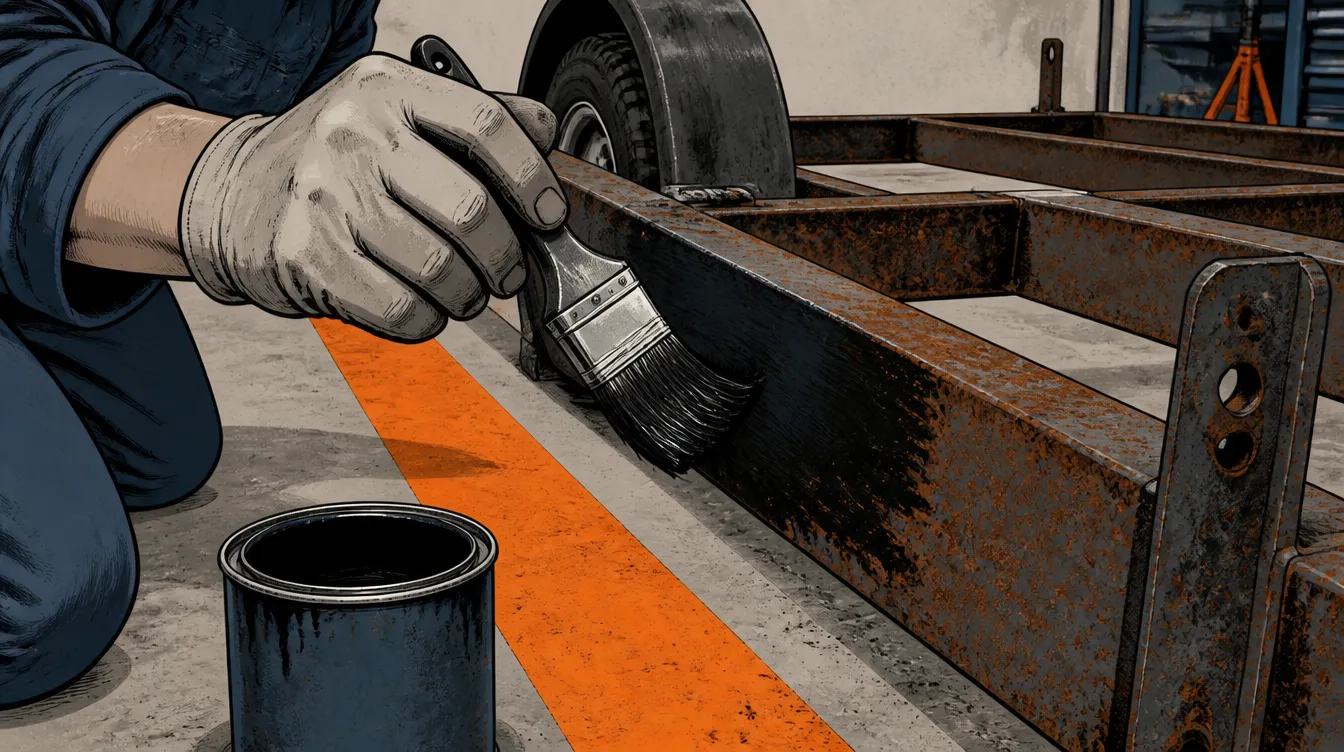
Rust converters make a bold promise: paint this liquid directly onto rusted metal, and it chemically transforms the rust into a stable, paintable surface instead of making you grind it back to bare steel first. The Rust-Oleum Rust Reformer is the version most people actually see on the shelf, cheap and familiar, sitting next to specialty brands that cost six times as much per ounce. The question is whether that price gap buys anything measurable.
A hands-on comparison tested exactly that, putting the Rust-Oleum Rust Reformer against eight rival rust converters through a genuinely brutal long-term test, and the results are a rare case of the budget option earning its reputation.
What the testing showed
The numbers below come from Project Farm's rust converter comparison, which tested 9 products head to head. The full lineup was POR-15, Eastwood Rust Encapsulator, Rust-Oleum Rust Reformer, Rust-Oleum 2X, Permatex Rust Treatment, VHT Rust Converter, Plastikote Rust Converter, Gempler's Aerosol Rust Converter, and Rust Kutter, priced from 33 cents to over 2 dollars per ounce.

Runner-up
Eastwood
Price shown in test: $30 for 15 oz, $2 per ounce
Affiliate link. We may earn a commission at no extra cost to you.
Every product went through two tests:
- 60-day rust resistance, with panels exposed to hydrogen peroxide, vinegar, and salt, plus outdoor weathering over the full two months.
- Rock chip resistance, firing a .177 caliber steel ball at roughly 200 mph into the coated panel and measuring the resulting damage.
POR-15 won overall, but the Rust-Oleum was named the budget pick

Winner
POR-15
Price shown in test: $33 for 16 oz, $2.06 per ounce, the most expensive product tested
Affiliate link. We may earn a commission at no extra cost to you.

Budget pick
Rust-Oleum Rust Reformer
Price shown in test: $5 for 10.25 oz, 49 cents per ounce
Affiliate link. We may earn a commission at no extra cost to you.
POR-15 finished first, and the test's verdict was unambiguous: "POR-15 definitely seems by far the best product." At 2.06 dollars per ounce, the most expensive product in the test, it took first place on both measurements, showing very little rust popping through after 60 days and being the only product to fully resist penetration on the rock chip test, with no chip and no exposed metal beneath the impact.
The Rust-Oleum Rust Reformer, at just 49 cents per ounce, was named the budget pick of the entire comparison. It finished third overall on the 60-day rust resistance test, "nearly tied with Rust-Oleum 2X but finished just ahead of it." Its weak point was rock chip resistance, where it posted 4.18 mm of chip damage, the largest damage area of any product tested, a real tradeoff buyers should know about before choosing it for a surface that will take physical impacts.
The runner-up and the surprise budget performance
Eastwood Rust Encapsulator finished as the runner-up at 2 dollars per ounce, taking second place on the 60-day test with only a very small amount of rust breaking through, though the coating peeled slightly at one panel edge, which the test attributes to a thin application there rather than a product flaw. On rock chip resistance it posted 3.17 mm of damage, a middling result compared to the field.
Rust-Oleum 2X, the least expensive product tested at just 33 cents per ounce, finished fourth on the 60-day test, with the tester noting genuine surprise that "the cheapest product beat five other brands." Its rock chip result was actually better than the Rust Reformer's, at 2.84 mm.
Where the rest of the field landed
Permatex, VHT, Plastikote, Gempler's, and Rust Kutter all finished behind the top four on the 60-day resistance test, with Rust Kutter finishing dead last, described as "the worst of all products, quite a bit of rust formed on all three panels including the one not exposed to corrosive agents." VHT posted the second-best rock chip result of the entire field at 2.2 mm, despite a mid-pack finish on rust resistance, showing that a single product does not necessarily excel at both jobs.
How to read this for your own purchase
The gap between POR-15 and the Rust-Oleum Rust Reformer on the 60-day test was real but not enormous, third versus first out of nine, while the price gap between them is roughly four times per ounce. That tradeoff is the crux of the buying decision.
If the coated surface will take physical impacts (a wheel well, a rocker panel, anything exposed to road debris), the Rust Reformer's weak rock chip result, the worst of all nine products, is a genuine reason to spend more on POR-15 or step down slightly to Eastwood instead.
If the job is a hidden or low-impact surface (frame rails, the inside of a panel, a tool that will not take direct hits), the Rust-Oleum Rust Reformer's strong 60-day corrosion result at a fraction of the price makes it the tested, sensible choice, exactly why it earned the budget pick designation.
A few universal rules the data supports for any rust treatment purchase:
- Rust resistance and impact resistance are separate properties. VHT scored well on chip resistance but only mid-pack on rust prevention; the Rust Reformer was the reverse. Buy based on which property your specific surface actually needs.
- The cheapest product is not always the weakest. Rust-Oleum 2X, the least expensive product in the test at 33 cents per ounce, beat five pricier rivals on the primary corrosion test.
- Application thickness matters. The one weak spot in the runner-up Eastwood's result was attributed to a thin application at a panel edge, not a formula problem, a reminder that even a top-tier product needs even coverage.
For more shop chemicals judged on measured results instead of label promises, browse the chemicals and lubricants hub.