Every dash cam box on the shelf claims "4K" or "ultra clear" footage, and it is genuinely hard to know from a spec sheet which camera will actually give you a readable license plate or road sign when it matters, at night, in the sunset glare, or from thirty feet away. Resolution numbers alone do not tell you how a camera's sensor and processing actually handle real driving conditions.
A hands-on test of eleven dash cams settled that question with real-world readability checks rather than lab charts, and the result was a genuine surprise: the camera that won outright was not even the highest-resolution one in the test.
What the testing showed
The numbers below come from Project Farm, who tested eleven dash cams for license plate readability, road sign clarity, night vision, and digital sign legibility, all under identical driving and lighting conditions. You can watch the full breakdown on the dash cams test. The host declared one clear overall winner in this video, an unusually decisive result for this kind of head-to-head.
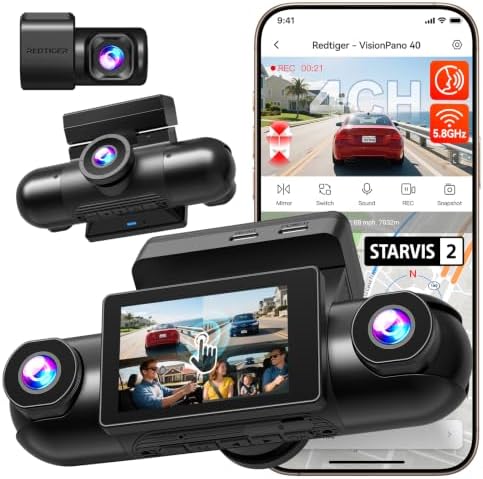
Runner-up
Red Tiger
Price shown in test: $100 with coupon
Affiliate link. We may earn a commission at no extra cost to you.
The overall winner was 1440p, not 4K
Viofo, priced at $114, was the outright winner with an average finish of 1.3 across all categories, described as "running circles around the competition." Its own spec sheet lists it as a 1440p camera, not 4K, despite several competing cameras in the same test marketing themselves as 4K. Viofo led license plate readability facing into a sunset (readable at 30 ft, the best exposure rating in the test), night vision readability (best possible rating), and digital sign readability (readable from a couple hundred feet away). The host stated he would buy this specific camera if choosing only one.

Winner
Viofo
Price shown in test: $114
Affiliate link. We may earn a commission at no extra cost to you.
Marketed 4K cameras did not automatically outperform lower-resolution ones
Red Tiger, which claims a full 4K front camera, finished 2nd overall with an average finish of 2.2, tied with Viofo on intersection readability but unable to match its license plate and digital sign results. Wolfbox, another camera marketed with a 4K front sensor, tied for second place on license plate readability at 20 feet but was not among the top overall finishers. Pruveo, at $120 with a coupon, one of the pricier cameras tested, was described as noticeably less sharp than Viofo on license plate readability and struggled badly with intersection sign legibility, illustrating that neither price nor a "4K" label reliably predicted real-world clarity in this test.
Budget cameras under $50 struggled across the board
Miden ($40) and E-Yegor ($45) both trailed the rest of the field significantly, with E-Yegor described as struggling the most of all dash cams in the review at that point, and Ovaman ($30) and its similarly priced competitors also underperformed on license plate readability past 20 feet.
How to read this for your own purchase
Resolution on the box is a starting point, not a guarantee, based on this test. A camera's sensor quality, exposure handling, and image processing determined real-world clarity far more than the megapixel number printed on the packaging.
If you want the single best result from this test, Viofo's win was decisive and across nearly every category, despite technically being the lowest-resolution camera among the top finishers.
If you need both front and rear coverage, note that Viofo in this specific test was front-only; Red Tiger and Wolfbox both include rear cameras and finished well, just not at Viofo's level on the readability tests.
If you are shopping under $50, be aware that this test's cheapest cameras consistently trailed the field on the tests that matter most in an actual incident: license plate and road sign readability at distance and in poor lighting.
It also helps to understand why resolution alone does not determine real-world clarity the way most shoppers assume. A camera's actual image quality depends on sensor size, lens quality, and how aggressively the camera compresses footage to fit a memory card, not just how many pixels the sensor captures. A 4K sensor crammed into a cheap camera body with a weak lens and heavy compression can produce a noticeably worse image than a well-engineered 1440p camera with a larger sensor and better glass, which is essentially what this test found when Viofo's 1440p camera beat multiple 4K-labeled competitors on every readability test that mattered. Treat "4K" as one input among several, not the deciding factor, when comparing dash cams.
A few universal rules the data supports:
- Do not buy on the "4K" label alone. The camera that won this test outright is marketed as 1440p, while several 4K-labeled competitors finished behind it.
- Check for front-and-rear coverage if you need it, since the single best performer here only covers the front.
- Night vision and sunset-facing readability are the tests that actually matter. Those are the conditions where a weak sensor gets exposed, and where this test showed the biggest spread between brands.
Curious how other car electronics and gadgets stack up under the same kind of testing? Browse the rest of the gadgets and tech tests for chargers, cameras, and tools compared spec for spec.