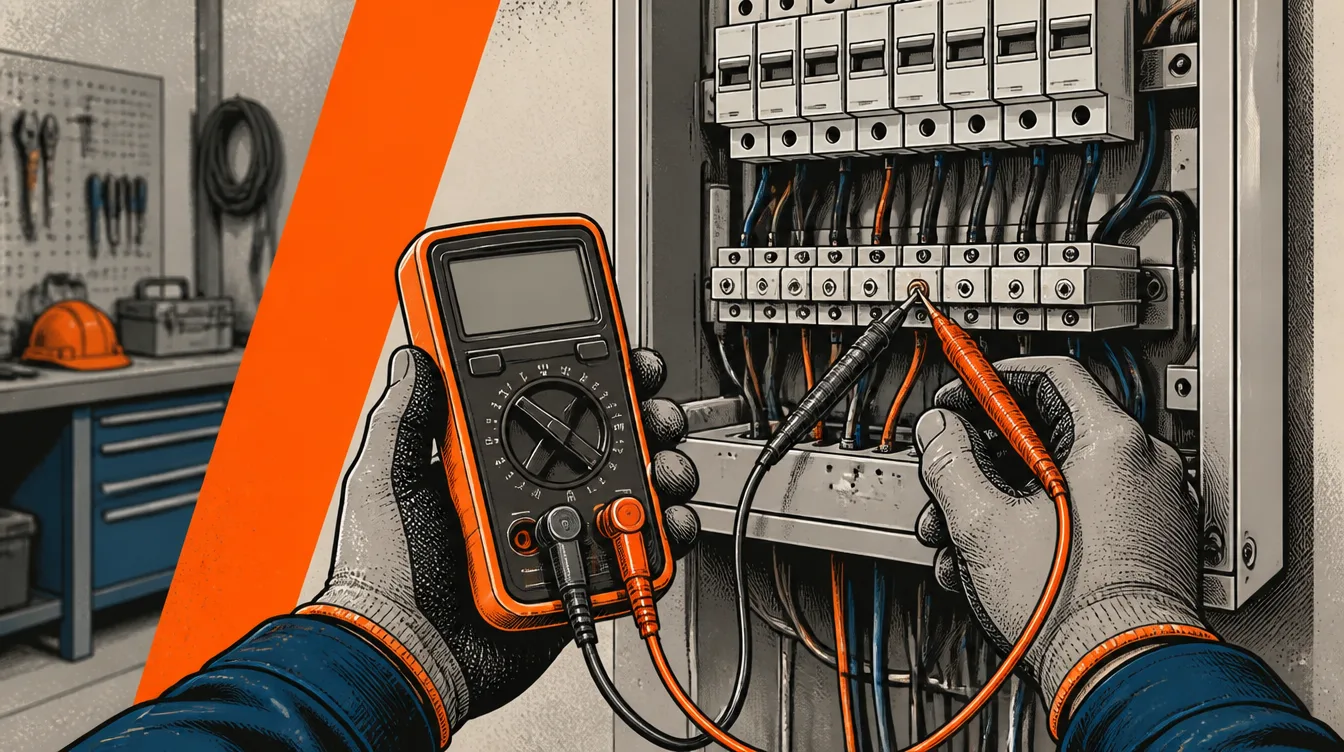
Fluke has a reputation among electricians and technicians that borders on unquestioned, the brand you buy when a reading actually has to be right. That reputation is real, but it deserves to be checked against actual measured data rather than accepted on brand name alone, especially given how much of a premium Fluke commands over nearly every competitor on the shelf.
Here is the honest situation: there is no dedicated hands-on test of Fluke multimeters specifically in this archive. What does exist is a Fluke unit tested in a different but closely related diagnostic-tool category, infrared thermometers, plus a separate battery diagnostic tool test that offers a useful contrast on how premium pricing does or does not translate to performance in this space.
What the testing showed
The figures below come from two of Project Farm's independent hands-on tests: a 15-unit infrared thermometer comparison that included a Fluke model, and a separate 14-unit car battery tester comparison that did not include Fluke but offers a relevant pattern on premium diagnostic tool pricing. The full breakdowns are on the 15-unit infrared thermometer test and the 14-unit car battery tester test. Neither test is a multimeter test; both are cited because they involve the same class of precision diagnostic instrument Fluke is best known for.
Fluke won the infrared thermometer test, at nearly triple the field's typical price

Winner
Fluke
Price shown in test: $245
Affiliate link. We may earn a commission at no extra cost to you.
Fluke, at 245 dollars, the most expensive unit in the 15-thermometer test by a wide margin, was named the declared overall and technical winner based on the scorecard. It measured just 0.7F off target at room temperature, among the most accurate results in the field. The test's own notes flagged a real limitation despite the win: a 12:1 distance-to-spot ratio, called "the biggest limitation" for the price, narrower than some competitors costing far less, including Klein Tools' IR10 at 104 dollars with a 20:1 ratio.
Klein Tools and Milwaukee stayed close behind at a fraction of the price
Klein Tools fielded two units in the same test. The IR10, at 104 dollars, offered a wider 20:1 distance-to-spot ratio, adjustable emissivity, and a rated drop survival from nearly 10 feet, features the Fluke lacked despite costing well over double the price. Milwaukee, at 86 dollars, posted 0.7F of error at room temperature, matching Fluke's own room-temperature accuracy almost exactly, and finished second in the cold-temperature test.
A separate battery tester test shows premium price does not guarantee better diagnostics
In the unrelated car battery tester test, Midtronics, the most expensive unit at 300 dollars, was criticized directly: it "lacks internal resistance and SOH measurement," features present on testers costing a fraction of the price, and does not remember settings between uses. Ancel, at just 32 dollars, was declared the overall winner and best value, described as the least expensive tester that "earned A's or passed each test in all graded categories." This is a different product category than Fluke, but it is directly relevant evidence that in diagnostic tools generally, premium pricing in this archive's testing has not automatically meant the best measured performance.

Winner
Ancel
Price shown in test: $32
Affiliate link. We may earn a commission at no extra cost to you.
Cheap diagnostic testers can also fail badly, in both directions
The battery tester test is a useful counterbalance to the "expensive is not always best" lesson above, because it also shows cheap is not automatically fine either. Vpeak, at 25 dollars, was the worst performer of all 14 testers in that comparison on an AGM-in-vehicle test, with repeated incorrect readings on both battery and cranking sub-tests, and it was grouped with two other budget units, OBD Resource and Kingbolen, as continuing to "struggle with state of charge" readings. Konnwei, at 30 dollars, had its claimed 99.99 percent accuracy specifically called out for scrutiny and performed well overall apart from a charging-system overvoltage error on the same AGM test. The honest takeaway across both the infrared thermometer and battery tester data is that price sits somewhere on a spectrum with real failures at both ends, not a clean line where more money guarantees more accuracy.
How to read this for your own purchase
Since no multimeter-specific test exists yet, the honest translation is this: Fluke's reputation for accuracy held up in the one adjacent diagnostic tool category where it was actually tested, but it did not sweep every measured category even in that win, and a completely separate diagnostic tool test shows the highest price in a lineup is not a reliable predictor of the best result.
If you need Fluke specifically for professional liability or workplace standards, its tested accuracy in the infrared thermometer comparison supports that reputation, even though it did not win on every measured spec.
If you are comparing purely on measured performance per dollar, the infrared thermometer test's Klein Tools and Milwaukee entries came within a hair of Fluke's accuracy at less than half the price, a pattern worth remembering when a Fluke multimeter costs several times what a comparably accurate competitor does.
Do not assume the most expensive diagnostic tool automatically performs best. The battery tester test's Midtronics result, the priciest unit lacking basic features cheaper competitors included, is a clear, tested counterexample in an adjacent tool category.
A rule that applies to any diagnostic tool purchase: check what the price is actually buying, whether that is a wider ratio, adjustable settings, drop rating, or brand-name accuracy, rather than assuming cost alone correlates with capability.
Browse the rest of the gadgets and tech tested this same hands-on way for chargers, cameras, and measuring tools put through comparable head-to-head testing.