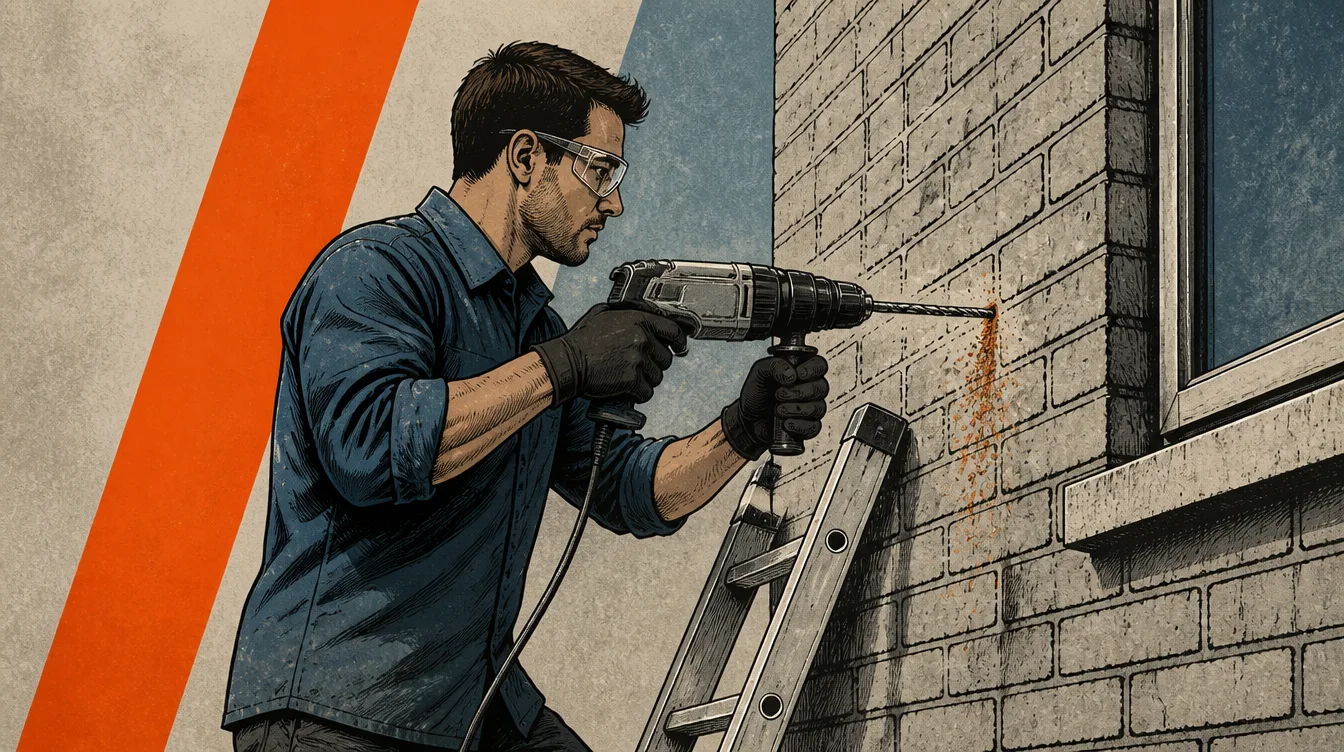
Masonry drill bits look interchangeable in the rack, all carbide-tipped, all promising fast holes in concrete, brick, or tile. What actually separates them shows up only once the material gets harder than fresh concrete, in a porcelain tile that will chip or a decades-old slab that has cured into something closer to stone. A hands-on test drilled 10 masonry bit brands through exactly that range of difficulty, and the results split the field in ways price alone did not predict.
What the testing showed
The figures below come from Project Farm, who bought 10 masonry drill bit brands and ran each through the same drilling gauntlet using a single Makita XPH07Z drill to power every brand's bits, removing drill variability from the results. The full 10-brand breakdown is on the masonry drill bit comparison, and every figure here traces to that video.
The lineup covered Irwin, Milwaukee Shockwave, Diablo, Bosch, Ryobi, Makita, DeWalt Rock Carbide, Hercules, EZARC, and Werktough, priced from 36 cents per bit up to 4.66 dollars per bit. Each bit was tested on:
- High strength concrete, fresh and consistent material.
- Hardened vintage concrete, decades-old material that proved to be the toughest test in the lineup.
- Pavers, plus a separate holding-strength check using a Tapcon pull-force test.
- Porcelain tile, a brittle material where several bits failed to finish.
Milwaukee was fastest on fresh concrete, but the field split hard on the vintage test
Milwaukee's Shockwave Impact Duty, the most expensive bit in the test at 4.66 dollars per bit, was the fastest of all 10 brands on high strength concrete at 7.3 seconds, and it was also the fastest of all brands that finished the hardened vintage concrete test, at 24.7 seconds. That vintage concrete stage was where the field separated most sharply: DeWalt, Hercules, Makita, and Werktough all failed to finish it, their tips worn down to nothing after 30 seconds to several minutes of drilling with minimal progress.
Diablo held up best against wear across multiple tests
Diablo, at 3.71 dollars per bit, finished the hardened vintage concrete test in 28.7 seconds with what the test calls "very minor wear," the best wear result of any brand in that stage. It was also the fastest of all 10 brands on porcelain tile, at 20.7 seconds, a material where several competitors either struggled badly or did not finish at all.
Irwin was named the best value

Budget pick
Irwin
Price shown in test: $11.99 for five bits, about $2.40 per bit
Affiliate link. We may earn a commission at no extra cost to you.
Irwin, the second least expensive bit set in the test at 2.40 dollars per bit, was named by the test's own host as "arguably the best value considering price and performance." It took the early lead on the high strength concrete test at 8.8 seconds, finished the hardened vintage concrete test in 29.3 seconds with only minor wear, and posted a notably fast porcelain tile time of 23 seconds for its price point.
Cheap did not mean durable, and pricey did not mean tough either
Werktough, the least expensive bit set in the entire test at just 36 cents per bit, was also the slowest on fresh concrete and did not finish either the hardened vintage concrete or the porcelain tile tests. DeWalt's Rock Carbide, mid-priced at 2.67 dollars per bit, started fast on fresh concrete but wore out quickly on the harder tests, failing to finish both the vintage concrete and tile stages despite the test noting it had the best holding strength result overall.
How to read this for your own purchase
No single bit won across every test in this lineup, and the pattern that emerged was that fresh concrete speed and long-term wear resistance are not the same measurement; a bit can be fast on soft material and still wear out fast on something tougher.
For general home and garage drilling in typical concrete or brick, Irwin's combination of strong early performance and low per-bit price makes it the tested value pick.
For harder, older, or unpredictable material, such as an aging foundation or a mixed-age slab, Diablo's wear resistance on the hardened vintage concrete test and its lead on porcelain tile make it the stronger tested choice when durability matters more than upfront cost.
For the fastest raw drilling on fresh concrete specifically, Milwaukee's Shockwave led that individual test, though at the highest per-bit price in the lineup.
A few rules the data backs up regardless of brand:
- Match the bit set size to the job. Sets ranged from 3 to 11 bits at wildly different per-bit prices; buying a large set of bit sizes you rarely use inflates cost without adding value.
- Age and hardness of the material change the outcome. Several bits that looked competitive on fresh concrete failed entirely on the vintage concrete stage; do not assume a bit rated for "concrete" performs the same on all concrete.
- Porcelain tile is a genuinely different challenge. Multiple otherwise-solid bits either struggled badly or did not finish this stage; if tile is part of the job, weight that result heavily.
Browse the rest of the blades, bits, and abrasives tested this same hands-on way for saw blades, sanding discs, and cutting wheels put through comparable head-to-head testing.