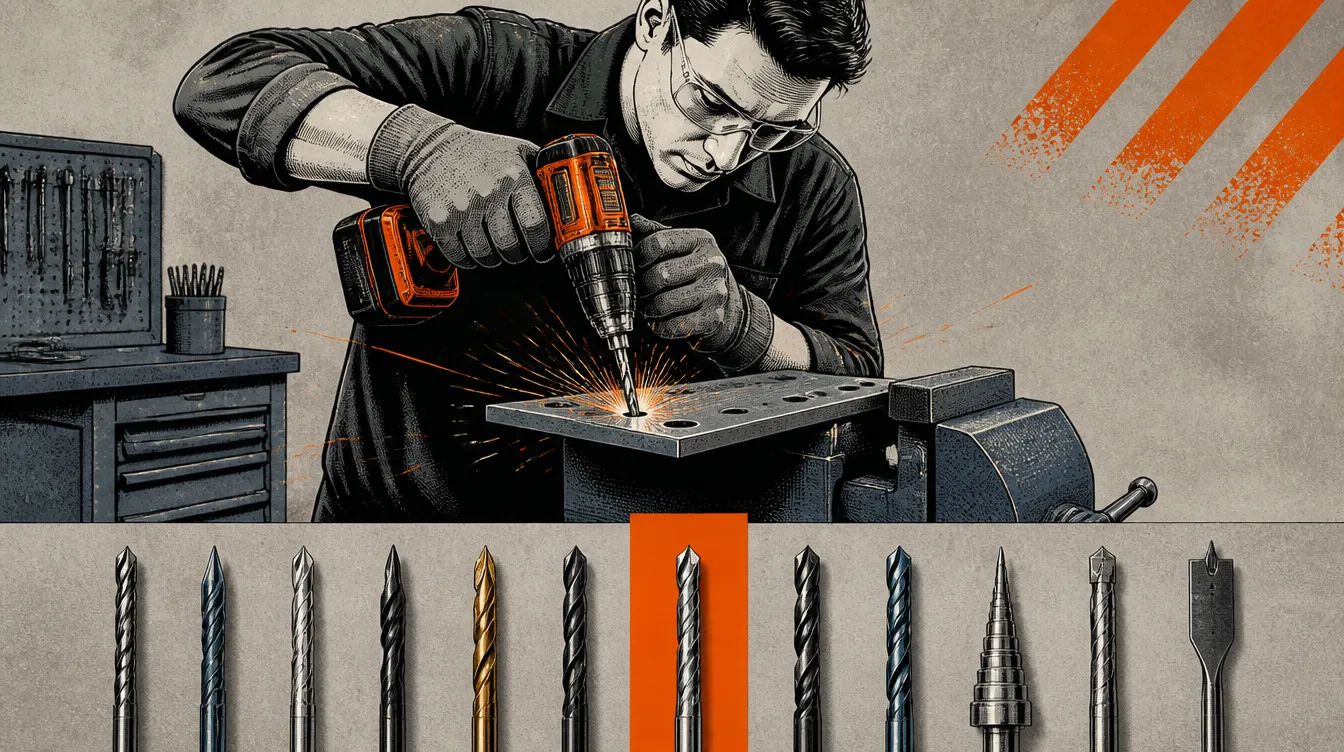
Drill bits look interchangeable on a shelf, black or gold or titanium-coated, all promising to cut faster and last longer than the last set you burned through. The price gap is enormous too, from an 11 dollar set at the bottom to 200 dollars at the top, and almost nothing about the packaging tells you whether that premium buys real cutting performance or just a nicer case.
So a hands-on tester bought 14 drill bit brands and ran them through mild steel, spring steel, and a bit-breaking torque test, then repeated key cuts to measure how much each bit dulled with use. The winner cost the most, but two much cheaper sets were called out as the smarter buy for most people.
Here is what actually happened when steel met bit.
What the testing showed
Every result below comes from Project Farm's independent bench testing. You can watch the full breakdown on the complete drill bit showdown, which tests 14 brands from 11 to 200 dollars, and the companion twist drill bit comparison for additional brand data.
The main test drilled a half-inch hole in mild steel at 600 RPM with about 175 pounds of downward force, cut into hardened spring steel at 340 RPM with about 220 pounds of force, repeated both cuts on fresh material to measure durability loss, and finished with a failure-torque test using quarter-inch bits to find the load at which each bit actually breaks.
Viking Drill and Tool won, but at the top of the price range

Winner
Viking Drill and Tool
Price shown in test: $200 (most expensive brand tested)
Affiliate link. We may earn a commission at no extra cost to you.
Viking, at 200 dollars, the most expensive brand tested, finished with the best average result. The tester's summary: "the Viking Drill and Tool came out on top with an average finish at 3.4," explicitly framed as the best overall performer, with the honest caveat that it is genuinely expensive.
Bosch was the tester's own pick for value and performance

Budget pick
Bosch
Price shown in test: $34 for 14 bits
Affiliate link. We may earn a commission at no extra cost to you.
Bosch, at just 34 dollars for 14 bits, a fraction of Viking's price, earned a direct personal recommendation: "for that reason the Bosch at $34 is a fantastic value and that's what I'd buy." That is not a budget-tier consolation prize, it is the tester's stated actual choice for most buyers.
The cheapest bit in the test had a real, honest use case
DeWalt's high-speed steel set, at 11 dollars for 14 bits, the least expensive brand tested, was recommended specifically for occasional use on softer metals: "for the person who needs occasional use on softer metals I'd definitely go with the DeWalt's high-speed steel, a great value for around $11." That is a narrower recommendation than Bosch's, tied specifically to lighter-duty use.

Winner
DeWalt
Price shown in test: $14.97
Affiliate link. We may earn a commission at no extra cost to you.
Two mid-priced sets kept pace with the winner
Drill Hog (140 dollars for 29 bits) and Comoware (80 dollars for 29 bits) were both called out as "not too far behind" the winning Viking across the tests, making either a reasonable step-down choice if the full 200 dollar Viking price feels like too much for your needs.
A companion test crowned a different winner using a different lineup
A separate, earlier Project Farm comparison, the twist drill bit test, used a distinct set of 11 brands and found DeWalt's black oxide 14-piece set, at just 14 dollars and 97 cents, the overall winner: "the dewalt did just that, it cut faster than the competition, and it also did a fine job as far as the quality of cut." That same test named Bosch's M42 cobalt set, at 39 dollars and 99 cents (the most expensive brand in that particular lineup), as the pick specifically for cutting hard steel like 304 stainless, "despite being the priciest brand." Two different tests, two different top price points, but Bosch and DeWalt show up as strong, repeatedly-praised names across both.
How to read this for your own purchase
Across both tests, a consistent pattern holds: the single top-ranked bit set tends to be the most expensive one, but a meaningfully cheaper set from a known name (Bosch or DeWalt, depending on which test and lineup) is repeatedly singled out as the smarter real-world buy for most people.
If you drill hard steel or hardened material regularly and budget allows, the tested data supports Viking (200 dollars) or, in the separate twist drill bit test, Bosch's cobalt M42 set (40 dollars) for that specific hard-material use case.
If you want the best balance of price and performance for general use, Bosch's 34 dollar 14-piece set was the tester's own direct pick in the main comparison, and DeWalt's black oxide set won outright in the separate twist drill bit test at under 15 dollars.
If your drilling is occasional and mostly on softer metals, the 11 dollar DeWalt high-speed steel set was specifically recommended for that lighter use case rather than as a universal budget pick.
A few universal rules the results support:
- Cobalt and M42 bits are worth the premium for hard steel, but represent real overkill (and wasted money) for occasional soft-metal drilling.
- Bit count and price per bit matter as much as the brand. A 200 dollar set with 25 bits and a 34 dollar set with 14 bits are not directly comparable on sticker price alone.
- Retest durability, not just the first cut, before trusting a bit set. Both tests specifically measured performance loss after repeat cuts, since a bit that cuts fast once and then dulls quickly is a worse buy than a slightly slower bit that holds its edge.
Want to compare more of the cutting tools and abrasives that live in a shop? Browse the blades, bits, and abrasives tests for masonry bits, step bits, and sharpeners tested the same way.