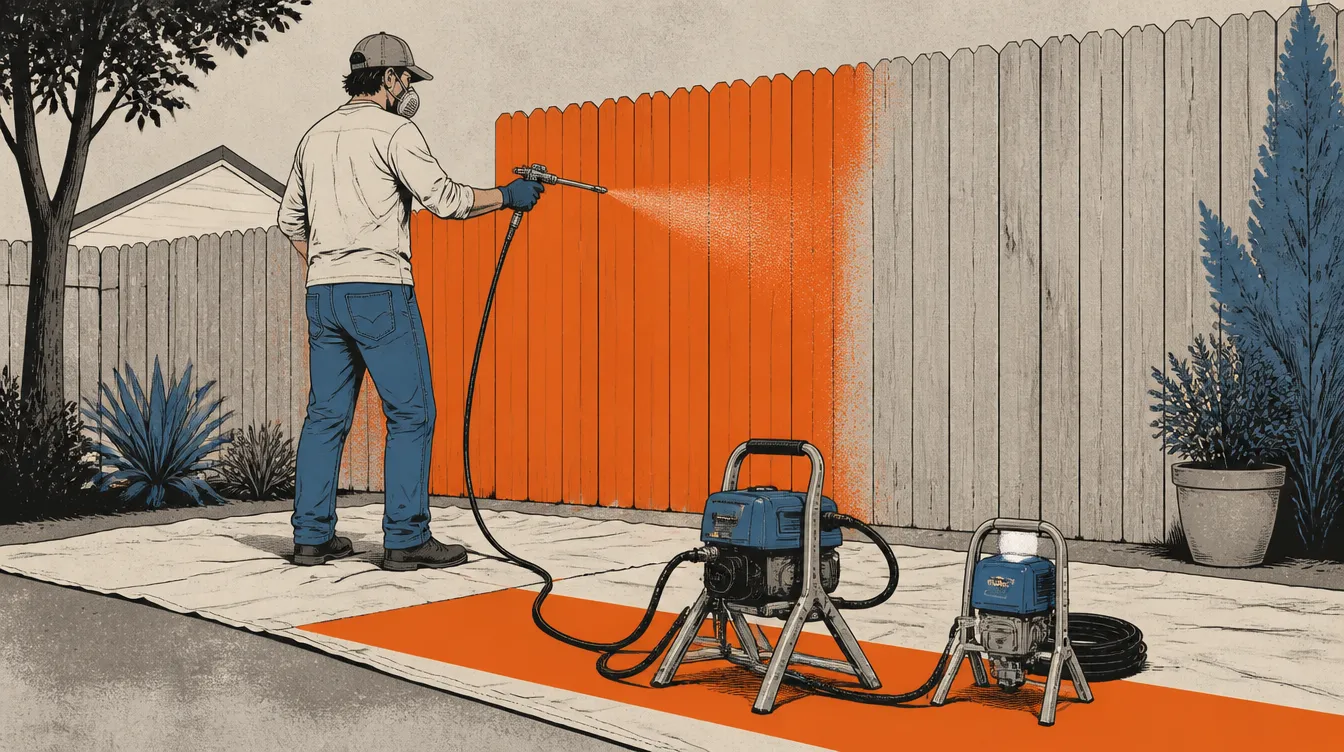
Searching "Graco Magnum X5" mostly turns up the same handful of product photos and the same handful of five-star reviews, which tells you nothing about how the finish actually holds up once the paint dries and something bumps into it. An airless sprayer like the X5 is a bigger purchase than a can of spray paint, but the underlying question shoppers actually have is the same one: does this brand's paint go on smooth, and does it survive contact once it's cured?
We could not find an airless sprayer shootout in the testing data behind this site, so this is a straightforward admission up front: nobody has put the Graco Magnum X5 through a hands-on head-to-head against its rivals in the corpus this guide is built from. What we can point to is a real, measured comparison of spray paint finishes, which speaks directly to half of what a sprayer buyer actually cares about, the quality and durability of the coat once it's down, even though the delivery method (aerosol can versus airless pump) is different.
What the testing showed
The numbers below come from Project Farm's spray paint brand comparison, which tested 8 spray paint brands for gloss and chip resistance. This is not an airless sprayer test, and the Graco Magnum X5 was not part of it, but the finish-quality lessons apply regardless of what device puts the paint on your project.
The 8 brands tested were Rust-Oleum Professional, Seymour, Valspar, Rust-Oleum 2X, Krylon, Majic Paints, Sherwin-Williams, and Color Place, priced from 96 cents to 15 dollars per can.

Winner
Rust-Oleum Professional
Price shown in test: $5.98 for 15 oz
Affiliate link. We may earn a commission at no extra cost to you.

Runner-up
Valspar
Price shown in test: $9.77 for 12 oz
Affiliate link. We may earn a commission at no extra cost to you.
Two measurements mattered most:
- Initial gloss, judged by how clean and reflective the cured finish looked.
- Initial chip resistance, measured in millimeters of paint loss after an impact test.
The winner and what separated it
Rust-Oleum Professional came out on top. The video's own conclusion was direct: "Regarding this showdown, rustoleum pro definitely seems like the best all-around paint." At 5.98 dollars for 15 ounces, it posted the best initial gloss of all 8 brands and held up well on chip resistance at 4.44 mm of paint loss, a middle-of-the-pack figure that still beat several pricier rivals.
Valspar, the runner-up, cost more per can (9.77 dollars for 12 ounces) and turned in a very small amount of loose paint on the chip test at 4.85 mm, but its gloss finished behind Rust-Oleum's.
Price did not track performance
The most expensive can in the test, Sherwin-Williams Work Day at 15.02 dollars for just 10 ounces, finished next to last on gloss, "just ahead of Color Place." Color Place, at 96 cents for 10 ounces and the cheapest can tested, had the worst gloss of all 8 brands but was not the worst on chip resistance.
Krylon, at a mid-range 4.29 dollars, actually posted the best chip resistance of the entire field at 3.45 mm of paint loss, beating every other brand including Rust-Oleum Professional. Rust-Oleum 2X, meanwhile, had the worst initial chip resistance of all 8 brands at 4.92 mm, despite being from the same overall brand family as the test's winner.
How to read this for your own purchase
Since no direct sprayer test exists in the corpus behind this guide, use the paint-quality lessons from the spray can comparison as one input into a sprayer purchase, alongside the practical, mechanical questions that only apply to a pump-driven sprayer like the Graco Magnum X5.
On the paint itself, the tested data supports buying Rust-Oleum for a genuinely strong, tested combination of gloss and durability, or Krylon specifically if impact resistance on a high-touch surface (railings, furniture, tool handles) is your top priority. Do not assume a higher price buys a better finish. The most expensive can in this test finished near the bottom on gloss.
On the sprayer itself, since that half of the question was not covered by any test in this dataset, rely on the practical basics that hold for any airless sprayer purchase: match the tip size to the material you are spraying (a fine finish tip clogs on thick latex, a wide tip wastes fine stains), buy a unit rated for the volume of your typical job so the motor is not straining constantly, and budget for tip replacement, since a worn tip ruins a finish no matter how good the paint is.
A few rules the spray paint data does back up for any coating purchase:
- Do multiple thin coats rather than one heavy one. Nearly every strong performer in the test benefited from an even, controlled application, which a sprayer (can or airless) is specifically good at compared to a brush.
- Let each coat cure fully before handling. Chip resistance in the test was measured after the paint had time to harden, and rushing that step undercuts even a top-tier product.
- Buy based on the finish you actually need. A brand that wins on gloss is not automatically the one that wins on durability, as Rust-Oleum 2X's poor chip score under the Rust-Oleum name shows.
Browse more real numbers on paint, adhesives, and shop supplies on the home and cleaning hub, where products are judged on what they actually do, not what the label promises.