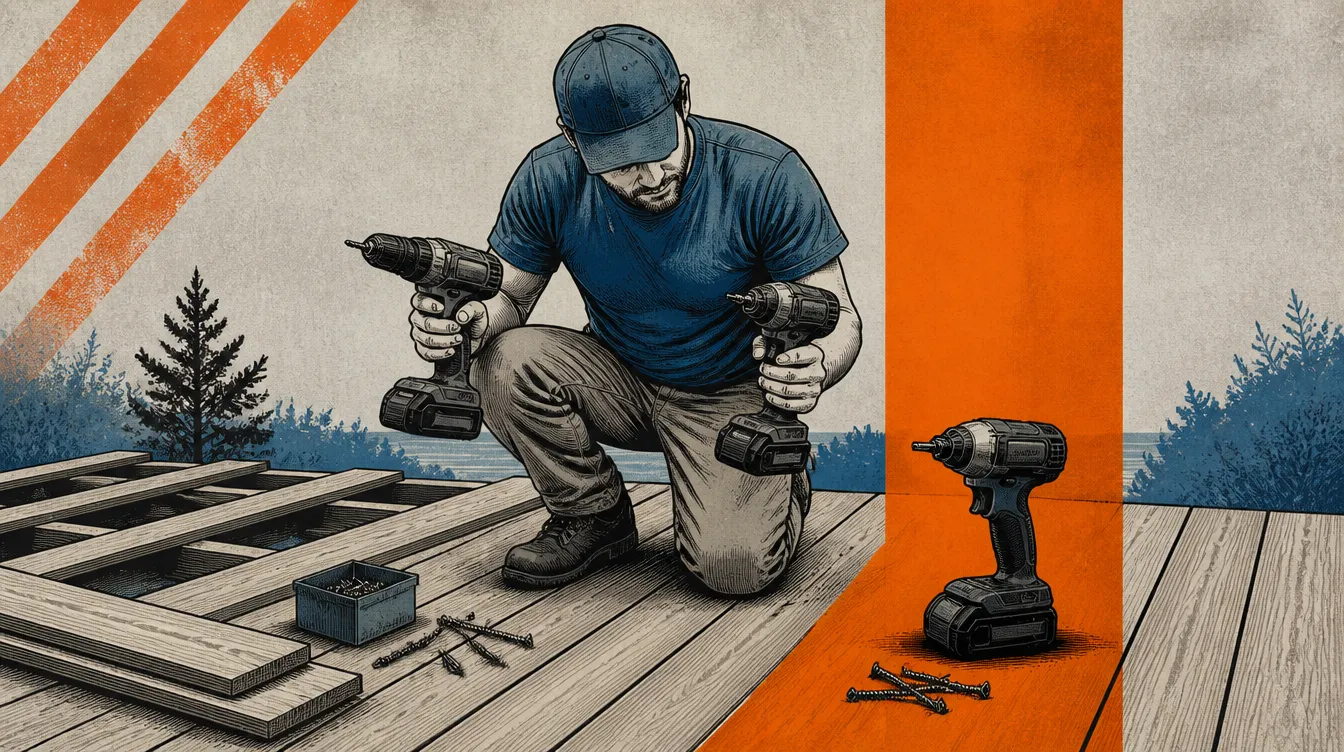
Walk into the tool aisle looking for a "drill and impact" and you will find a wall of combo kits bundling two tools that look nearly identical, same battery platform, same brand colors, same shape, and no obvious explanation of why you need both. The honest answer is that a drill and an impact driver do different jobs, and the marketing rarely spells out which.
There is no single hands-on test in this archive that bench-tested a combo kit as a package. What does exist is separate, detailed testing of cordless drills and cordless impact drivers on their own, and reading those two tests side by side answers the real question better than a combo kit review would anyway: which tool wins which task.
What the testing showed
The figures below come from two separate Project Farm tests, one covering 8 cordless drills and one covering 12 cordless impact drivers, each run through its own set of driving and drilling tasks. The full breakdowns are on the 8-drill cordless drill comparison and the 12-driver impact driver comparison. No combo kit was tested as a bundled unit; every number here traces to one of those two individual tool tests.
The drill test measured control, not just power
The cordless drill test covered Milwaukee, DeWalt, Makita, Bauer, Ryobi, Ridgid, Bosch, and Festool, with prices from 45 dollars for the Bauer up to 544 dollars for the Festool kit. The test graded low RPM control, clutch torque range, maximum torque, and endurance under sustained use, in addition to raw speed. No single drill was declared the winner, but Bauer, the least expensive drill in the test at 45 dollars, was named the budget pick, meaning it delivered competitive results at a fraction of the field's average price.

Budget pick
Bauer
Price shown in test: $45 for just the drill, not battery and charger; least expensive brand tested
Affiliate link. We may earn a commission at no extra cost to you.

Runner-up
Milwaukee M18 Fuel
Price shown in test: 100
Affiliate link. We may earn a commission at no extra cost to you.
The impact driver test measured speed under load, and DeWalt 860 won it

Winner
DeWalt 860
Price shown in test: 140
Affiliate link. We may earn a commission at no extra cost to you.
The impact driver test covered 12 brands including DeWalt 860, Milwaukee M18 Fuel, Hercules, Makita, Kobalt, Ryobi One+ HP, and Craftsman. DeWalt's 860, at 140 dollars, took the outright win with the best average finish across three graded events. It was the fastest driver in the test on the number 10 by 5 inch screw driving task, finishing in 1.41 seconds average and taking the lead from Milwaukee, which had led on earlier tasks.
Milwaukee's M18 Fuel, at 100 dollars, finished as runner-up. It measured the highest no-load RPM of any driver tested at 3,889 RPM and had the best low RPM control in the field at around 77 RPM, useful for delicate driving where a drill's clutch would otherwise strip a screw head.
The two tool categories reward different things
Put side by side, the pattern is clear: the drill test rewarded control across a wide torque range and endurance under sustained drilling, while the impact driver test rewarded raw speed and holding power on fasteners under load. Neither test suggests one tool can substitute for the other; they measured different jobs because the tools do different jobs.
The drill test also shows price does not guarantee the best control
Bosch, at 154 dollars for the drill alone, posted the best low RPM control of all 8 drills tested at 7.3 RPM and the quietest baseline noise at 77 decibels, useful for precise starts in tight spots. But it also tied for the slowest first-gear driving time and had the lowest maximum clutch torque output in the lineup, showing that a drill can win on control and still lag on raw power. Festool, at 544 dollars including battery and charger, the most expensive drill tested by a wide margin, over three and a half times the next most expensive tool-only price, passed an endurance test in second gear where most other brands in the lineup failed, a genuine durability advantage for anyone drilling all day, every day. Bauer, the 45 dollar budget pick, was the only brushed-motor drill in the test and had the shortest work light duration, trade-offs the reviewer called reasonable specifically "for light duty or occasional use."
How to read this for your own purchase
Since no combo kit was tested as a package, the honest way to shop a "drill and impact" bundle is to check whether each half of the kit performs well on its own, using the individual test data above, rather than trusting bundle marketing.
Buy the drill for anything that needs a bit spinning at a controlled speed: drilling holes, driving screws where stripping matters, mixing paint, or any task with a clutch setting. The cordless drill test's own budget pick, Bauer, shows you do not need to spend Festool money to get usable results here.
Buy the impact driver for anything that needs sudden, repeated torque: driving long deck screws, lag bolts, or lug nuts on wheels. DeWalt's 860 won the impact driver test specifically on speed under load, the exact scenario where a plain drill stalls or strips.
If you are buying a combo kit anyway, match the brand to which individual tool matters more for your work. If fastening speed is the priority, DeWalt's individual impact driver result is the stronger data point. If drilling control matters more, none of the individually tested drills separated clearly from the pack, so price and battery ecosystem are reasonable tiebreakers.
A rule that applies regardless of brand: check what is actually in the box. Combo kit contents (batteries, charger, case) vary by retailer even under the same model number, and neither tool tested here was evaluated as part of a bundle.
Browse the rest of the power tools tested the same hands-on way for drills, drivers, saws, and grinders put through comparable head-to-head testing.