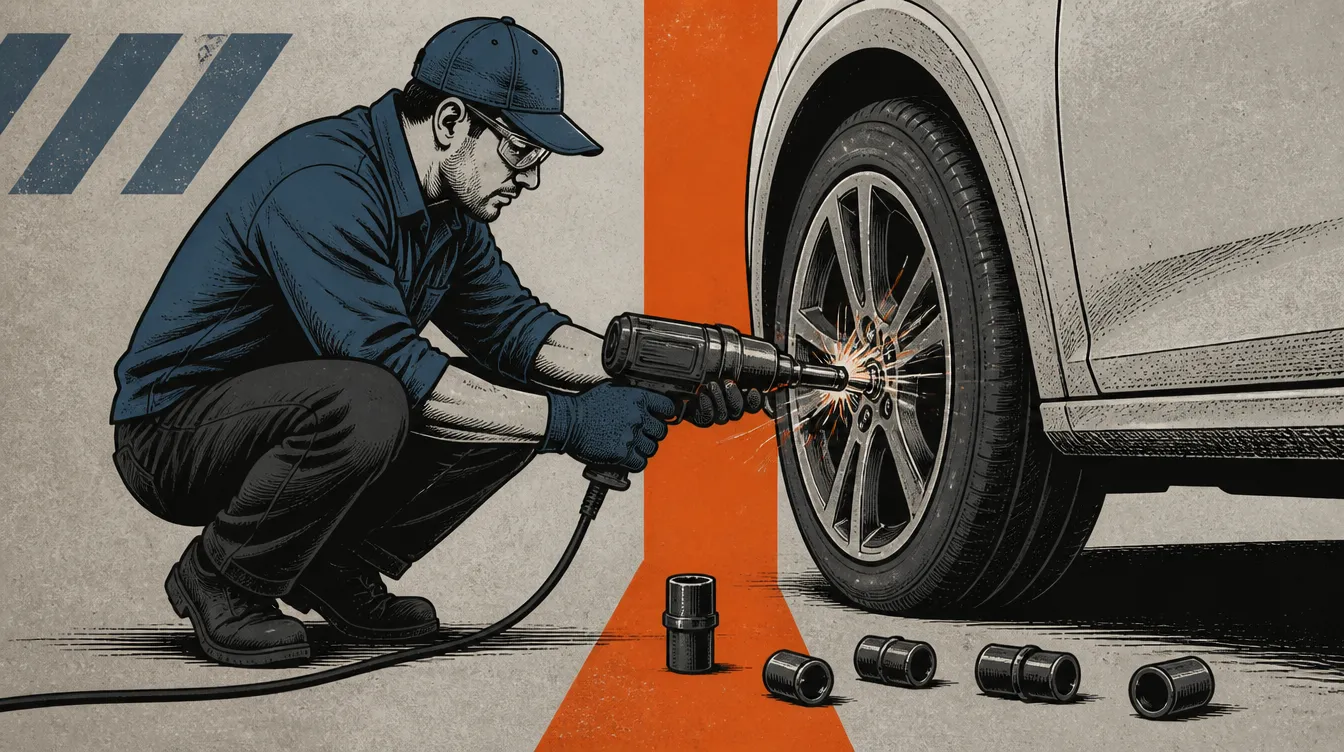
An impact wrench lives on the "do I really need this" shelf right up until you meet a lug nut that a hand ratchet will not budge, or a lag bolt buried three inches into pressure-treated lumber. Then the question changes to which one, because the shelf at the hardware store runs from 90 dollar off-brand guns all the way to a 746 dollar Snap-on, and every box promises hundreds of foot-pounds of torque you have no way to check yourself.
Somebody did check. A hands-on bench test put 13 cordless impact wrenches through the same loosening, driving, and extraction tasks, on camera, with a torque gauge doing the arguing instead of the marketing copy.
Here is what actually separated the guns that earn their price from the ones that do not.
What the testing showed
Every number below comes from Project Farm, who bought 13 cordless impact wrenches and ran them through the same five tasks back to back. The full breakdown, including the timed lag bolt extractions, is on the 13-wrench impact wrench head-to-head. Everything cited here traces to that video.
The lineup covered a wide spread of brands and prices: Milwaukee (both an M12 Fuel and an M18 Fuel model), Flex, DeWalt Atomic, Greenworks, Kobalt, Ryobi 1+ HP, Seesii, Avhrit, Ridgid, Skil, Makita, and Snap-on. Each wrench went through:
- Claimed torque and idle sound level, taken straight from the packaging and a decibel meter.
- Looseningtorque on a 3/4 inch bolt, measured as actual clamp load in pounds, converted to foot-pounds.
- A 30-second lag bolt drive test into a half inch by 10 inch lag bolt, measured by how far the bolt sank into the board.
- Three lag bolts driven for time, a 5 inch bolt run three times per wrench.
- Three lag bolts extracted for time, the reverse of the driving test.
Milwaukee M12 Fuel and Flex tied for the best overall scorecard
According to the test's own scorecard, the Milwaukee M12 Fuel and the Flex 24V wrench finished with the same average placement across the five graded categories, an average finish of two out of thirteen. The M12 Fuel won the raw looseningtorque test outright at 29,183 pounds of clamp load, which works out to 341 foot-lb, and it did that while being the lightest wrench in the lineup at 3.085 lb. It runs 279 dollars for the full kit with battery and charger.
Flex, at 239 dollars, won both timed lag bolt tests, finishing the three-bolt drive test in an average of 7.58 seconds and the extraction test in 2.89 seconds average, edging out DeWalt Atomic by about a hundredth of a second. Flex is also the heaviest wrench at that point in the lineup, 4.72 lb, and one of the louder guns at 112 decibels on the lag bolt test.
DeWalt Atomic and Milwaukee M18 Fuel were strong, not top
DeWalt Atomic, at 160 dollars, won the 30-second lag bolt drive test outright with 8.5 inches of progress thanks to a mode built specifically for driving lag bolts into wood, something the test notes call "a huge positive difference." It finished third overall on the final scorecard.
Milwaukee's other entry, the M18 Fuel, is the compact option at only 4.8 inches long and 156 dollars for just the wrench. It produced 227 foot-lb on the loosening test and was strong early in the lag bolt tests, but the notes say it was "later surpassed by DeWalt Atomic, Flex, and Milwaukee M12 Fuel" as the rest of the field came through.
The 746 dollar Snap-on did not justify its price
Snap-on was the most expensive wrench in the test by a wide margin at 746 dollars for the wrench and battery alone, with the charger sold separately. It performed respectably, posting 315 foot-lb on the looseningtorque test for second place behind the Milwaukee M12 Fuel, but it has no dedicated lag bolt setting and finished behind cheaper wrenches on the timed tests. The test's own conclusion is blunt: the price is "way overpriced given it is not as compact, is pretty heavy, and does not perform as well as far less expensive competition."
How to read this for your own purchase
No single wrench was crowned the outright winner. Two guns tied for the best average scorecard, and which of those two fits you depends on what you actually do with it.
If you work mostly on vehicles, favor the Milwaukee M12 Fuel. It posted the single highest raw looseningtorque number in the test and is the lightest wrench in the lineup, which matters when you are holding it under a wheel well for an hour.
If you do construction or wood-heavy work, Flex or DeWalt Atomic are the better picks. Both won the lag bolt tasks, and DeWalt's dedicated lag bolt mode is a real, measured advantage rather than a marketing line.
Do not assume price tracks performance. The most expensive wrench in the test, the Snap-on at 746 dollars, finished behind multiple wrenches that cost a fifth as much. A high price bought a brand name and a warranty network, not more torque.
A few rules the data backs up regardless of brand:
- Match the anvil size and drive to your bolts. A 1/2 inch drive wrench covers almost everything a homeowner needs; larger anvils are for heavier commercial work.
- Battery platform matters as much as the tool. If you already own batteries for a brand, staying in that ecosystem often beats chasing a few extra foot-pounds elsewhere.
- Noise and vibration are real ownership costs. Several wrenches in the test that hit hardest were also flagged as rough on the hands; that trade-off is worth feeling in person before you buy.
Browse the rest of the power tools put through the same kind of hands-on grind if you are cross-shopping drills, drivers, and grinders at the same time.