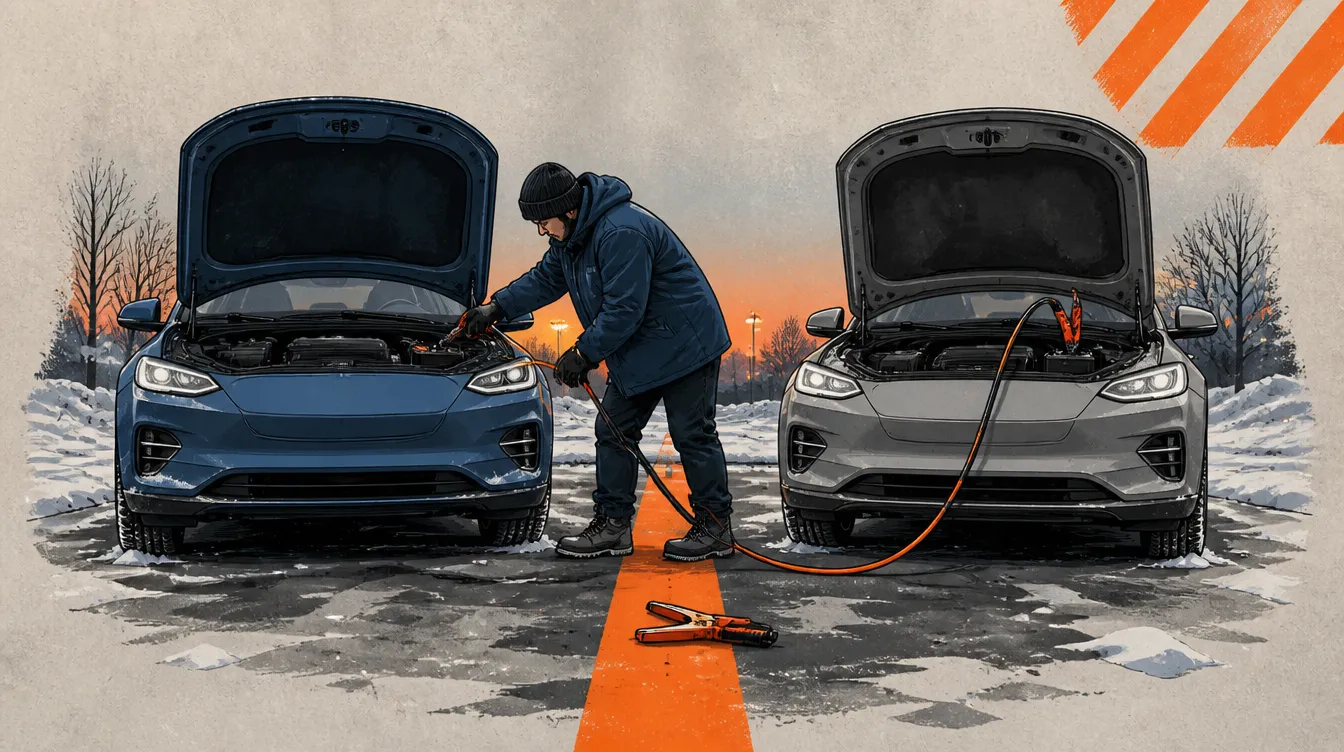
Jumper cables feel like the obvious cheap alternative to a portable jump starter: no battery to keep charged, no electronics to fail, just a set of thick copper cables that connect your dead car to a running one. That logic holds up fine as long as a second running vehicle is actually available. The honest question most shoppers never get answered is what happens when that assumption fails, or when you try to substitute cables for a proper jump starter using a different power source entirely.
Here is the honest situation: there is no dedicated, brand-versus-brand jumper cable bench test in the testing corpus this site draws from yet. What does exist is a real jump starter comparison that included a bare set of jumper cables as a specific test case, framed by its own methodology as a direct answer to the question "why buy an expensive jump starter when you can just buy the set of cables." That result is genuinely useful, even though it is not a ranking of cable brands against each other.
What the testing showed

Winner
NOCO GBX155
Price shown in test: around $370
Affiliate link. We may earn a commission at no extra cost to you.
The relevant data point comes from Project Farm's most recent jump starter showdown, which tested 13 products including a bare set of 2-foot, 8-gauge jumper cables designed to draw power from a separately owned DeWalt power tool battery, priced at just 18 dollars.
That cable set failed its very first test, unable to produce enough current to spin over a V6 engine with a completely dead battery. It did not reappear in any of the video's later tests (tire inflation, V8 starts, diesel starts, LED brightness, battery capacity, or the bench cranking test), because it did not survive the initial attempt. The video's own notes are direct about the setup: the product includes no reversed-polarity protection, an explicitly called-out safety concern, and it was not tested with an actual DeWalt battery attached beyond that single failed attempt.
That same test also surfaced a separate cable-related failure worth knowing about: one of the 13 self-contained jump starters, priced at 70 dollars, had its own jumper cable literally melt during the bench cranking test, a reminder that cable quality and gauge matter even inside a fully assembled jump starter, not just in a bare cable set.
What this data does not tell you is which jumper cable brand, from a standalone set meant to connect two vehicles directly, performs best on gauge thickness, clamp grip, or cold-weather flexibility. That comparison has not been run in the testing this site indexes, and we are not going to invent a brand ranking where none exists.
How to read this for your own purchase
Since a direct cable-brand ranking is not available, the most honest guidance is to think carefully about what a set of jumper cables is actually for, and to buy based on the physical specs that determine whether cables can carry the current a dead battery needs.
Standard jumper cables, connecting two running vehicles, are a fundamentally different tool from the cable-and-tool-battery setup that failed in the test above. Traditional jumper cables draw power from a second vehicle's alternator and battery simultaneously, a much larger and more sustained power source than a single handheld tool battery. Do not read the tested failure as proof that all jumper cables are unreliable; read it as proof that a bare cable set with no internal power source is not a substitute for either a second vehicle or a proper jump starter.
Gauge thickness is the single most important spec. Thicker cables (a lower gauge number, like 4-gauge or 6-gauge) carry more current with less resistance and voltage drop than thin 8- or 10-gauge cables, which matters enormously for actually turning over a cold, weak engine.
Cable length matters for real-world usability. Cables under 10 feet can leave you unable to position two vehicles correctly, especially with modern engine bays where battery placement varies. Longer cables, generally 16 to 20 feet, offer more flexibility for awkward parking situations.
Clamp quality and insulation matter as much as the wire itself. A cable with weak, poorly insulated clamps can arc, corrode, or fail to make solid contact, undermining even a properly gauged cable.
If a self-contained jump starter is a realistic option for you instead of relying on a second vehicle, the tested data on jump starters themselves is directly useful. Browse the full jump starter comparison or the rest of the jump starters and car power tests for brand-versus-brand breakdowns that actually exist.