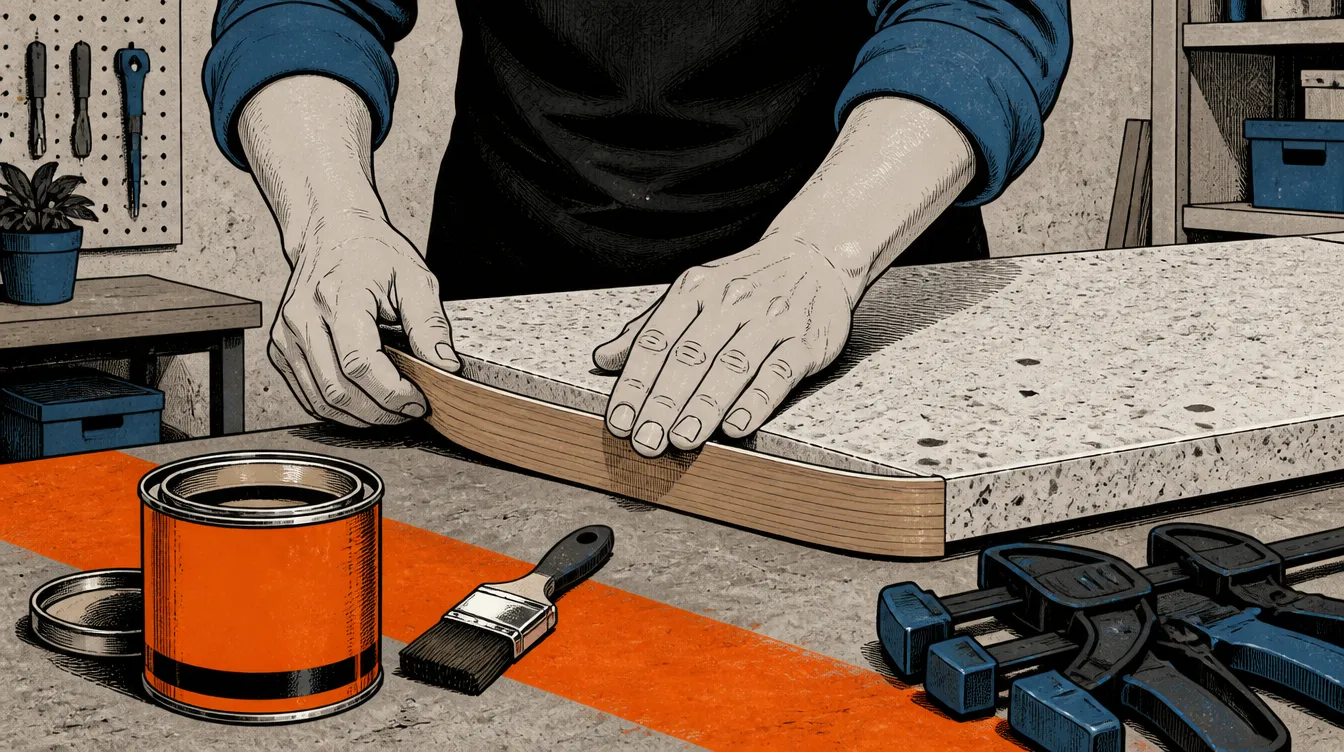
Contact cement is the go-to adhesive for laminate countertops, veneer, and shoe repair, prized for the instant, permanent bond it forms the moment two coated surfaces touch. That property, no clamping, no waiting, is also exactly why a weak or slow-curing contact cement is a real problem: there is no second chance once the surfaces meet.
Here is the honest scope of what follows: there is no dedicated contact cement test in the data this guide draws from. What does exist is detailed, hands-on testing of construction adhesive and general-purpose adhesive/glue products, different formulations built for different jobs, but tested with the same bonding-strength methodology (pull-apart force, durability under stress) that matters for judging any adhesive claim, contact cement included.
What the testing showed
The numbers below come from Project Farm, who tested five construction adhesive brands and four general adhesive/glue brands for bonding strength and durability. No contact cement product was part of either test. You can watch the full breakdowns on the construction adhesive test and the adhesive/glue test. Loctite PL 8X won the construction adhesive test; JB Weld won the general adhesive/glue test.

Winner
Loctite PL 8X
Price shown in test: 78 cents per oz, tied with Liquid Nails Fuze It as the most expensive tested
Affiliate link. We may earn a commission at no extra cost to you.

The construction adhesive test showed real strength differences between brands
Loctite PL 8X was named the overall winner of the five-brand construction adhesive test, with DAP Dyna Grip named the budget pick. Construction adhesives are built for permanent, high-load structural bonds, generally between wood, drywall, or masonry, a similar demand to what a contact cement needs to deliver on a laminate countertop bond that will see years of daily use.

Budget pick
DAP Dyna Grip
Price shown in test: 40 cents per oz
Affiliate link. We may earn a commission at no extra cost to you.
The general adhesive/glue test showed how much formulation affects real-world bonding
JB Weld won the four-brand adhesive/glue test outright, beating Loctite, Flex Glue, and Gorilla in head-to-head bonding comparisons. This test is a useful reference point for contact cement specifically because it compared products across different adhesive chemistries rather than just within one category, the same kind of comparison a shopper choosing between a solvent-based and water-based contact cement effectively has to make.
Neither test found price to be a reliable predictor of bonding performance
In both tests, the named budget pick and the named overall winner were not simply the most expensive product available; strength and value did not move in lockstep, a pattern that shows up consistently across nearly every adhesive category this site has indexed, including epoxy and construction adhesive testing.
How to read this for your own purchase
Since no contact cement product was directly tested, use the bonding-strength principles from these related adhesive tests, and confirm with the specific product's application instructions before committing to a permanent laminate or veneer bond.
If you are bonding a large laminate surface like a countertop, prioritize a contact cement rated for the specific substrate (particle board, plywood, or metal edge banding) and follow the manufacturer's coat count and open-time instructions exactly; unlike construction adhesive, contact cement bonds instantly on contact and there is no repositioning once surfaces touch.
If you are choosing between a solvent-based and water-based contact cement, solvent-based formulas generally bond faster and hold better initial tack, but require more ventilation and carry stronger fumes; water-based formulas are safer indoors but often need a longer open time before bonding. Neither property was directly measured in the tests cited here, so check the specific product's data sheet.
If your project needs gap-filling or structural load-bearing strength rather than a thin, flat bond, a construction adhesive or epoxy is the more appropriate product than contact cement, which is designed for large-surface-area flat bonds, not gap-filling.
It also helps to understand why contact cement cannot really be judged by the same pull-apart strength numbers these tests used for construction adhesive and glue. Construction adhesive and epoxy-based glues cure chemically over time, building strength as the material hardens, which is exactly what a pull-apart or compressive strength test after a set curing period measures. Contact cement works through a completely different mechanism: two rubber-based or synthetic-rubber coated surfaces are pressed together while still tacky, and the bond forms almost entirely through that immediate physical contact rather than a slow chemical cure. That is why a strength test built around curing time would not translate cleanly to contact cement even if one existed, and why manufacturer instructions around coat count and open time matter more for this specific adhesive than for almost any other category on a hardware store shelf.
A few universal rules the adhesive data supports across categories:
- Match the adhesive chemistry to the actual job. Contact cement, construction adhesive, and epoxy each solve a different bonding problem; using the wrong one for your surface type or load requirement undermines even a strong product.
- Price is not a reliable strength signal. Across every adhesive category tested here, the most expensive product was not consistently the strongest performer.
- Follow open-time and coat-count instructions exactly for contact cement specifically, since its instant-bond nature means there is no correcting a mistake after the surfaces touch.
Looking for more bonding and adhesive products tested the same hands-on way? Browse the rest of the adhesives, glue and tape tests for construction adhesive, epoxy, and threadlocker comparisons.