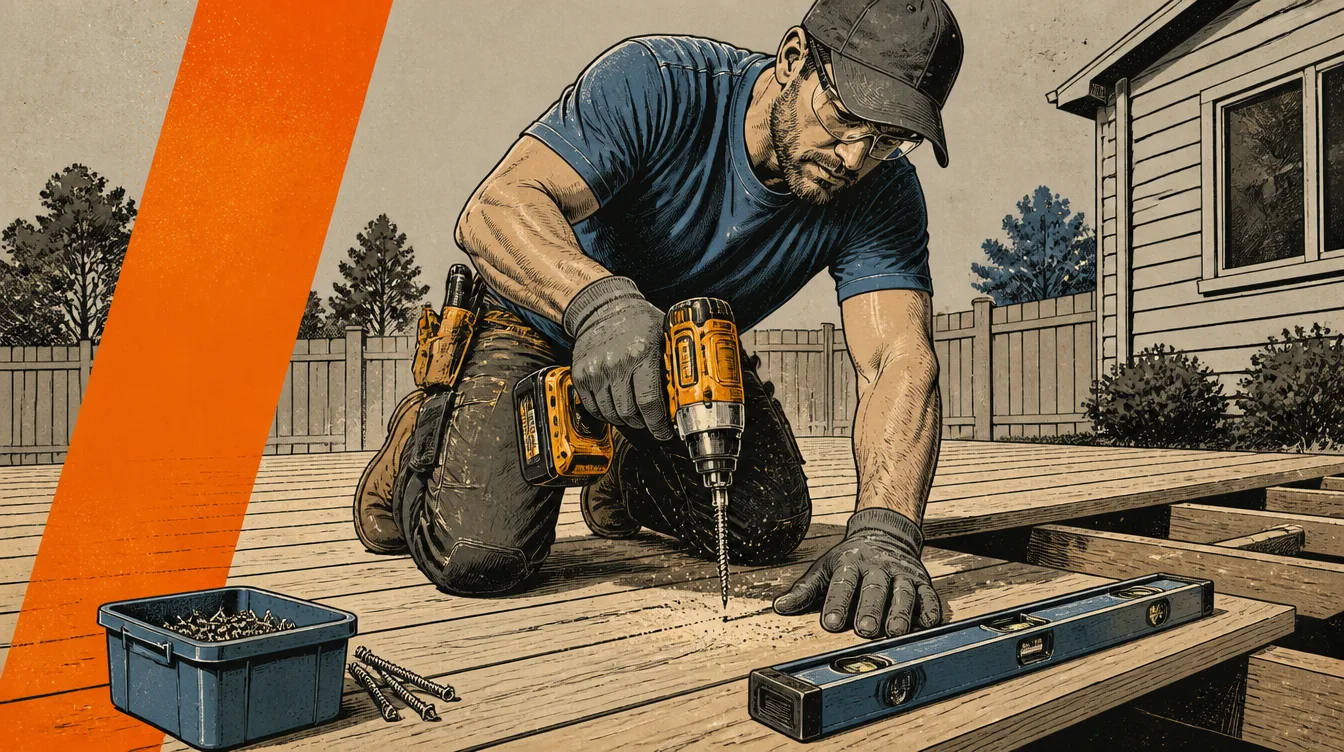
DeWalt owns enough shelf space at the hardware store that "DeWalt impact driver" can mean three or four different tools depending on which line you grab, from the compact Atomic series up through hydraulic-drive models built for low-vibration comfort. Two separate hands-on tests give real numbers on two of those DeWalt models, and the results are stronger than a lot of DeWalt marketing actually claims.
What the testing showed
The figures below come from two of Project Farm's independent hands-on tests. One covered 12 cordless impact drivers including a DeWalt 860 and a separate DeWalt Hydraulic model, and one covered 4 impact drivers including a DeWalt DCF888BR. The full breakdowns are on the 12-driver impact driver comparison and the 4-driver impact driver comparison.
DeWalt 860 won the larger 12-brand test outright

Winner
DeWalt 860
Price shown in test: 140
Affiliate link. We may earn a commission at no extra cost to you.
DeWalt's 860, at 140 dollars, took the outright win in the 12-driver test, with the best average finish across three graded events. It was the fastest of all 12 drivers on a number 10 by 5 inch screw driving task, averaging 1.41 seconds and taking the lead from Milwaukee, and it also posted the fastest average lag bolt time in the field at 4.95 seconds. Its measured no-load RPM was 3,850, second only to Milwaukee's M18 Fuel, and it produced 24,429 lb of clamp load on the maximum torque burst test.

Runner-up
Milwaukee M18 Fuel
Price shown in test: 100
Affiliate link. We may earn a commission at no extra cost to you.
DeWalt Hydraulic was the quietest and most compact, but had the lowest torque rating
A second DeWalt model in the same 12-driver test, the DeWalt Hydraulic at 200 dollars, took a different approach entirely. It measured 91.1 decibels while driving under load, described as "by far the quietest under load of any brand tested," consistent with its marketed hydraulic drive system. It was also the most compact driver in the comparison at just under 4 inches front to back, and it earned the best subjective comfort and vibration rating in the test. The trade-off is torque: it is rated for only 500 in-lb by design, positioned deliberately as a fast, quiet, low-to-medium torque tool rather than a maximum-power driver. The test's own narrator called it "my favorite impact driver for the 99 percent of work that does not require high torque," while also noting that excluding the max-torque test from scoring would have moved it into third place overall, implying it placed lower once torque was factored in.
DeWalt's DCF888BR won a separate, smaller torque-focused test
In a different, earlier 4-driver comparison against Milwaukee's M18 Fuel, Makita's XDT16Z, and a Bauer, DeWalt's DCF888BR, at 150.87 dollars, carried the highest claimed torque rating of the four at 1,825 in-lb and tied with Makita for second place on the tightening torque test at 1,450 PSI, despite that higher claim. It was the lightest of the four with its battery included. Milwaukee's M18 Fuel won that particular test outright, with Makita's XDT16Z as runner-up, so DeWalt's DCF888BR finished third in that specific comparison.

Runner-up
Makita XDT16Z
Price shown in test: $167.03
Affiliate link. We may earn a commission at no extra cost to you.
The budget entry in that smaller test failed outright
For context on what the DeWalt models beat in the smaller 4-driver test, Bauer's 20V Hypermax, at 69.99 dollars with battery and charger included, was the only brushed-motor tool in that field and finished last on both the tightening and looseningtorque tests. During the lag bolt test it began smoking at the 1.5 minute mark, reached roughly 300F, and stopped functioning entirely. A later teardown found the internal bracket holding its motor brushes had failed, wiping out the fan blades on the armature and leaving it, in the test's own words, "pretty much a brushless motor by accident." That failure is useful context for how much of a gap separated DeWalt's tested models from the cheapest competitor in that particular comparison.
How to read this for your own purchase
DeWalt does not have one single "the DeWalt impact driver" answer here; it has at least three tested models built for different priorities, and the data separates them clearly.
For the strongest all-around performer, the DeWalt 860 is the tested pick, winning the larger 12-brand test outright on both timed driving tasks.
For quiet, low-vibration work where maximum torque is not the priority, such as finish carpentry, cabinetry, or repeated all-day use, the DeWalt Hydraulic's measured quietness and top comfort rating in the same 12-driver test are real, tested advantages, with the trade-off being a deliberately capped torque rating.
If you are shopping specifically against Milwaukee, know that in the smaller 4-driver comparison, Milwaukee's M18 Fuel beat DeWalt's DCF888BR outright, while in the larger 12-driver comparison, DeWalt's 860 beat Milwaukee's M18 Fuel. Different DeWalt and Milwaukee models were tested in each case, so the "which brand wins" answer depends on which specific model within each brand you are comparing.
A rule that applies across all three DeWalt models tested: check the torque rating against your actual job, not just the brand name. The Hydraulic's 500 in-lb rating and the 860's stronger torque numbers serve genuinely different use cases within the same DeWalt lineup.
Browse the rest of the power tools tested this same hands-on way for drills, wrenches, and grinders put through comparable head-to-head testing.