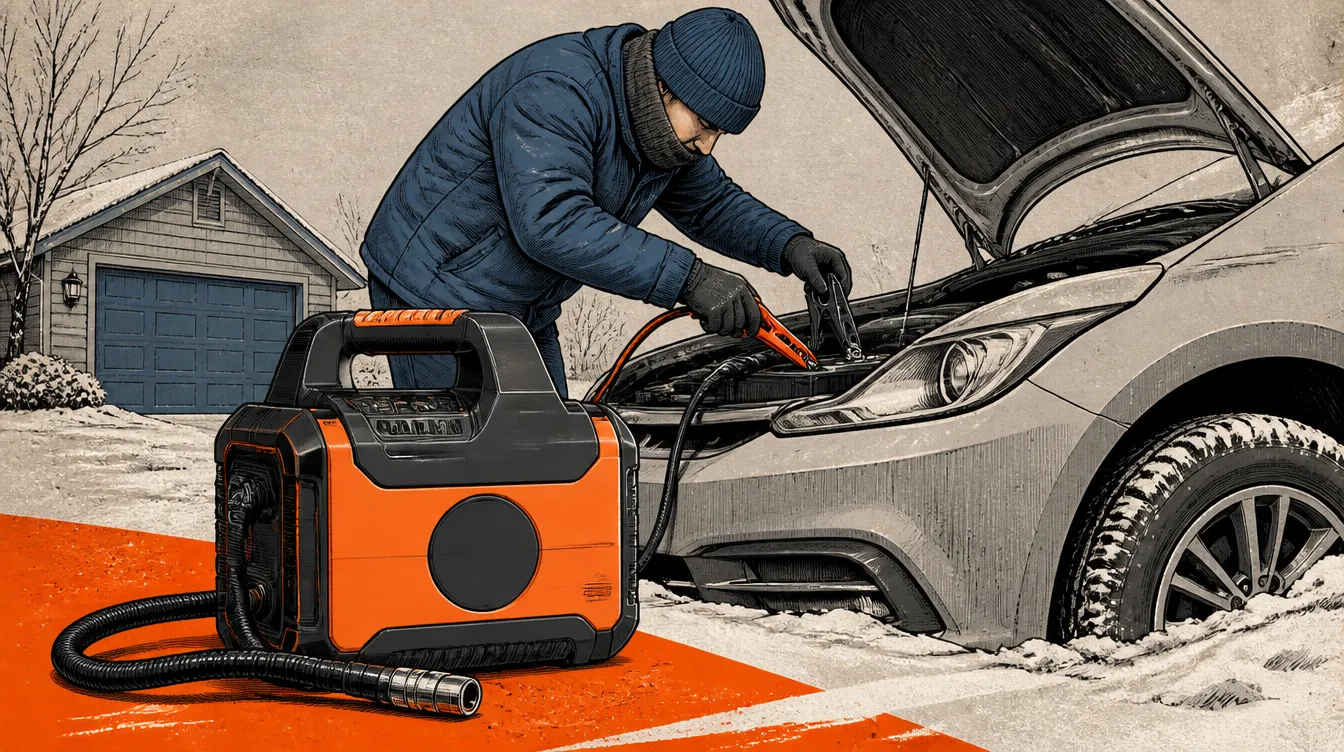
A combo jump starter with a built-in air compressor sells itself on convenience, one device in the trunk that can restart a dead battery and air up a low tire. No dedicated combo-unit test exists in the testing corpus behind this guide, so the honest starting point is that the specific 2-in-1 devices were not part of any cited test. What was tested, in a rigorous 14-unit comparison, is the standalone jump-starting performance that is the harder and more important half of any combo unit's job, since a jump starter that cannot reliably crank a dead engine is not worth the trunk space regardless of what accessories it bundles in.
What the testing showed
The numbers below come from Project Farm's jump starter comparison, which tested 14 units. None of these are combo air-compressor units specifically, but every unit was tested on the exact core function a combo device also needs to deliver: reliably cranking a genuinely dead V6 engine.
The winner posted a decisive, real gap over the field
NOCO's GBX155 finished on top, and the video's own summary was direct: "The Noco came out on top with the best average finish of 1.6." At around 370 dollars and 5.61 lb, it delivered "by far the most current yet" on the dead V6 battery start test, described as making the test "look way too easy" and earning the best possible score in that category.
GooLoo, the runner-up, at just 99 dollars and 2.23 lb, turned the engine over the fastest of the cheaper units at that point in testing, running for 13 seconds, tied for second place with the Wolfbox at 110 dollars.

Runner-up
Gooloo
Price shown in test: $99
Affiliate link. We may earn a commission at no extra cost to you.
The most expensive unit after NOCO underperformed

Winner
NOCO GBX155
Price shown in test: around $370
Affiliate link. We may earn a commission at no extra cost to you.
Milwaukee's Hot Shot, at 300 dollars for the jump starter alone (a compatible battery sold separately), was by far the heaviest unit tested at 6.9 lb alone and 9.25 lb including its battery. Despite that price and weight, it "gave up really early at just over 2 seconds, a poor result for the most expensive unit tested" after the NOCO. That is a direct, measured reminder that price and weight are not reliable predictors of jump-starting performance.
Several budget units genuinely struggled with a fully dead battery
Multiple units in the 50 to 90 dollar range needed an external jumper just to "excite" the unit before they could attempt a start at all, including the YUSMAN, KOLTGOO, DECHANIE, WNDFLV, and Sharmeal. The IIXWUQ, an 18 dollar DeWalt-battery jumper cable set, "did not produce enough current to spin over the engine at all, a complete failure on the very first test." The NACKEO, at 70 dollars, stood out among the budget tier by including a boost button that let it work with a completely dead battery without needing an external excite, performing the best of that price tier at that point in testing.
How to read this for your own purchase
Since no combo air-compressor-and-jump-starter unit was part of any cited test, apply the standalone jump-starting lessons directly, since that function is the harder engineering problem and the one that matters most in an emergency.
Prioritize verified dead-battery cranking performance over the air compressor feature. A combo unit's air compressor is a genuine convenience add, but a jump starter that cannot reliably crank a truly dead engine, as several budget units in this test could not without external help, is not solving the problem you bought it for.
Weight and price are not reliable predictors of jump-start performance. The Milwaukee Hot Shot, the second most expensive unit and by far the heaviest, badly underperformed cheaper, lighter rivals in this test.
Check the battery capacity split between functions on any combo unit before buying. A jump starter and air compressor built into one housing share a single internal battery, so running the compressor to air up a tire before an emergency start draws down the same reserve the jump-start function needs. None of the units in this test were combo devices, but that shared-capacity tradeoff is a real engineering constraint worth asking about directly when a listing does not disclose it.
A few universal rules the data supports for any combo or standalone jump starter purchase:
- A boost or excite-assist feature is a real, measurable advantage on a genuinely dead battery, as the NACKEO demonstrated among budget units in this test.
- Test claims like "8,000 cranking amps" are frequently debunked once measured, as happened repeatedly across the cheaper units in this comparison, so treat any cranking-amp number on a combo unit's packaging with the same skepticism.
- A combo unit adds an air compressor pump that draws from the same internal battery as the jump-start function. Verify the unit's standalone jump-start rating is strong on its own before assuming the added compressor comes without any tradeoff in jump-start capacity.
Check the air compressor's actual PSI and fill-rate specs against your tire size, since a compact combo unit's built-in pump is typically weaker than a dedicated portable tire inflator. If airing up a full-size truck tire regularly is part of the use case, a combo unit's compressor may be better suited to occasional top-offs than full inflation from flat, a distinction worth confirming directly since no cited test measured a combo unit's compressor output.
Keep comparing the gear that gets you moving again on the jump starters and car power hub.