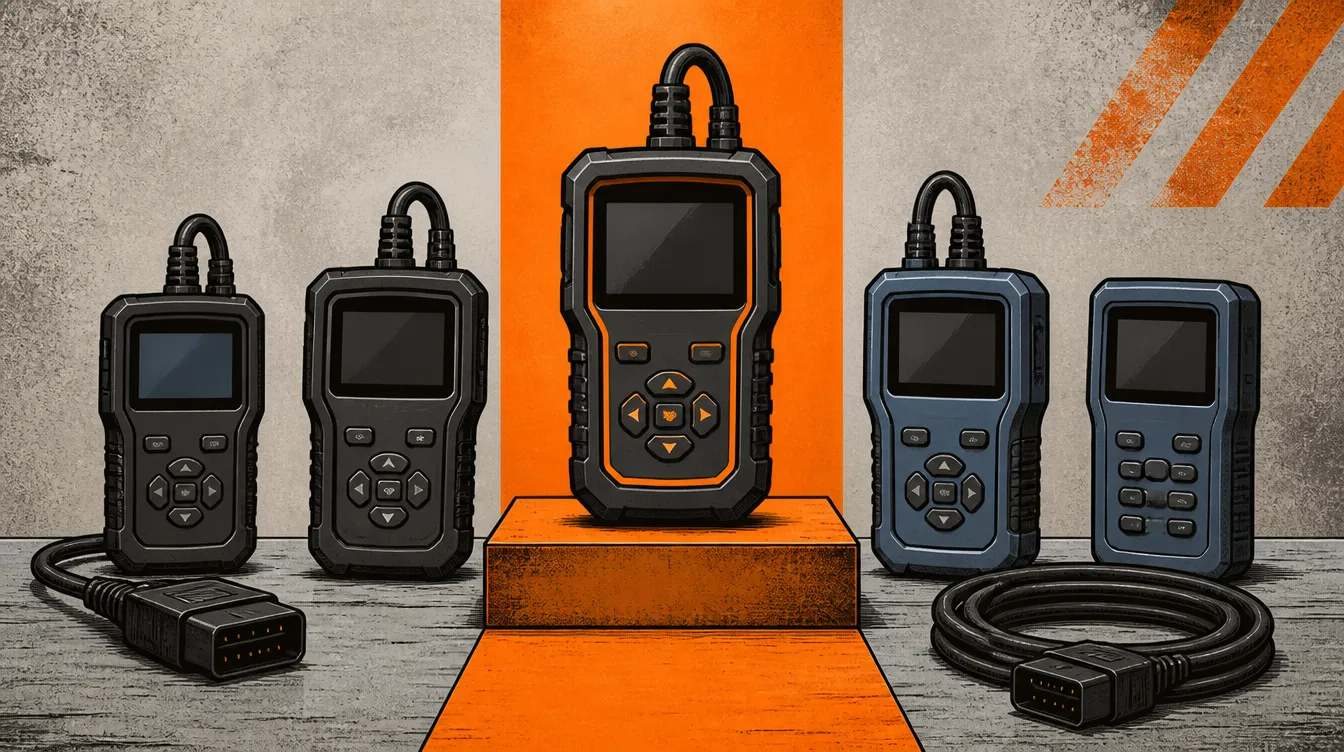
Which OBD2 Code Scanner Brand Wins?
This head-to-head test of 9 obd2 code scanner options has the measured results for each. See how they ranked and watch the full test video.

Moto Power and Ancel 310 (tied, ~$23 tier)
Price shown in test: $40
Affiliate link. We may earn a commission at no extra cost to you.
The measured results
Every number below is read straight from the test. Products are listed in the order they finished.
Boot Up
- 1AUTOPHIX OM126P2 seconds
(fast)
- 2Ancel 410 (AD410)2 seconds
- 3MotoPowerabout2.5 seconds
- 4Ancel 310about5.3 seconds
(almost as slow as the base Autel)
- 5Foxwell NT2014.4 seconds
- 6Foxwell NT3014.3 seconds
- 7Autel6.3 seconds
(slow)
- 8LeeKooLuuabout4 seconds
- 9Launch Creaderjust over4 seconds
Code Retrieval
- 1AUTOPHIX OM126P1 second
with a single hot-key press (tied fastest/simplest)
- 2Ancel 410 (AD410)
just over half a second, no hot key but only 3 button presses
- 3MotoPower1.3 seconds
with a single hot-key press (best yet at the time, tied simplest)
- 4Ancel 310about20 seconds
(slowest of all 9 to retrieve codes), 4 button presses
- 5Foxwell NT2017.5 seconds
5 button presses (extra step attributed to its added capability to store existing codes for future reference)
- 6Foxwell NT3017.3 seconds
5 total button presses
- 7Autel1.8 seconds
3 button presses
- 8LeeKooLuu
very close to 1.4 seconds (pretty quick), 3 button presses to display the first of three codes
- 9Launch Creader
FAILED entirely: after 42 seconds and 5 separate attempts it could not retrieve codes from the 2003 Chevrolet Suburban
Transmission Code Test 2008 Honda Civic
- 1AUTOPHIX OM126P
successfully located both codes quickly via the hot key, requiring the least amount of menu navigation of any tool per the narrator
- 2Ancel 410 (AD410)
not individually narrated in this section; inferred as one of the 6 (of 9) scanners that successfully found both codes, since the narrator states exactly 6 succeeded and the other 8 tools are each individually accounted for as success or failure
- 3MotoPower
found only the engine code, missed the transmission code
- 4Ancel 310
successfully located both the engine and transmission codes, though required a lot of menu navigation
- 5Foxwell NT201
identified both trouble codes, though required a lot of menu navigation
- 6Foxwell NT301
identified both codes (algorithm described as the same as the NT201), required quite a few keystrokes to navigate
- 7Autel
the first scanner in the lineup to successfully locate the transmission fault code, though it took a lot of navigating
- 8LeeKooLuu
found only the engine code, missed the transmission code
- 9Launch Creader
also failed to find the transmission fault code on the second vehicle
Screen Readability In Sunlight
- 1AUTOPHIX OM126P
hardest to read in direct sunlight of all 9 tools (backlight not bright enough)
- 2Ancel 410 (AD410)
a little easier to see than AUTOPHIX, but harder than Launch Creader and Foxwell 201 (2nd hardest overall)
- 3MotoPower
large screen, very easy to read in direct sunlight (named among the two best, tied with LeeKooLuu)
- 4Ancel 310
pretty easy to see, smaller font than Moto Power
- 5Foxwell NT201
as difficult to see in direct sunlight as the Launch Creader (among the worst)
- 6Foxwell NT301
a little better than AUTOPHIX and the Ancel 410, but still not great
- 7Autel
font a little smaller but still pretty easy to see in direct sunlight
- 8LeeKooLuu
very easy to see in direct sunlight (named among the two best, tied with Moto Power)
- 9Launch Creader
nearly impossible to read, screen contrast and backlight both inadequate
Freeze Frame Data
- 1AUTOPHIX OM126P8
button engagements (most of any tool) but only 3.75 seconds; 3 data points per screen (fewest, requires scrolling), info spelled out in full rather than abbreviated
- 2Ancel 410 (AD410)5
button engagements, took a full second longer than AUTOPHIX to retrieve, screens identical to AUTOPHIX
- 3MotoPower7
button engagements, 3.75 seconds, 4 data points per screen, large easy-to-read font
- 4Ancel 3105
button engagements, 3.4 seconds raw retrieval (fastest raw time) but lags over 1 second per button press (about 9 seconds total to advance screens); 6 data points per screen (most among non-hot-key tools) but requires scrolling through each point
- 5Foxwell NT2016
button strokes, 6.4 seconds (slowest at the time it was tested), 7 data points per screen (most of any tool up to that point), no noticeable lag
- 6Foxwell NT3016
button strokes, 6.65 seconds (slowest of all 9), 7 data points per screen, all abbreviated, includes a help key for additional info
- 8LeeKooLuu4
button engagements, 4 seconds, 4 data points per screen
- 7Autelnot tested
- 9Launch Creadernot tested
Im Readiness
- 1AUTOPHIX OM126P
hot key, just over 1 second (about 10x faster than Foxwell), everything on one screen, subjectively easier on the eyes
- 2Ancel 410 (AD410)
hot key, just over 1 second, one screen, display looks identical to AUTOPHIX
- 3MotoPower5
button strikes, 3 screens
- 4Ancel 3105
button strikes, 4 screens (only 3 data points per screen)
- 5Foxwell NT201
hot key, 10 seconds (slow), everything on one screen
- 6Foxwell NT301
hot key, just over 10 seconds (slowest hot-key tool), one screen
- 8LeeKooLuu5
button strikes, 3 screens, accurate info
- 7Autelnot tested
- 9Launch Creadernot tested
Live Data Test 2022 Toyota 4 Runner
- 1AUTOPHIX OM126P
launches in 5.8 seconds, info spelled out, 3 data points per screen, no noticeable lag; offers oxygen sensor graphing
- 2Ancel 410 (AD410)5.8 seconds
(same as AUTOPHIX), screens look identical to AUTOPHIX, offers oxygen sensor graphing
- 4Ancel 310
fastest of all 9 to launch the live stream (about 5.5 seconds) but scrolling lags badly (about 1 second per scroll)
- 5Foxwell NT201
very slow to launch, just over 32 seconds, but 7 data points per screen with no lag once running
- 6Foxwell NT30132.7 seconds
to launch (slowest, essentially tied with the NT201)
- 3MotoPowernot tested
- 7Autelnot tested
- 8LeeKooLuunot tested
- 9Launch Creadernot tested
Software Update
- 1AUTOPHIX OM126P
has an update mechanism, already had the latest software, download as quick as Foxwell's
- 4Ancel 310
no update software exists for it
- 5Foxwell NT201
has an update mechanism, already had the latest software installed
- 6Foxwell NT301
has an update mechanism, already had the latest software installed
- 9Launch Creader
has an update mechanism but the update attempt failed; the unit could not get past the language-selection prompt and the screen would not power up during the attempt
- 2Ancel 410 (AD410)not tested
- 3MotoPowernot tested
- 7Autelnot tested
- 8LeeKooLuunot tested
All measurements (3 more)+
Fault Code Lookup
- 4Ancel 310
has trouble-code lookup capability, though less user-friendly to input (must hold enter while using the up/down arrow)
- 5Foxwell NT201
one-handed / one button at a time to input trouble code info, as informative as the Ancel 310
- 6Foxwell NT301
one-handed input; uniquely provides possible causes/reasons for the trouble code, not just identification
- 7Autel
not able to look up trouble code information
- 8LeeKooLuu
not able to look up trouble code information
- 1AUTOPHIX OM126Pnot tested
- 2Ancel 410 (AD410)not tested
- 3MotoPowernot tested
- 9Launch Creadernot tested
Boot Plus Retrieve Combined
- 1AUTOPHIX OM126P3 seconds2nd
(2nd fastest of all 9, per the closing speed recap)
- 2Ancel 410 (AD410)2.7 seconds
(fastest of all 9 tools per the closing speed recap)
- 3MotoPower3.8 seconds3rd
(3rd fastest of all 9 per the closing speed recap)
- 4Ancel 310not tested
- 5Foxwell NT201not tested
- 6Foxwell NT301not tested
- 7Autelnot tested
- 8LeeKooLuunot tested
- 9Launch Creadernot tested
Screen Size
- 1AUTOPHIX OM126P2.98 square inches
- 3MotoPower3.29 square inches
- 6Foxwell NT301almost4 square inches
(largest of all 9)
- 2Ancel 410 (AD410)not tested
- 4Ancel 310not tested
- 5Foxwell NT201not tested
- 7Autelnot tested
- 8LeeKooLuunot tested
- 9Launch Creadernot tested
How it was tested
- boot-up time to main screen after plugging into OBD port
- time and button-press count to retrieve trouble codes on a 2003 Chevrolet Suburban
- ability to locate both an engine and a transmission trouble code on a 2008 Honda Civic
- time, button-press count, and data-points-per-screen for freeze frame data retrieval
- time, button-press count, and screen count for I/M readiness retrieval
- trouble-code lookup / definition capability
- screen readability in direct sunlight
- screen size measurement
- software update capability and process
- live data stream launch time and responsiveness on a 2022 Toyota 4Runner
- oxygen sensor graphical performance testing capability
Data notes and caveats
No single scanner is declared an outright winner; the closing guidance is use-case based: Moto Power and Ancel 310 for basic code reading/clearing around $23, and the four priciest brands (Foxwell 201, AUTOPHIX, Ancel 410, Foxwell 301) for buyers wanting to begin real troubleshooting. The clearest explicit negative verdict is against Launch Creader, which failed to retrieve codes on 2 of 3 test vehicles despite marketing claims. AUTOPHIX (transcribed as 'Autel Fix'/'AutoFix') is the most consistent top performer across the individual speed and navigation metrics and is the most likely referent of the title's 'One Stood Out,' but no transcript sentence explicitly crowns it, so winner is left null per the per-use-case convention. Nine total products tested, matching the description's list exactly.