Which Solar Car Battery Chargers Brand Wins?
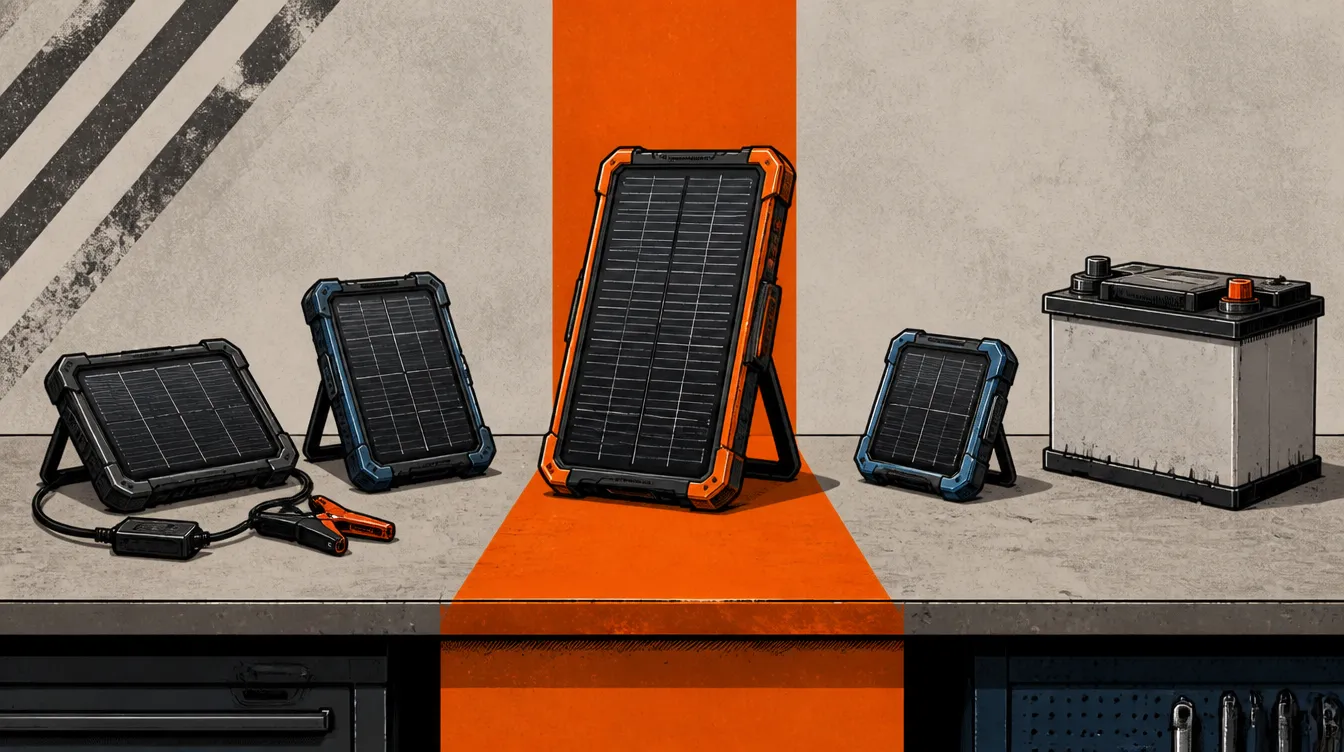
In our test we compared 14 solar car battery chargers options head to head. FlexSolar came out on top. See the measured results, the runner-up, the budget pick, and a link to the full test video.

FlexSolar
Price shown in test: $80
Affiliate link. We may earn a commission at no extra cost to you.

Grecell
Price shown in test: $50
Affiliate link. We may earn a commission at no extra cost to you.
Grecell
Price shown in test: $50
Affiliate link. We may earn a commission at no extra cost to you.
The quick take
The short version of why each pick lands where it does, built straight from the measured results.
“the Flex Solar came out on top with the best average finish of 3.5.”
Best in 2 of 5 measurements, including Hot sunny conditions and Efficiency.
Placed top three in 1 of 5 measurements.
Placed top three in 1 of 5 measurements.
The measured results
Every number below is read straight from the test. Products are listed in the order they finished.
Weight
- 1SHASUXTING154 g
- 2Hoysicy1,598 g
/ 3.52 lb
- 3Newpowa746 g
/ 1.64 lb
- 4VOLT HERO1,510 g
/ 3.32 lb
- 5TBER1,274 g
/ 2.81 lb
- 6EBL1,024 g
/ 2.26 lb
- 7Grecell1,034 g
/ 2.28 lb
- 8SOLPERK1,324 g
/ 2.92 lb
- 9NXQWLL524 g
/ 1.15 lb
- 10TogoPOWER1,462 g
/ 3.22 lb
- 11FlexSolar636 g
/ 1.4 lb
- 12SUNER POWER
stated in the transcript as '284 g or 4.59 lb', which is numerically inconsistent (284 g would be about 0.63 lb, not 4.59 lb); described as by far the heaviest brand up to that point in testing, so the 4.59 lb figure (about 2,082 g) is likely the more accurate one and '284 g' is likely a caption/transcription error; both figures are kept verbatim here per the no-invention rule
- 13Schumacher4,926 g
/ 10.86 lb, described as 'absolutely massive' and 'quite a behemoth', by far the heaviest panel in the video
- 14PulseTech994 g
/ 2.19 lb
Overcast, flat / 28 deg angle
- 1SHASUXTING0.8 W
at 19.47 V flat; 0.76 W at 28 degrees
- 2Hoysicy6.09 W
at 22.13 V (charge controller read 22.5 V) flat; 6.47 W at 28 degrees
- 3Newpowa3.35 W
at 18.97 V flat; 2.68 W at 28 degrees (worse than the Hoysicy)
- 4VOLT HERO4.13 W2nd
at around 20 V flat (2nd place behind Hoysicy at that point); 4.11 W at 28 degrees
- 5TBER6.37 W
at just over 22 V flat, the best flat result up to that point in testing; 4.57 W at 28 degrees
- 6EBL4.87 W
at 13.14 V flat; 4.18 W at 28 degrees, about 21 W below its rating
- 7Grecelljust over7 W
at just under 14 V flat, moving into the lead at that point; 8.87 W at 28 degrees
- 8SOLPERK5.81 W
at around 20 V flat; 3.85 W at 28 degrees (angle hurt performance)
- 9NXQWLL10.67 W
at 14.7 V flat, moving into the lead; 10.49 W at 28 degrees
- 10TogoPOWER2.68 W
at around 10 V flat, described as underpowered and not enough to charge a car battery; 2.28 W at 28 degrees, still around 10 V
- 11FlexSolar4 W
at around 19 V flat; just under 5 W at 28 degrees
- 12SUNER POWER7.33 W
at around 22 V flat, performing better than average; 5.79 W at 28 degrees
- 13Schumacher3.08 W
at around 20 V flat; 2.25 W at 28 degrees, described as performing poorly compared to the competition
- 14PulseTech0.12 W
at around 18.3 V flat, the worst result in the entire competition; 0.1 W at 28 degrees
Hot sunny conditions
- 1SHASUXTING2.22 W
- 2Hoysicy16.49 W3rd
about 3.5 W short of its 20 W rating (3rd place in this test)
- 3Newpowajust over14 W
notably impacted by the heat
- 4VOLT HERO15.55 W2nd
handling the heat better than Newpowa (2nd place at that point in testing)
- 5TBER14.37 W
over 5 W short of its rating
- 6EBLjust over14 W
over 10 W short of its 25 W rating
- 7Grecell15.71 W
continuing to outperform the visually similar EBL
- 8SOLPERK14.51 W
well below its 20 W rating; noted as very hot to the touch in direct sunlight
- 9NXQWLL16.77 W2nd
moving into the lead at that point (2nd place in the final hot-sun ranking behind FlexSolar)
- 10TogoPOWER14.19 W
struggling in the heat
- 11FlexSolarjust over21.5 W
the best of all 14 brands, exceeding its own rating and seemingly unaffected by heat
- 12SUNER POWER14.75 W
about average for the 20 W-rated chargers
- 13Schumacher11.86 W
described as really struggling for its size
- 14PulseTech11.97 W
about 3 W short of its rated output (the transcript states this is 'about 3 watts short of its rating' after describing the rating as 15 W in this section, versus 12 W stated in the brand's intro; see notes)
Float charge test
- 1SHASUXTING
SAFETY ISSUE: began charging a near-dead battery at under 1 V, but never stopped charging even after the battery reached 15.5 V (overcharged); no functioning cutout observed
- 2Hoysicy
SAFETY ISSUE: began charging at under 1 V, but its factory float charge is supposed to cut out around 14 V or less; the battery reached 16.2 V and it was still overcharging
- 3Newpowa
SAFETY ISSUE: began charging at under 1 V, but never stopped charging even after the battery reached well over 15 V
- 4VOLT HERO
cut-in voltage 13.1 V, cutout voltage 14.1 V; functioning cutout observed
- 5TBER
SAFETY ISSUE: began charging at under 1 V, but never stopped charging even after the battery reached 15.5 V
- 6EBL
cut-in voltage 12.6 V, cutout voltage 13.8 V; functioning cutout observed
- 7Grecell
cut-in voltage 13.3 V, cutout voltage 14.1 V; described in the closing summary as better cut-in/cutout points than the FlexSolar
- 8SOLPERK
begins charging at 5 V; cut-in voltage 13.7 V, cutout voltage 15.2 V, which the reviewer flags as 'seems too high'
- 9NXQWLL
cut-in voltage 13.8 V, cutout voltage 14.5 V; functioning cutout observed
- 10TogoPOWER
cut-in voltage 13.8 V (same as NXQWLL), cutout voltage 14.5 V (same as NXQWLL); functioning cutout observed
- 11FlexSolar
begins charging only at 5 V or higher (will not charge a battery under 5 V); cut-in voltage 14.1 V (described as a little high), cutout voltage 14.4 V (also described as pretty high)
- 12SUNER POWER
begins charging at around 5 V; cut-in voltage around 13.8 V, cutout voltage around 14.3 V
- 13Schumacher
designed to only begin charging a battery with at least a 3.3 V charge (cannot jump-start a fully dead battery like most other brands); cut-in voltage 12.3 V (below a fully charged battery's baseline of 12.6 V), cutout voltage 14.4 V
- 14PulseTech
powers on at just under 1 V; cut-in voltage 13.8 V; during testing the battery reached 15.5 V and the charger still had not reached a cutout voltage, leaving its actual cutout point unresolved
Scratch resistance (Mohs pick)
- 1SHASUXTING
damaged easily at pick #5
- 2Hoysicy
damaged at pick #8
- 3Newpowa
damaged at pick #6
- 4VOLT HERO
damaged at pick #9 per the main test narration ('performed the best yet'), though the closing summary recap states pick #8 for this brand; this is a numeric inconsistency between the two parts of the transcript and both figures are preserved here
- 5TBER
damaged at pick #9 per the main test narration (tied with Volt Hero), though the closing summary recap states pick #8; both figures preserved here
- 6EBL
has a rubberized coating; earned a perfect 10 with no damage from any pick tested
- 7Grecell
has a rubberized coating; earned a perfect 10 with no damage from any pick tested
- 8SOLPERK
no rubberized coating; damaged at pick #8
- 9NXQWLL
not very durable, damaged at the relatively soft pick #3, the worst scratch result of any brand
- 10TogoPOWER
damaged at pick #8, much better than the NXQWLL
- 11FlexSolar
has a rubberized coating; earned a perfect 10 with no damage from any pick tested
- 12SUNER POWER
pretty durable, damaged at pick #8
- 13Schumacher
light scratches at pick #7, deeper grooves at pick #8
- 14PulseTech
scratches pretty easily at the relatively soft pick #3, despite being the most expensive charger in the video
Impact resistance (4 ft drop test)
- 1SHASUXTING
not durable, quite a bit of visible damage
- 2Hoysicy
held up just fine
- 3Newpowa
soft panel, left a pretty big dent
- 4VOLT HERO
held up just fine, no damage
- 5TBER
survived without any damage
- 6EBL
held up just fine, no visible damage
- 7Grecell
held up just as well as the EBL, no damage
- 8SOLPERK
WORST RESULT: ruined by the impact
- 9NXQWLL
experienced a pretty big dent but the panel still works fine
- 10TogoPOWER
survived without any damage
- 11FlexSolar
small dent from the impact
- 12SUNER POWER
held up just fine
- 13Schumacher
held up just fine
- 14PulseTech
pretty soft, experienced a dent
Rated wattage claim
- 1SHASUXTING30 W
(the highest claimed rating of any brand tested)
- 2Hoysicy20 W
- 3Newpowa20 W
- 4VOLT HERO20 W
- 5TBER20 W
- 6EBL25 W
- 7Grecell25 W
- 8SOLPERK20 W
- 9NXQWLL20 W
maximum output
- 11FlexSolar20 W
(per the hot-sun test section)
- 12SUNER POWER20 W
- 13Schumacher15 W
- 14PulseTech12 W
maximum energy production, the lowest claimed rating of any brand tested
- 10TogoPOWERnot tested
Reverse polarity test
- 1SHASUXTING
passed; only a tiny spark, no damage
- 7Grecell
passed (not one of the two brands that failed)
- 9NXQWLL
FAILED: experienced a pretty significant spark and the wiring became extremely hot; the reviewer notes a continuous connection would likely have caused damage, though the tool still worked fine after the brief test
- 11FlexSolar
passed (not one of the two brands that failed)
- 14PulseTech
FAILED: delivered a pretty hot spark and the wiring became hot very quickly; the reviewer notes an extended reverse connection would likely have caused damage, though the tool still worked fine after the brief test
- 2Hoysicynot tested
- 3Newpowanot tested
- 4VOLT HEROnot tested
- 5TBERnot tested
- 6EBLnot tested
- 8SOLPERKnot tested
- 10TogoPOWERnot tested
- 12SUNER POWERnot tested
- 13Schumachernot tested
All measurements (3 more)+
Panel size
- 1SHASUXTING5
x 12 in, 65 sq in, the smallest of all 14 panels
- 9NXQWLL165 sq in3rd
(3rd smallest mentioned)
- 14PulseTech125 sq in
(referred to in the transcript as 'the PTSE', likely a caption mangling/abbreviation of PulseTech; resolved by elimination and context, at lower confidence)
- 2Hoysicynot tested
- 3Newpowanot tested
- 4VOLT HEROnot tested
- 5TBERnot tested
- 6EBLnot tested
- 7Grecellnot tested
- 8SOLPERKnot tested
- 10TogoPOWERnot tested
- 11FlexSolarnot tested
- 12SUNER POWERnot tested
- 13Schumachernot tested
Average overcast production
- 7Grecell7.95 W2nd
2nd place overall behind NXQWLL
- 9NXQWLL10.58 W
the best of all 14 brands in this test
- 12SUNER POWER6.56 W3rd
3rd place overall
- 1SHASUXTINGnot tested
- 2Hoysicynot tested
- 3Newpowanot tested
- 4VOLT HEROnot tested
- 5TBERnot tested
- 6EBLnot tested
- 8SOLPERKnot tested
- 10TogoPOWERnot tested
- 11FlexSolarnot tested
- 13Schumachernot tested
- 14PulseTechnot tested
Efficiency
- 9NXQWLL0.1 W
per square inch (tied with PulseTech for 2nd behind FlexSolar); 14.52 W per pound (close 2nd behind FlexSolar)
- 11FlexSolar
best of all 14 brands: 0.12 W per square inch and 15.35 W per pound
- 14PulseTech0.1 W2nd
per square inch, tied with NXQWLL for 2nd best behind FlexSolar
- 1SHASUXTINGnot tested
- 2Hoysicynot tested
- 3Newpowanot tested
- 4VOLT HEROnot tested
- 5TBERnot tested
- 6EBLnot tested
- 7Grecellnot tested
- 8SOLPERKnot tested
- 10TogoPOWERnot tested
- 12SUNER POWERnot tested
- 13Schumachernot tested
How it was tested
- solar production under overcast skies, panel flat and at a 28-degree angle (watts, volts)
- solar production in hot, direct sunlight at an optimized angle (watts)
- efficiency: watts produced per square inch of panel and per pound of weight
- charging a near-dead battery and float-charge cut-in/cut-out voltage behavior
- reverse polarity protection (deliberately reversed charger clamp connections)
- scratch resistance via a Mohs hardness pick set (higher pick number survived = more resistant; perfect score = no damage from any pick)
- impact resistance (4 ft drop test with a foot-long, half-inch socket extension onto the panel)
“the Flex Solar came out on top with the best average finish of 3.5.”