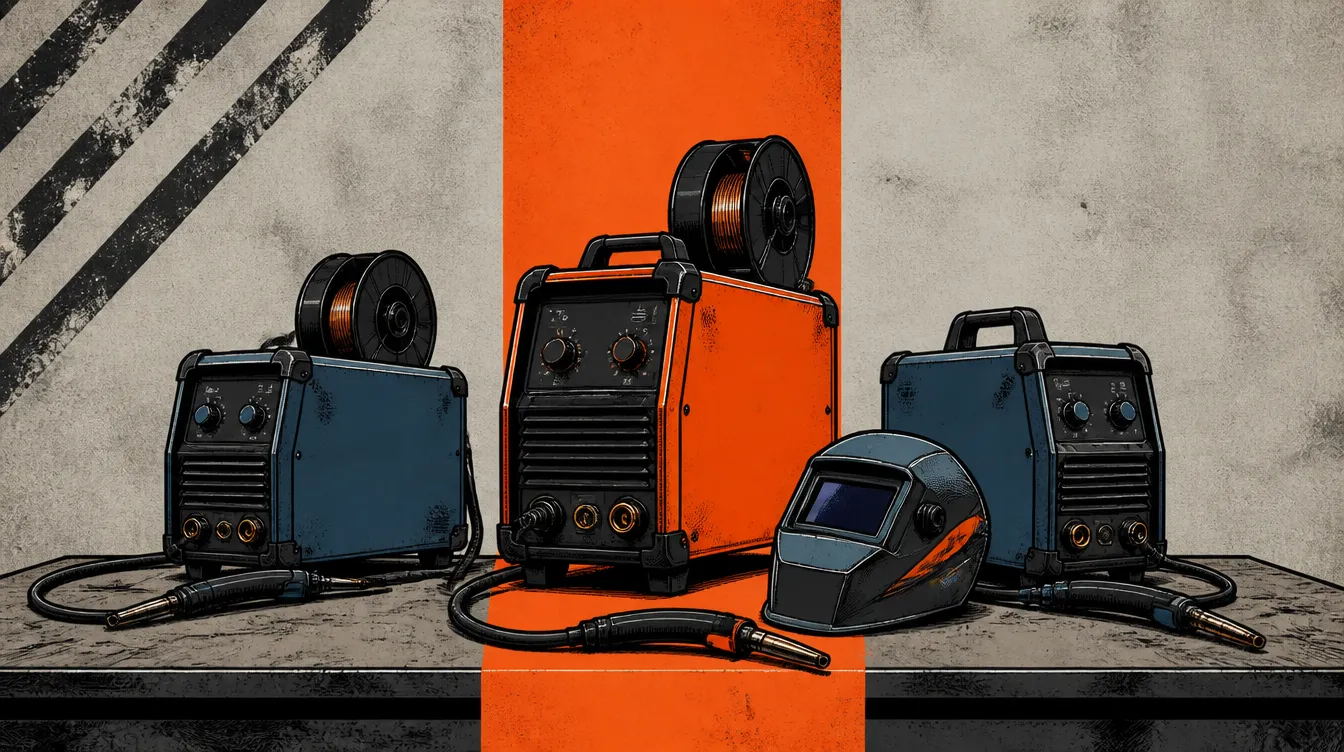
Which MIG Welders Brand Wins?
In our test we compared 7 mig welders options head to head. Lincoln 210 came out on top. See the measured results, the runner-up, the budget pick, and a link to the full test video.

Lincoln 210
Price shown in test: $2,300
Affiliate link. We may earn a commission at no extra cost to you.

Vulcan Omni Pro 220
Price shown in test: $1,150
Affiliate link. We may earn a commission at no extra cost to you.

Yeswelder Mig 205 DS
Price shown in test: $360
Affiliate link. We may earn a commission at no extra cost to you.
The quick take
The short version of why each pick lands where it does, built straight from the measured results.
“the Lincoln finished first in every category except for weld penetration”
Best in 1 of 4 measurements, including Weld break strength.
The measured results
Every number below is read straight from the test. Products are listed in the order they finished.
Amp output at lowest and highest current settings
- 1Lincoln 210
lowest setting 21 to 49 amps; highest setting 281 amps dropping to approximately 208.5 amps after 3 seconds (transcript reads 281 to 208 5 amps); a separate recap sentence states the Lincoln made the most current at 281 amps while the Warcking and Yeswelder tied for second at 211 amps and the Vulcan read 203 amps
- 2Vulcan Omni Pro 220
lowest setting 72 to 105 amps; highest setting started at 257 amps and dropped to 206 amps after 3 seconds (a later recap sentence gives 203 amps for the same reading; both figures recorded, not reconciled)
- 3Yeswelder Mig 205 DS
lowest setting consistent from 59 to 68 amps; highest setting started hot and cooled to 211 amps after 3 seconds (transcript literally reads 2 and 11 amps; corrected to 211 because a later recap sentence independently states the Yeswelder tied for second at 211 amps, so two mentions agree)
- 4Azzuno
lowest setting started at 22 amps and warmed into the 40s; highest setting started at 206 amps and cooled to 196 amps after 3 seconds
- 5Flameweld50 amp
setting varied from 37 to 97 amps; highest setting started at 158 amps and dropped to 151 amps after 3 seconds
- 6Chicago Electric
lowest setting started at 82 amps and dropped to around 67 amps; highest setting started at 151 amps and warmed to 168 amps after 3 seconds
- 7Warcking
lowest setting fluctuated from 41 to 106 amps; highest setting started at 229 amps and dropped to 211 amps after 3 seconds
Weld penetration depth in quarter inch steel plate
- 1Lincoln 2100.185 inches
close second to the Vulcan's 0.188
- 2Vulcan Omni Pro 2200.188 inches
deepest of all seven
- 3Yeswelder Mig 205 DS0.183 inches
third deepest
- 4Azzuno
no measurement given, transcript only says the wire skipped a little during feed but offered a decent weld for the price
- 5Flameweld
no measurement given, narrator says it did not produce enough current for good penetration but still made a nice looking weld
- 6Chicago Electric
no measurement given, wire speed fluctuated quite a bit
- 7Warcking
narrator notes a lot of penetration but inconsistent, no measurement given; narrator says he would throw this one in the trash
Weld break strength
- 1Lincoln 2106349 pounds1st
highest of all seven, moved into first place
- 2Vulcan Omni Pro 220almost6000 pounds
no exact figure given by the narrator
- 3Yeswelder Mig 205 DS5143 pounds
- 4Azzuno6133 pounds
led the strength test at the point it was tested (higher than Vulcan's approximate figure, though the narrator's final composite verdict still ranked Vulcan and Lincoln above it)
- 5Flameweld5972 pounds
- 6Chicago Electric4759 pounds
described as a little below average
- 7Warcking3743 pounds
weakest of the seven
Thin 20 gauge sheet metal weldability
- 1Lincoln 210
not clearly attributed to this brand in the transcript, see videoNotes
- 2Vulcan Omni Pro 220
not clearly attributed to this brand in the transcript, see videoNotes
- 3Yeswelder Mig 205 DS
not clearly attributed to this brand in the transcript, see videoNotes
- 4Azzuno
current range of 22 to 58 amps on lowest setting gave it a big advantage on thin material, held up well if kept moving
- 5Flameweld
ran way too hot even on the lowest setting, burned straight through, not suited for thin material
- 6Chicago Electric
not well designed for welding thin material per the narrator
- 7Warcking
ran way too hot on the lowest setting to lay down a good weld without burning through
5 minute sustained current test
- 1Lincoln 210
started at 160 amps, dropped to around 145 amps by the 5 minute mark, finished the full test
- 2Vulcan Omni Pro 220
held at 160 amps for the first three minutes, dropped to 144 amps for the final two minutes, finished the full test
- 3Yeswelder Mig 205 DS
started at 156 amps, dropped to around 147 amps at 3 minutes, finished at 5 minutes at 133 amps
- 4Azzunoclose to160 amps
after a minute, best of all seven at that point, stayed close to 123 amps for the rest of the five minutes, finished
- 5Flameweld
set for 165 amps but only produced 100 amps after two minutes, stayed around 85 amps for the rest of the test
- 6Chicago Electricaround127 amps
after a minute, dropped to about 100 amps after two minutes, overheated and shut down at 3 minutes 43 seconds, did not finish
- 7Warcking
held around 160 amps for the first two minutes, dropped to 155 then 144 amps by four minutes, shut down at 4 minutes 52 seconds without finishing
How it was tested
- amp output at lowest and highest current settings (0.035 flux core wire, 3 second reading)
- weld penetration depth in quarter inch steel plate (0.035 solid wire, argon CO2 shielding gas)
- weld break strength (0.035 flux core, quarter inch beveled plate, two pass cap weld)
- thin 20 gauge sheet metal weldability (0.03 inch flux core wire, 120 volt outlet)
- 5 minute sustained current test at approximately 160 amps target
“the Lincoln finished first in every category except for weld penetration”
Data notes and caveats
Seven MIG welders compared: Lincoln, Vulcan, Yeswelder, Azzuno, Flameweld, Chicago Electric and Warcking, all resolved against the description's Products Tested affiliate link list. Two conflicting readings kept as-is rather than guessed: the Vulcan's highest-setting 3 second current reads both 206 and 203 amps in different parts of the transcript. The Yeswelder's garbled 2 and 11 amps figure was corrected to 211 amps because an independent recap sentence elsewhere states the same 211 figure for that brand. The thin 20 gauge sheet metal test is clearly attributed for only four of the seven brands (Flameweld, Chicago Electric, Azzuno, Warcking); the final two ambiguous paragraphs of that section, which line up with the meta chapter titled Will Not Weld 22 Gauge, describe a welder that struggles on 22 gauge metal but the transcript never names which of Yeswelder, Vulcan or Lincoln it refers to, so it was left unassigned rather than guessed. The narrator gives two distinct budget style recommendations at the end for different audiences: Yeswelder as the best buy for a budget conscious buyer (about $360) and Azzuno as the best pure value pick (about $250); Yeswelder was recorded as budgetPick since it directly answers the video's own budget framing, with the Azzuno value pick noted here. The full 1 through 7 product ranking is not stated verbatim by the narrator; it was inferred by combining his explicit statements (Lincoln first in every category but penetration, Vulcan barely ahead of Yeswelder, Warcking called the worst and thrown in the trash, Chicago Electric called a little below average, Flameweld called surprisingly good for the price) with the largely complete break-strength numbers, which do not perfectly agree with that ordering (Azzuno's 6133 pound strength figure is actually higher than the Vulcan's approximate almost-6000 figure).