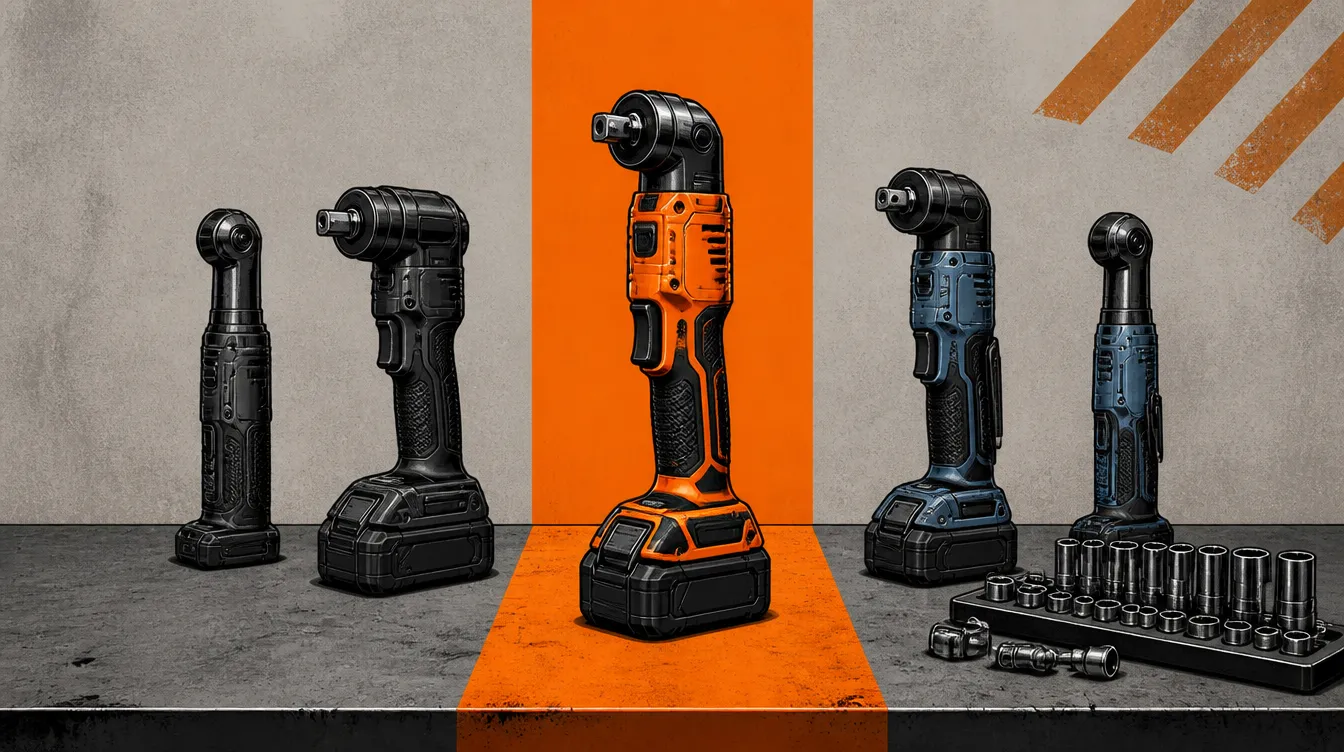
Which Cordless Right Angle Impact Wrenches (and Battery Ratchets) Brand Wins?
This head-to-head test of 9 cordless right angle impact wrenches (and battery ratchets) options has the measured results for each. See how they ranked and watch the full test video.

Skil
Price shown in test: $100 (for the impact wrench, battery, and charger together)
Affiliate link. We may earn a commission at no extra cost to you.
The measured results
Every number below is read straight from the test. Products are listed in the order they finished.
Weight
- 1Milwaukee M12 battery ratchet1 lb
7.9 oz / 678 g (lightest of all tools compared in the weight factor recap at 23.9 oz)
- 2Milwaukee M12 1/4in right angle impact wrench2 lb
3.1 oz / 996 g (35.1 oz per the weight factor recap)
- 3Skil2 lb
7.6 oz / 1,124 g (39.7 oz per the weight factor recap)
- 4Kobalt 24V ratchet, 3/8in drive3 lb
1.2 oz / 1,397 g
- 5Kobalt 24V right angle impact wrench, 3/8in drive3 lb
6.8 oz / 1,556 g
- 6Milwaukee M18 (two-speed, 3/8in right angle impact)2 lb
7.6 oz / 1,123 g (39.6 oz per the weight factor recap)
- 7Milwaukee M12 Fuel (3/8in right angle impact with friction ring)2 lb
13.8 oz / 1,301 g
- 8Makita40.1 oz
per the weight factor recap
- 9Ingersoll Rand3 lb
10.6 oz / 1,663 g, heaviest tool of the entire test
Head size
- 1Milwaukee M12 battery ratchet29.7
by 31.42 mm (smallest head diameter and depth of all tools tested)
- 2Milwaukee M12 1/4in right angle impact wrench38.1
by 56.8 mm
- 3Skil5 mm
larger diameter and nearly 10 mm longer front-to-back than the 1/4in Milwaukee
- 4Kobalt 24V ratchet, 3/8in drive40.4
by 45.59 mm
- 5Kobalt 24V right angle impact wrench, 3/8in drive57.96
by 77.81 mm (nearly twice as large as the Milwaukee ratchet)
- 6Milwaukee M18 (two-speed, 3/8in right angle impact)38.08
by 58.28 mm (2nd most compact head of the lineup)
- 7Milwaukee M12 Fuel (3/8in right angle impact with friction ring)58.93
by 71.85 mm (described as pretty large)
- 8Makita35.69
by 58.1 mm, described as designed for tight spaces
- 9Ingersoll Rand54.11
by 72.05 mm
Noise
- 1Milwaukee M12 battery ratchet79.4 dB
measured 24in away
- 2Milwaukee M12 1/4in right angle impact wrench71.2 dB
(nearly as quiet as the M18, the two quietest impacts of the lineup)
- 3Skil79 dB
(8 dB louder than the 1/4in Milwaukee impact)
- 4Kobalt 24V ratchet, 3/8in drive86 dB
(loudest tool of the entire test)
- 5Kobalt 24V right angle impact wrench, 3/8in drive81.8 dB2nd
(2nd loudest tool of the test)
- 6Milwaukee M18 (two-speed, 3/8in right angle impact)71.1 dB
(quietest tool of the entire test)
- 7Milwaukee M12 Fuel (3/8in right angle impact with friction ring)79.1 dB
- 8Makita75 dB
quieter than average
- 9Ingersoll Rand78.7 dB
a little louder than average
No-load RPM range
- 1Milwaukee M12 battery ratchet22
to 485 (would not spin slower than 22 rpm without stalling)
- 2Milwaukee M12 1/4in right angle impact wrench73
to 2,378 (measured, versus 0 to 2,425 claimed)
- 3Skil156
to 2,650 (worse low-rpm control than the Milwaukee's 73 rpm floor)
- 4Kobalt 24V ratchet, 3/8in drive22.6
to 235 (nearly as slow-spinning as the Milwaukee ratchet)
- 5Kobalt 24V right angle impact wrench, 3/8in drive285
to 1,964
- 6Milwaukee M18 (two-speed, 3/8in right angle impact)170
to 2,051
- 7Milwaukee M12 Fuel (3/8in right angle impact with friction ring)180
to 2,818 (fastest spinning tool of the entire lineup)
- 8Makita81
to 1,833 (best low-rpm control of the lineup per the narrator)
- 9Ingersoll Rand215
to 1,719
Screw driving speed (5in wood screws)
- 1Milwaukee M12 battery ratchet26.1s
25.4s, 25.4s (no explicit average stated)
- 2Milwaukee M12 1/4in right angle impact wrench15.97s
20.1s, 20.7s, average 18.9 seconds
- 3Skil9.4s
11.2s, 11.2s; final leaderboard lists 10.6 seconds average, finishing 4th of the 4 ranked in that recap (Milwaukee M12 Fuel, Kobalt impact, Ingersoll Rand, Skil)
- 4Kobalt 24V ratchet, 3/8in drive23.64s
23.3s, 22.1s, average 23 seconds (about 2.5 seconds faster than the Milwaukee ratchet)
- 5Kobalt 24V right angle impact wrench, 3/8in drive8.0s2nd
9.01s, 9.4s; final leaderboard lists 8.9 seconds average, 2nd of 4 ranked
- 6Milwaukee M18 (two-speed, 3/8in right angle impact)16.8s
19.4s, 19.4s (individual times only; not included in the final 4-way screw-speed leaderboard recap)
- 7Milwaukee M12 Fuel (3/8in right angle impact with friction ring)6.74s1st
7.04s, 7.86s, average 7.2 seconds, first place; narrator calls it 'a torque monster'
- 8Makita19.16s
21.35s, 22.5s (individual times only, no average given; not included in the final screw-speed leaderboard recap)
- 9Ingersoll Rand9.2s3rd
9.89s, 10.9s, average 10 seconds, 3rd place, 'fast enough to move into third position'
Lug nut installation speed (free driving)
- 1Milwaukee M12 battery ratchet1 minute 16 seconds
- 2Milwaukee M12 1/4in right angle impact wrench
not stated as an exact number for this tool; the transcript only says the M18 finished in 30.5s, 'a fraction of a second slower than the 1/4in Milwaukee and the SKIL,' implying this tool's own time was marginally faster than 30.5s but no digit is given
- 3Skil
not given as an exact digit; only that the M18 finished 'a fraction of a second slower than the 1/4in Milwaukee and the SKIL' at 30.5s
- 4Kobalt 24V ratchet, 3/8in drive1 minute 35 seconds
by far the slowest of all tools in this test; narrator notes it reacts strongly when a lug nut runs out of threads
- 5Kobalt 24V right angle impact wrench, 3/8in drive32.1 seconds
only 2 seconds slower than the Milwaukee and Skil; narrator notes a small delay between trigger pull and tool response
- 6Milwaukee M18 (two-speed, 3/8in right angle impact)30.5 seconds
'a fraction of a second slower than the 1/4in Milwaukee and the SKIL;' narrator praises very responsive electronics
- 7Milwaukee M12 Fuel (3/8in right angle impact with friction ring)30.7 seconds
narrator notes he made a small error on the last lug nut which slowed this tool down
- 8Makita31.3 seconds
narrator praises great electronics and instant trigger response despite the lower no-load rpm
- 9Ingersoll Rand34.7 seconds
slowest of the powered tools in this particular test; narrator notes trigger response is not as immediate as most other brands
Loosening torque test
- 1Milwaukee M12 battery ratchet25 PSI
barely moved the needle again
- 2Milwaukee M12 1/4in right angle impact wrench300 PSI
before running out of time
- 3Skil750 PSI4th
(finished 4th of 5 in the final ranking)
- 4Kobalt 24V ratchet, 3/8in drive450 PSI
- 5Kobalt 24V right angle impact wrench, 3/8in drive1,550 PSI2nd
(finished 2nd of 5, moved ahead of the Skil)
- 6Milwaukee M18 (two-speed, 3/8in right angle impact)525 PSI5th
(lowest, 5th of 5)
- 7Milwaukee M12 Fuel (3/8in right angle impact with friction ring)2,000 PSI1st
first place overall, 'very impressive'
- 9Ingersoll Rand1,025 PSI3rd
- 8Makitanot tested
50 ft-lb lug nut breakaway
- 1Milwaukee M12 battery ratchet
did not make enough torque to break the lug nut loose
- 2Milwaukee M12 1/4in right angle impact wrenchabout1.5 seconds
- 3Skil
about half a second, fastest at that point in the sequence
- 5Kobalt 24V right angle impact wrench, 3/8in drive
fastest at that point in the sequence (qualitative, no exact time given)
- 6Milwaukee M18 (two-speed, 3/8in right angle impact)
just over a second
- 7Milwaukee M12 Fuel (3/8in right angle impact with friction ring)
even faster than the Kobalt
- 8Makitaabout1.3 seconds
- 9Ingersoll Rand
very fast (qualitative only, no time given)
- 4Kobalt 24V ratchet, 3/8in drivenot tested
All measurements (10 more)+
Claims
- 2Milwaukee M12 1/4in right angle impact wrench0
to 2,425 rpm, 0 to 3,300 impacts per minute, 600 in-lbs fastening torque; brushed motor
- 3Skil
brushless 12V system with Power Core 12 battery technology; claims 900 in-lbs torque (versus the 1/4in Milwaukee's claimed 600); 0 to 2,700 rpm, 0 to 3,750 impacts per minute; charges 0-25% in 5 minutes, 100% in 45 minutes
- 4Kobalt 24V ratchet, 3/8in drive
no-load speed up to 250 rpm; brushless motor; 55 ft-lbs torque; manual hand-torque mode up to 150 ft-lbs; LED light
- 5Kobalt 24V right angle impact wrench, 3/8in drive
brushless motor; maximum torque 180 ft-lbs; 0 to 2,000 rpm; up to 3,400 impacts per minute; impact assembly located at the head of the tool
- 6Milwaukee M18 (two-speed, 3/8in right angle impact)up to60 ft-lbs
of torque (notably the lowest torque spec of the powered impact wrenches tested, per the transcript as stated); 0 to 2,250 rpm; up to 3,400 impacts per minute; includes LED light; head diameter stated separately as 'right at 1.4 in'
- 7Milwaukee M12 Fuel (3/8in right angle impact with friction ring)up to220 ft-lbs
of 'nut busting torque'; brushless motor; 3 modes, highest mode up to 3,000 rpm; battery level indicator; LED light; impact assembly located at the head of the tool
- 8Makita3/8in
drive, brushed motor, 0 to 2,000 rpm, 0 to 3,000 impacts per minute, LED light, compact 2 1/4in head, delivers up to 44 ft-lbs of torque (the lowest torque spec of all impact wrenches tested), long ergonomic body for maximum reach
- 9Ingersoll Randup to1,900 rpm
180 ft-lbs of reactionless torque; brushed motor; long-life 20V lithium ion battery with high charge capacity and low internal impedance; no light included; impact assembly located at the head of the tool
- 1Milwaukee M12 battery ratchetnot tested
Made in
- 2Milwaukee M12 1/4in right angle impact wrench
China
- 3Skil
China
- 4Kobalt 24V ratchet, 3/8in drive
China
- 5Kobalt 24V right angle impact wrench, 3/8in drive
China
- 6Milwaukee M18 (two-speed, 3/8in right angle impact)
China
- 7Milwaukee M12 Fuel (3/8in right angle impact with friction ring)
China
- 8Makita
Japan (the only tool in the lineup not made in China)
- 9Ingersoll Rand
battery made in Taiwan, impact wrench made in China
- 1Milwaukee M12 battery ratchetnot tested
Tightening torque test
- 2Milwaukee M12 1/4in right angle impact wrench325 PSI
- 3Skil815 PSI4th
(took the lead over the Milwaukee impacts at that point in testing; finished 4th of 5 in the final ranking)
- 4Kobalt 24V ratchet, 3/8in drive350 PSI
- 5Kobalt 24V right angle impact wrench, 3/8in drive1,625 PSI2nd
(nearly twice the Skil; finished 2nd of 5 in the final ranking)
- 6Milwaukee M18 (two-speed, 3/8in right angle impact)500 PSI5th
(lowest of the 5 ranked impacts, 5th of 5)
- 7Milwaukee M12 Fuel (3/8in right angle impact with friction ring)2,100 PSI1st
first place overall, 'moves into first place over the Kobalt... very impressive'
- 8Makita305 PSI
very low, consistent with its low 44 ft-lb torque spec
- 9Ingersoll Rand1,075 PSI3rd
'good enough to move into third place behind the Kobalt'
- 1Milwaukee M12 battery ratchetnot tested
100 ft-lb lug nut breakaway
- 2Milwaukee M12 1/4in right angle impact wrench
unable to remove the lug nut
- 3Skil2 seconds
- 5Kobalt 24V right angle impact wrench, 3/8in drive
less than half a second
- 6Milwaukee M18 (two-speed, 3/8in right angle impact)
unable to remove the lug nut
- 7Milwaukee M12 Fuel (3/8in right angle impact with friction ring)
even faster than the Kobalt, succeeded
- 8Makita
too much for the Makita, could not remove it
- 9Ingersoll Rand
about half a second
- 1Milwaukee M12 battery ratchetnot tested
- 4Kobalt 24V ratchet, 3/8in drivenot tested
Average finish ranking (5-way, size not a factor)
- 3Skil3.253rd
(3rd of 5)
- 5Kobalt 24V right angle impact wrench, 3/8in drive3.02nd
(2nd of 5)
- 6Milwaukee M18 (two-speed, 3/8in right angle impact)4.5
(5th/last of 5 on raw average finish)
- 7Milwaukee M12 Fuel (3/8in right angle impact with friction ring)1.751st
first place overall on raw average finish
- 9Ingersoll Rand4.04th
(4th of 5)
- 1Milwaukee M12 battery ratchetnot tested
- 2Milwaukee M12 1/4in right angle impact wrenchnot tested
- 4Kobalt 24V ratchet, 3/8in drivenot tested
- 8Makitanot tested
150 ft-lb lug nut breakaway
- 3Skil
too much for the Skil, could not remove it
- 5Kobalt 24V right angle impact wrench, 3/8in drive
made very easy work of removing the lug nut
- 7Milwaukee M12 Fuel (3/8in right angle impact with friction ring)
made very easy work of the lug nut, succeeded
- 9Ingersoll Rand
needed a few extra seconds but got the job done
- 1Milwaukee M12 battery ratchetnot tested
- 2Milwaukee M12 1/4in right angle impact wrenchnot tested
- 4Kobalt 24V ratchet, 3/8in drivenot tested
- 6Milwaukee M18 (two-speed, 3/8in right angle impact)not tested
- 8Makitanot tested
3-way lag bolt head-to-head (8in lag bolts)
- 5Kobalt 24V right angle impact wrench, 3/8in drive
beat the Ingersoll Rand 38s to 47s; lost to the Milwaukee M12 Fuel 40s to 23s
- 7Milwaukee M12 Fuel (3/8in right angle impact with friction ring)
beat the Kobalt impact 23s to 40s, described as 'by far the fastest'
- 9Ingersoll Rand
lost to the Kobalt impact 47s to 38s
- 1Milwaukee M12 battery ratchetnot tested
- 2Milwaukee M12 1/4in right angle impact wrenchnot tested
- 3Skilnot tested
- 4Kobalt 24V ratchet, 3/8in drivenot tested
- 6Milwaukee M18 (two-speed, 3/8in right angle impact)not tested
- 8Makitanot tested
Note on price
- 1Milwaukee M12 battery ratchet
no price stated in the transcript for this ratchet specifically
- 2Milwaukee M12 1/4in right angle impact wrenchnot tested
- 3Skilnot tested
- 4Kobalt 24V ratchet, 3/8in drivenot tested
- 5Kobalt 24V right angle impact wrench, 3/8in drivenot tested
- 6Milwaukee M18 (two-speed, 3/8in right angle impact)not tested
- 7Milwaukee M12 Fuel (3/8in right angle impact with friction ring)not tested
- 8Makitanot tested
- 9Ingersoll Randnot tested
Tightening torque test (hydraulic gauge, 15 sec)
- 1Milwaukee M12 battery ratchet
barely moved the needle past zero
- 2Milwaukee M12 1/4in right angle impact wrenchnot tested
- 3Skilnot tested
- 4Kobalt 24V ratchet, 3/8in drivenot tested
- 5Kobalt 24V right angle impact wrench, 3/8in drivenot tested
- 6Milwaukee M18 (two-speed, 3/8in right angle impact)not tested
- 7Milwaukee M12 Fuel (3/8in right angle impact with friction ring)not tested
- 8Makitanot tested
- 9Ingersoll Randnot tested
Battery note
- 9Ingersoll Rand
uses a 2.5 amp hour battery, versus the 2 amp hour batteries used on all other tools in this test
- 1Milwaukee M12 battery ratchetnot tested
- 2Milwaukee M12 1/4in right angle impact wrenchnot tested
- 3Skilnot tested
- 4Kobalt 24V ratchet, 3/8in drivenot tested
- 5Kobalt 24V right angle impact wrench, 3/8in drivenot tested
- 6Milwaukee M18 (two-speed, 3/8in right angle impact)not tested
- 7Milwaukee M12 Fuel (3/8in right angle impact with friction ring)not tested
- 8Makitanot tested
How it was tested
- maximum tightening torque (hydraulic ram gauge, 15 second test, reported in PSI)
- maximum loosening torque (same hydraulic rig with a left-hand threaded bolt, reported in PSI)
- speed driving 5in wood screws under load (3 attempts each)
- 3-way head-to-head race driving 8in lag bolts among the three fastest impact wrenches (Milwaukee M12 Fuel, Kobalt, Ingersoll Rand)
- speed installing lug nuts freely (not torqued), a qualitative/less-scientific comparison
- breakaway torque removing lug nuts torqued to 50, then 100, then 150 ft-lb
- no-load RPM range (minimum controllable speed to maximum speed)
- noise level (dB) measured 24in from the tool
- weight, head diameter, and front-to-back head depth measurements
Brand head-to-head scoreboards featuring this test
Data notes and caveats
This video declares two different conditional winners rather than one universal winner, matching the per-use-case-favorites pattern: (1) on the raw 5-way average-finish ranking across torque, speed, and lug-nut tests ('if tool size is not a factor'), the Milwaukee M12 Fuel came out on top at an average finish of 1.75, with Kobalt impact 2nd (3.0), Skil 3rd (3.25), Ingersoll Rand 4th (4.0), and Milwaukee M18 5th (4.5); (2) once weight, noise, head diameter, and low-rpm control are factored in, the narrator explicitly states 'the Milwaukee M18 came out on top, but it was a very tight race among the top four finishers.' A third, separate value/budget recommendation calls out the Skil brand for its price-to-performance ratio. Per the extraction rule against forcing a single winner onto per-use-case conclusions, winner is left null here with both conditional verdicts and the value pick preserved above and in the affected products' own notes. All three brands able to break loose a lug nut torqued to 150 ft-lb (Milwaukee M12 Fuel, Kobalt impact, Ingersoll Rand) share the same impact-assembly-at-the-head design, which the narrator credits directly for the extra torque. Two ratchets (Milwaukee, Kobalt) are included as a separate baseline comparison against the impact wrenches; both ratchets lacked enough torque to break loose even the 50 ft-lb lug nut in powered mode. Makita is missing from the final 5-way average-finish ranking table despite being tested throughout every other metric; this gap is flagged rather than resolved. No brand-name transcription/mangling issues occurred in this video; all names matched the description's Products Tested list cleanly throughout, and chapters map to each brand's individual test section.