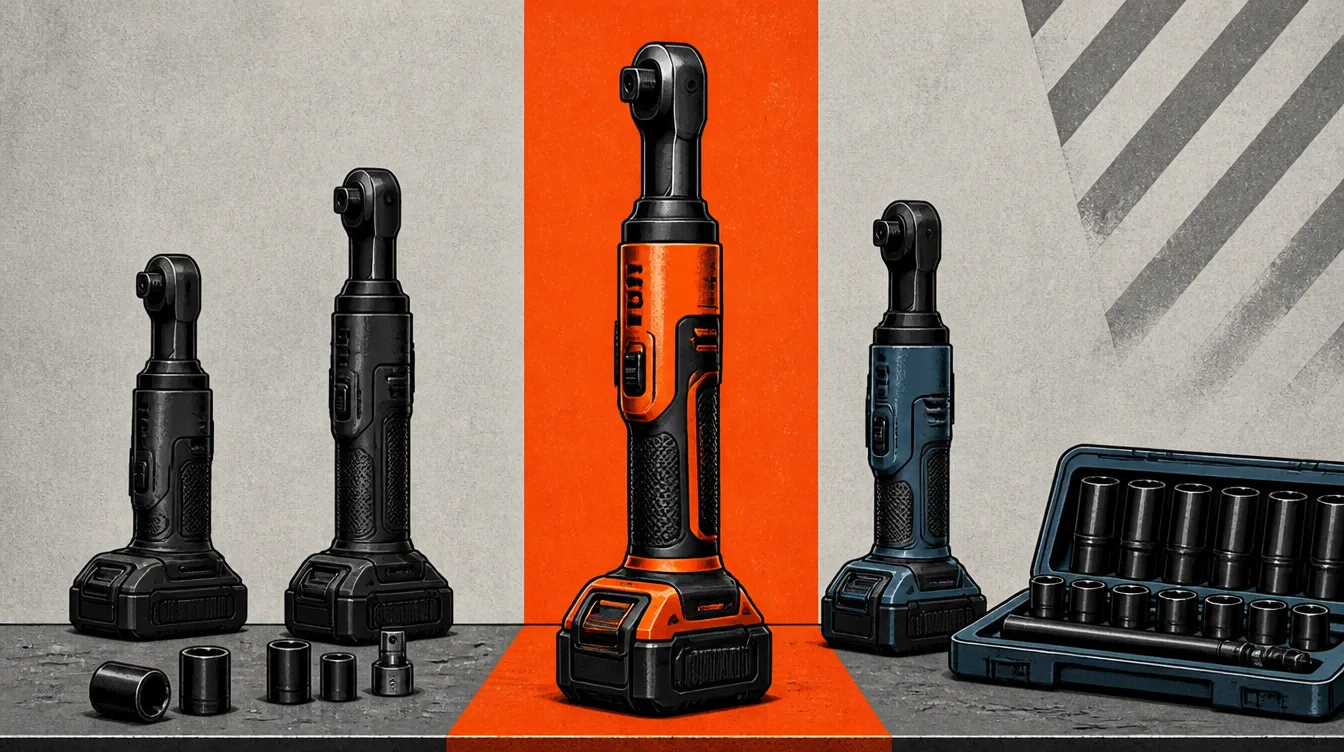
Which Cordless Ratchets Brand Wins?
In our test we compared 6 cordless ratchets options head to head. Ryobi came out on top. See the measured results, the runner-up, the budget pick, and a link to the full test video.

Ryobi
Price shown in test: $90
Affiliate link. We may earn a commission at no extra cost to you.

Husky
Price shown in test: $60
Affiliate link. We may earn a commission at no extra cost to you.
The quick take
The short version of why each pick lands where it does, built straight from the measured results.
“I really like the Robi quite AIT in my opinion it did the best overall”
Placed top three in 1 of 12 measurements.
Placed top three in 1 of 12 measurements.
The measured results
Every number below is read straight from the test. Products are listed in the order they finished.
Specs
- 1Husky3/8in
drive, battery powered or manual operation, variable speed up to 230 RPM, built-in battery, includes carrying case, made in China, has LED light (not very bright), battery level indicator, trigger lock
- 2Ryobi18V
3/8in ratchet kit, up to 35 ft-lb of torque, four position rotating head, dual LEDs, 230 RPM, 1.5 Ah battery, made in China, no battery level indicator, has trigger lock
- 3ACDelco
made in Taiwan, 2 Ah battery, has trigger lock, no battery level indicator, LED not quite as bright as Ryobi or Husky; the transcript's trigger-style sentence is internally contradictory, stating both that Husky and Ryobi use paddle triggers while AC Delco uses a button 'just like the Robi and the Husky', which cannot both be true as captioned, kept verbatim and flagged rather than resolved
- 4Ingersoll Rand12V
tool and battery, battery made in Taiwan, charger made in China, 2 Ah battery, brushed motor, has a battery level indicator (unlike every other brand tested), no trigger lock (the only brand tested without one), LED brighter than AC Delco but not as bright as Ryobi
- 5Milwaukee
comes with two 2 Ah batteries, LED described as seeming like the best of the lineup, has trigger lock, has battery level indicator, brushless motor (confirmed later alongside AC Delco), made in China
- 6Snap-on14.4V
microlithium cordless kit, manufacturer-claimed maximum torque of 40 ft-lb and 275 RPM, designed and engineered by Snap-on and assembled in the US with US and imported components (the only US-assembled brand tested), brushed motor (explicitly contrasted with the cheaper, brushless Milwaukee), comes with two 2.5 Ah batteries (largest battery capacity in the lineup), no trigger lock, no battery level indicator, LED described as pretty bright
Weight (g)
- 1Husky977g
total (2 lb 2.5 oz); 578 front, 484 back (front+back does not sum to the stated total, kept verbatim, same non-summing pattern recurs for every brand in this video)
- 2Ryobi1441g
total (3 lb 2.8 oz); 705 front, 822 back
- 3ACDelco
captioned as '2 lb 13.9 oz' and '131 G' in the same sentence, which are inconsistent (2 lb 13.9 oz is roughly 1310g, not 131g, almost certainly a dropped digit); the closing weight recap independently states 'AC Dela 1,31', consistent with approximately 1310 to 1315g, used here as the better-supported figure while the literal 131g caption is flagged, not silently discarded; 843 front, 542 back
- 4Ingersoll Rand998g
total (2 lb 3.2 oz); 484 front, 601 back
- 5Milwaukee1285g
total (2 lb 13.4 oz); 859 front, 512 back
- 6Snap-on1163g
total (2 lb 9 oz); 77 front (verbatim as captioned; implausibly light next to every other brand's front-weight reading of roughly 480 to 860g, almost certainly a dropped digit such as 770, not corrected), 542 back
Size Side To Side (mm)
- 1Husky3.91mm
(verbatim as captioned; implausibly small next to every other brand's 28 to 45mm range, almost certainly 39.1mm with a misplaced decimal, not corrected)
- 2Ryobi29.75mm
most compact tool at that point in the video
- 3ACDelco4.38mm
(verbatim as captioned; implausibly small next to every other brand's 28 to 45mm range, almost certainly 43.8mm with a misplaced decimal, not corrected)
- 4Ingersoll Randapproximately28.43mm
called the most compact tool yet at that point in the video; the front-to-back figure and a stated 200 RPM max spec are merged into an unreadable run of digits in the transcript ('28.432177 Tor 200 RPM'), a clear caption garble; front-to-back size not recoverable
- 5Milwaukee40.3mm
- 6Snap-on32.59mm
more compact than Milwaukee and Ryobi from side to side
Noise (dB)
- 1Husky83dB
- 2Ryobi
not stated anywhere in the transcript, unlike Husky, AC Delco, Milwaukee, and Snap-on, an apparent gap
- 3ACDelco88dB
called the loudest yet at that point in the video (later brands top this figure)
- 4Ingersoll Rand
not stated anywhere in the transcript, unlike Husky, AC Delco, Milwaukee, and Snap-on, an apparent gap
- 5Milwaukee89dB
called the loudest tool of all six brands; described as just not very compact
- 6Snap-on87dB
described as pretty loud
Low RPM Control
- 1Husky147 RPM
minimum, described as not very good low RPM control; 419 RPM max
- 2Ryobi42 RPM
minimum, described as very good low RPM control; 457 RPM max
- 3ACDelco48 RPM
minimum, described as pretty good low RPM control; 294 RPM max
- 4Ingersoll Rand14 RPM
minimum, described as the best low RPM control of all six brands; 381 RPM max
- 5Milwaukee41 RPM
minimum, described as good low RPM control; 321 RPM max
- 6Snap-on25 RPM2nd
minimum, described as the second best low RPM control of all six brands; 407 RPM max
Trigger Delay Bracket 1 Result
- 1Husky
lost to Ryobi in the head to head (Ryobi faster off the line and faster to stop); finished sixth (last) in this bracket's final tally
- 2Ryobi
beat Husky (faster off the line, faster to stop); finished third of six in this bracket's final tally
- 3ACDelco
narrowly beat Ryobi off the line and at stopping, beat Ingersoll Rand, tied Milwaukee (narrator says the less expensive AC Delco 'will advance' from that tie), beat Snap-on; the bracket's final tally lists AC Delco and Milwaukee 'tied for first', which sits oddly against the earlier 'AC Delco will advance' phrasing from their tied matchup, both statements kept verbatim and flagged as an internal contradiction rather than resolved one way
- 4Ingersoll Rand
lost to AC Delco; finished fifth of six in this bracket's final tally
- 5Milwaukee
tied with AC Delco; see the AC Delco entry for the transcript's internally contradictory phrasing about whether AC Delco 'advances' from the tie or the two are tied for first
- 6Snap-on
beat AC Delco (edged it out both starting and stopping); finished fourth of six in this bracket's final tally
Lug Nut Spin Time (sec)
- 1Husky79sec
(1 minute 19 seconds); finished fourth of six in the final timed ranking
- 2Ryobi73sec
(1 minute 13 seconds), the fastest time of all six brands in this test
- 3ACDelco113sec
(1 minute 53 seconds), the slowest time of all six brands in this test
- 4Ingersoll Rand76sec2nd
(1 minute 16 seconds), second fastest of six
- 5Milwaukee110sec
(1 minute 50 seconds), fifth of six
- 6Snap-on78sec3rd
(1 minute 18 seconds), third fastest of six
Side By Side Bracket 2 Result
- 1Husky
finished fourth of six in this second live elimination bracket's final tally
- 2Ryobi
beat AC Delco 3 wins to 0, beat Ingersoll Rand narrowly, beat Milwaukee 3 wins to 0, but lost to Snap-on 0 wins to 3; finished second of six in this bracket's final tally
- 3ACDelco
finished sixth (last) of six in this bracket's final tally
- 4Ingersoll Rand
finished third of six in this bracket's final tally
- 5Milwaukee
finished fifth of six in this bracket's final tally
- 6Snap-on
beat Ryobi 3 wins to 0, the only brand to beat Ryobi in this bracket; finished first (fastest) of six in this bracket's final tally
All measurements (9 more)+
Stall Resistance Rotations 7 2 Ftlb 30 S
- 1Husky41
struggled and stalled out several times, motor got pretty hot by the end
- 2Ryobi53
slowed down noticeably under load but never stalled out
- 3ACDelco71
performed very well, credited to a much lower no-load speed; an accurate internal component temperature reading could not be captured because the plastic housing blocked the sensor
- 4Ingersoll Rand12
the worst of all six brands; really struggled to get up to speed but survived the test without stalling out completely
- 5Milwaukee76
the best of all six brands; took a couple of tries to get going but performed best once up to speed
- 6Snap-on142nd
second worst of all six brands, really struggled and never got up to speed
Max Working Torque (ft-lb)
- 1Husky16.3ft-lb
finished fifth of six
- 2Ryobi23.1ft-lb
finished third of six
- 3ACDelco23.6ft-lb
narrowly beat Ryobi's 23.1, finished second of six
- 4Ingersoll Rand11.7ft-lb
the worst of all six brands, gave up before making much progress
- 5Milwaukee29.4ft-lb
the best of all six brands, took the lead from AC Delco
- 6Snap-on22.1ft-lb
fourth of six, notably below its own manufacturer-claimed 40 ft-lb spec and behind three cheaper brands (Milwaukee, AC Delco, Ryobi)
Breakaway Torque Test 73 8 To 74 Ftlb
- 1Husky
short handle but held up just fine removing the nut
- 2Ryobi
longer handle offered more leverage, no problem removing the lug nut
- 3ACDelco
handle is quite a bit longer, offering more leverage, held up just fine
- 4Ingersoll Rand
much shorter handle and a lot less leverage than AC Delco, took more effort, but held up just fine
- 5Milwaukee
long handle offered plenty of leverage, narrator says it 'definitely seems built for this', held up just fine
- 6Snap-on
held up just fine
No Load Temp 10 Min (°F)
- 1Husky130°F
- 2Ryobi150°F
- 3ACDelco160°F
- 4Ingersoll Randapproximately130°F
(captioned as very close to 130)
- 5Milwaukee145°F
- 6Snap-on205°F
by far the hottest of all six brands at the 10 minute mark; continued to heat up until it was visibly smoking, requiring fans to keep it running for the rest of the test
No Load Runtime (min)
- 1Husky42.3min
(42 minutes 19 seconds); finished fifth of six
- 2Ryobi43.8min
(43 minutes 43 seconds), the longest battery run time of all six brands
- 3ACDelco22.2min
(22 minutes 19 seconds), the shortest battery run time of all six brands, first to run out of juice
- 4Ingersoll Rand35.8min3rd
(35 minutes 50 seconds), third longest of six
- 5Milwaukee23.3min2nd
(23 minutes 15 seconds), second shortest of six; one of the two brushless-motor brands to run out first
- 6Snap-on26min3rd
(just under 26 minutes), third shortest of six
Recharge Time (min)
- 1Husky64.5min3rd
(64 minutes 30 seconds); third fastest of six
- 2Ryobi54min2nd
second fastest of six
- 3ACDelco94min
the slowest of all six brands by about 25 minutes
- 4Ingersoll Rand69.5min2nd
(69 and a half minutes), second slowest of six
- 5Milwaukee39min
the fastest of all six brands
- 6Snap-on67min4th
fourth fastest of six
Size Front To Back (mm)
- 1Husky33.8mm
- 2Ryobi
not recoverable; the transcript merges this figure with AC Delco's torque/RPM spec into an unreadable run of digits ('31.399839 Max torque 65 ft-lb 0 to 220 RPM'), a clear caption garble rather than an omission
- 3ACDelco42.74mm
- 5Milwaukee40.86mm
- 6Snap-on45.4mm
the least compact of all six brands front to back
- 4Ingersoll Randnot tested
Brand Resolution
- 3ACDelco
captioned as AC Delo, AC Dela, and AC duckco throughout; resolved to ACDelco via the description
- 4Ingersoll Rand
captioned as ingresa Rand, ingr saww Rand, Ina Rand, angera Rand, anrol Rand, and Ina ran across the video; resolved to Ingersoll Rand via the description
- 1Huskynot tested
- 2Ryobinot tested
- 5Milwaukeenot tested
- 6Snap-onnot tested
Balance
- 3ACDelco
described as definitely not as balanced as some of the other brands
- 1Huskynot tested
- 2Ryobinot tested
- 4Ingersoll Randnot tested
- 5Milwaukeenot tested
- 6Snap-onnot tested
How it was tested
- manufacturer specs and features (drive size, RPM, claimed max torque, battery capacity, trigger lock, battery indicator, LED brightness)
- weight in grams, including front (anvil side) vs back (handle side) balance
- physical size at the ratchet head (mm side to side and front to back)
- noise level in dB measured 24in from the tool
- low RPM control: minimum controllable RPM and maximum RPM
- trigger delay and stopping speed: live paired side by side elimination bracket, round 1
- timed test spinning 28 lug nuts, seconds to complete
- trigger delay and stopping speed: live paired side by side elimination bracket, round 2 (after the lug nut test)
- stall resistance: rotations completed in 30 seconds against 7.2 ft-lb of engine brake resistance
- maximum working torque via breaker bar and torque adapter, tightening until the tool stalls (ft-lb)
- breakaway torque test: manually loosening a fastener pre-tightened to 73.8 to 74 ft-lb
- no-load battery run time: internal temperature at 10 minutes, and total minutes until the battery died
- battery recharge time from fully drained (minutes)
“I really like the Robi quite AIT in my opinion it did the best overall”
Brand head-to-head scoreboards featuring this test
Data notes and caveats
Closing recommendations split by use case even though an overall winner is named: Husky for affordable light duty use ('it's really hard to argue against the Husky for $60, it did a great job'), Ryobi as the explicit overall winner, and Milwaukee for daily use with heavier torque loads. Two brands (ACDelco and Milwaukee) have no price stated anywhere in the transcript, a genuine narration/caption gap rather than an omission, unlike every other brand which gets an explicit price introduction. Two brands (Ryobi and Ingersoll Rand) have no individually stated noise dB reading. This video runs three separate speed-related sub-tests with three different rankings, not one metric repeated: an initial live side by side trigger delay and stopping bracket (AC Delco and Milwaukee tied for first, Ryobi third, Snap-on fourth, Ingersoll Rand fifth, Husky sixth), the actual timed 28 lug nut spin test (Ryobi fastest at 73 seconds through AC Delco slowest at 113 seconds), and a second live side by side elimination bracket run after the lug nut test (Snap-on fastest, Ryobi second, Ingersoll Rand third, Husky fourth, Milwaukee fifth, AC Delco sixth); all three are preserved separately per brand rather than merged. Several weight and size figures are implausible against their neighbors within this same video (Husky and AC Delco side to side dimensions read roughly 10x too small, AC Delco's initial total weight and Snap-on's front weight both read roughly 10x too light) and are flagged per product rather than corrected. Ryobi's and Ingersoll Rand's front to back size figures are unrecoverable, merged into runs of digits with adjacent spec numbers in the transcript.