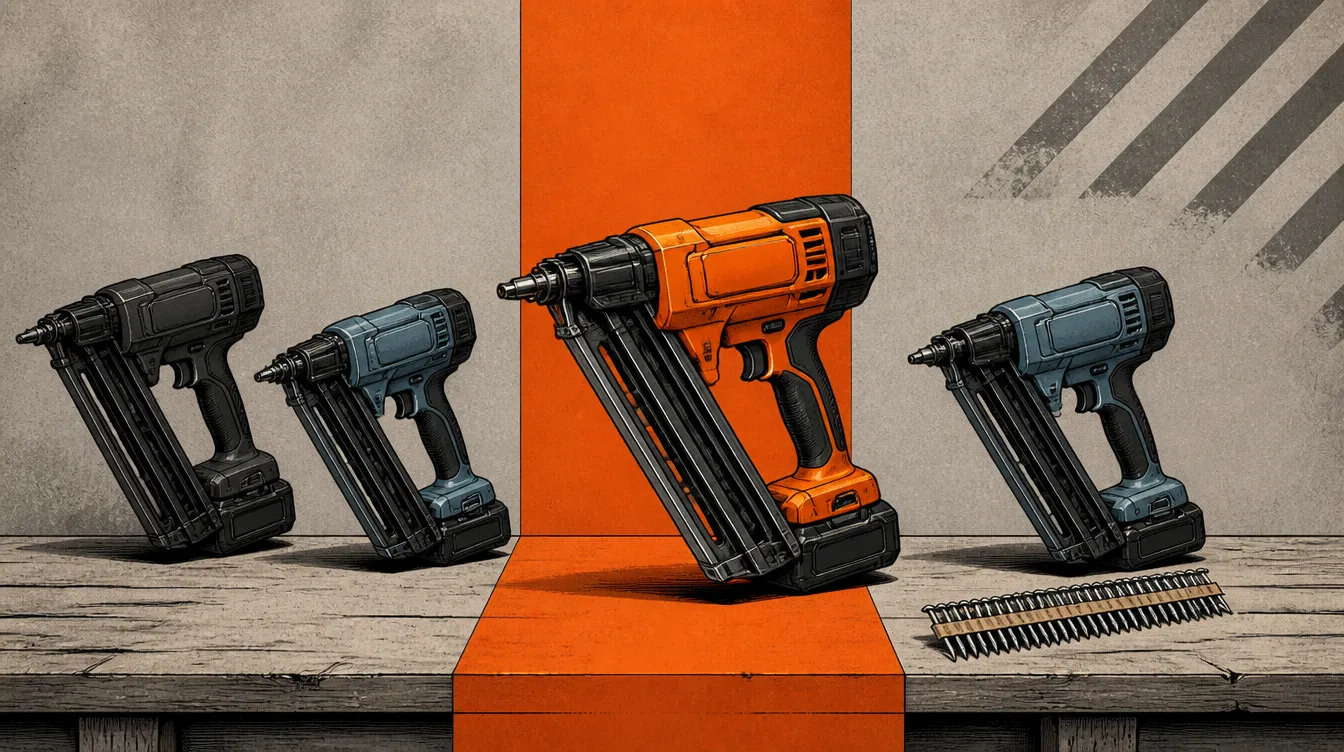
Which Cordless Framing Nailer Brand Wins?
In our test we compared 6 cordless framing nailer options head to head. Milwaukee came out on top. See the measured results, the runner-up, the budget pick, and a link to the full test video.

Milwaukee
Price shown in test: $379 for just the nailer, not battery and charger
Affiliate link. We may earn a commission at no extra cost to you.
The quick take
The short version of why each pick lands where it does, built straight from the measured results.
“Taking into consideration just tool performance and not categories such as tool weight or noise, the Milwaukee came out on top with an average finish of 1.5.”
Placed top three in 1 of 7 measurements.
The measured results
Every number below is read straight from the test. Products are listed in the order they finished.
Specs
- 1Milwaukee
brushless motor, 21 degree, claims power to nail engineered lumber, 3 nails per second, nails 2 to 3.5 in, made in China
- 2Paslode30 degree
nailer, claims superior battery life (9,000 shots per charge) and lightest cordless nailer on the market, drop-in fuel system delivers instant power for 1,200 nails; tool designed and assembled in USA, battery made in Japan, charger made in China
- 3Ridgid21 degree
brushless motor, claims pneumatic-nailer power, up to 3 nails per second, up to 750 nails per charge, selectable contact-actuation or single-sequential mode, holds up to 33 nails, nails 2 to 3.5 in, made in China
- 4Craftsman21 degree
nailer, brushless motor, tool-free depth adjustment, LED jam indicator, rafter hook, on-board tool storage, nails 2 to 3.25 in, dry fire lockout, holds up to 49 nails, made in Mexico
- 5DeWalt30 degree
nailer, brushless motor, claims consistent nail penetration into soft and hard joints, two-speed selector switch, easy-access jam-clearing nose piece, LED jam light, nails 2 to 3.5 in, holds up to 55 nails, made in Mexico
- 6Metabo HPT21 degree
nailer, brushless motor, claims pneumatic-like power with 18V cordless freedom, flip-switch sequential/bump-fire modes, air spring drive system, claims zero ramp-up time, nails 2 to 3.5 in, 37 nail capacity, made in China; narrator notes the rafter hook 'seems a little too large'
Weight
- 1Milwaukeeover12 lb
(12.06 lb per closing weight chart), by far the heaviest of all brands
- 2Paslode
by far the lightest of all brands at 7.9 lb
- 3Ridgid10.7 lb
- 4Craftsman10.6 lb
with 4 amp hour battery and nails
- 5DeWalt
lightest of the fully battery-electric nailers at just over 10 lb
- 6Metabo HPT10.5 lb
with the included 3 amp hour battery (10.49 lb per closing weight chart)
Noise
- 1Milwaukee89.8 dB
- 2Paslode104.8 dB
- 3Ridgid87.9 dB
- 4Craftsman108.5 dB
loudest of all brands
- 5DeWalt107.3 dB
about as loud as the Craftsman
- 6Metabo HPT100.3 dB
Consistency Depth Test
- 1Milwaukee
best result yet: eight perfect drives, one too deep, one too shallow
- 2Paslode
six perfect drives, two too deep and two too shallow; one nail underperformed badly, left sticking up a quarter of an inch
- 3Ridgid
a little more consistent than Craftsman: six perfect nails, two too deep, two too shallow, 'very good results overall'
- 4Craftsman
four nails seated perfectly, one too high, five too low; quite a bit of recoil, nailer lifted off the board between shots
- 5DeWalt
seven perfect nails, three too deep
- 6Metabo HPT
seven perfect drives, three a little too deep; recoil about the same as Ridgid, far less than DeWalt and Craftsman
Speed Test 25 Nails
- 1Milwaukee
fastest of all brands at 10.4 seconds
- 2Paslode
third fastest at 14.1 seconds; the purchased unit did not come with a working bump-fire trigger, so timing the tip/trigger sequence manually held it back
- 3Ridgid
second fastest at 12.3 seconds
- 4Craftsman
slowest of all brands at 20.1 seconds (no bump-fire mode, trigger/contact action timed manually)
- 5DeWalt15 seconds
faster than Craftsman but slower than Ridgid
- 6Metabo HPT17.9 seconds
narrator pushed the trigger too hard and it misfired several times during the timed test, suggesting a faster time is achievable with practice
Oak Test
- 1Milwaukee
more than enough power, completely buried the nail heads, described as 'very impressive'; noticeably less recoil than Craftsman and DeWalt
- 2Paslode
slightly more recoil than the Milwaukee; did well on one nail but left the other with unfinished business
- 3Ridgid
less recoil than Craftsman but, like Craftsman, drove nails in without quite burying the head
- 4Craftsman
a lot of recoil; did not have enough power on the maximum setting to bury the nail head
- 5DeWalt
quite a bit of recoil like Craftsman; performed very close to the same as Craftsman and Ridgid
- 6Metabo HPT
really struggled: first nail stuck up about 1/4 in, second nail also did not fully seat
Battery Drain Test
- 1Milwaukee
performed just as well with a partially drained battery, no drop-off
- 2Paslode
skipped, since the Paslode uses a fuel-cell system rather than a swappable battery
- 3Ridgid
performed just as well with a partially drained battery
- 4Craftsman
only nailer to drop off noticeably with a partially drained battery, driving nails less deep
- 5DeWalt
performed just as well with a partially drained battery
- 6Metabo HPT
performed just as well with a partially drained battery
Cold Test
- 1Milwaukee
fired the first nail with a cold battery but would not fire the second until a warm battery was installed; narrator says it 'done the best job yet' driving nails in the cold
- 2Paslode
sounded unhappy but worked; did well on the first two nails, left unfinished business on the second two
- 3Ridgid
cold temperature disabled it entirely; would not drive a nail even with a warmed-up battery
- 4Craftsman
performed poorly in cold: could not get revved up enough at 0F even with a warmed-up battery; partially drove a nail and needed a reset before the second nail
- 5DeWalt
too cold to spin up initially; with a warmed-up battery, drove both nails most of the way
- 6Metabo HPT
would not drive nails even with a warmed-up battery
All measurements (8 more)+
Composite Lumber Test
- 1Milwaukee
came out on top, fully drove in all three nails with no malfunctions, described as 'very impressive'
- 2Paslode
struggled on all three nails with no jams; nails left sticking out about 1 to 1.25 in above the board
- 3Ridgid
lost pressure after cold exposure and needed air added to its pressure tank (up to 125 PSI); made three attempts on all three nails with no malfunctions but nails stuck out 7/16 to 9/16 in
- 4Craftsman
jammed after the first nail, needed a reset after the second, needed attention after the third attempt; all three nails stuck out about 1/4 to 7/16 in; finished third overall in this test at 0.32 in behind Milwaukee and DeWalt
- 5DeWalt
needed a reset before the second and third nails similar to Craftsman; came up short on all three nails by about 1/4 to 7/16 in; finished second overall in this test at 0.3 in
- 6Metabo HPT
made all three attempts with no mechanical or electronic malfunctions but really struggled, leaving nails sticking up about 3/4 in above the board, worst depth result of the composite test
Downward Force Test
- 1Milwaukee
performed extremely well with and without downward force, actually slightly better without extra force
- 2Paslode
continued to struggle: 7/8 in without force, almost 1.25 in with a lot of downward force
- 3Ridgid
performed better without extra downward force: about 1/4 in without force vs 7/16 in with a lot of downward force
- 4Craftsman
no noticeable difference with or without downward force
- 5DeWalt
performed nearly the same with and without downward force, around 1/4 in
- 6Metabo HPT
continued to struggle with and without downward force, just over 3/4 in on both attempts
Toe Nail Angle Test
- 1Milwaukee
lost grip at 52.6 degrees, third place behind Paslode (76.1) and Metabo HPT (56.2)
- 2Paslode
won this test at 76.1 degrees, described as 'by far the best designed for driving nails at an angle'
- 3Ridgid26.1 degrees
better than DeWalt but still described as struggling
- 4Craftsman
struggled, lost grip at 18.9 degrees, tied for worst result with DeWalt
- 5DeWalt18.4 degrees
performed almost the same as Craftsman (tied for worst result)
- 6Metabo HPT
won this test outright at 56.2 degrees, described as 'very well designed for driving in nails at an angle'
Offset From Wall
- 1Milwaukee2.1 in
offset
- 2Paslode
won this test at 1.63 in, the best offset profile of all brands
- 3Ridgid2.4 in
offset, the worst (largest) of all brands
- 4Craftsman2.1 in
offset
- 5DeWalt2.1 in
offset, close to Craftsman and Milwaukee
- 6Metabo HPT1.75 in2nd
best of the four standard brushless nailers, second best overall behind Paslode
Compactness
- 1Milwaukee
fits between studs at 16 in centers but a pretty tight fit
- 3Ridgid
least compact of all brands at 15 in height, too tall to fit between studs for a perpendicular nail shot
- 4Craftsman13.75 in
height, easily fits between studs, tied best result with DeWalt
- 5DeWalt
same height as Craftsman, an inch and a quarter shorter than Ridgid, plenty of space between studs at 16 in centers
- 2Paslodenot tested
- 6Metabo HPTnot tested
Overall Ranking
- 1Milwaukee
average finish of 1.5 on tool performance alone (excluding weight and noise), named best nailer in the lineup
- 2Paslode
tied with Ridgid for second place, average finish of 3.25 on tool performance alone
- 3Ridgid
tied with Paslode for second place, average finish of 3.25 on tool performance alone
- 4Craftsmannot tested
- 5DeWaltnot tested
- 6Metabo HPTnot tested
Ramp Up Time
- 4Craftsman
needs just over half a second to spin up before deploying a nail; no bump-fire mode
- 1Milwaukeenot tested
- 2Paslodenot tested
- 3Ridgidnot tested
- 5DeWaltnot tested
- 6Metabo HPTnot tested
Ramp Up
- 5DeWalt
needs over half a second to wind up in sequential mode like the Craftsman; fires immediately in bump-fire mode once already revved up
- 1Milwaukeenot tested
- 2Paslodenot tested
- 3Ridgidnot tested
- 4Craftsmannot tested
- 6Metabo HPTnot tested
How it was tested
- consistency of nail depth test (10 lb of downward force applied)
- speed test: time to fire 25 nails
- power test driving nails into oak on the highest power setting
- performance with a partially drained battery vs a fully charged battery
- cold weather performance (nailers placed in a freezer at 0F)
- power test driving nails into 4 in composite lumber
- performance with and without 10 lb of downward force on the nailer
- toe-nailing grip test (angle at which the nailer tip loses grip)
- offset from a vertical surface (closeness of nail placement to a wall)
- physical stats: weight, noise, and height/compactness for fitting between studs
“Taking into consideration just tool performance and not categories such as tool weight or noise, the Milwaukee came out on top with an average finish of 1.5.”
Brand head-to-head scoreboards featuring this test
Data notes and caveats
Declared tie for second place (runner-up): the closing scorecard gives Paslode and Ridgid the identical average finish of 3.25 ('Paslode and Ridgid had an average finish of 3.25'). runnerUp is left null rather than arbitrarily picking one of the two tied brands.