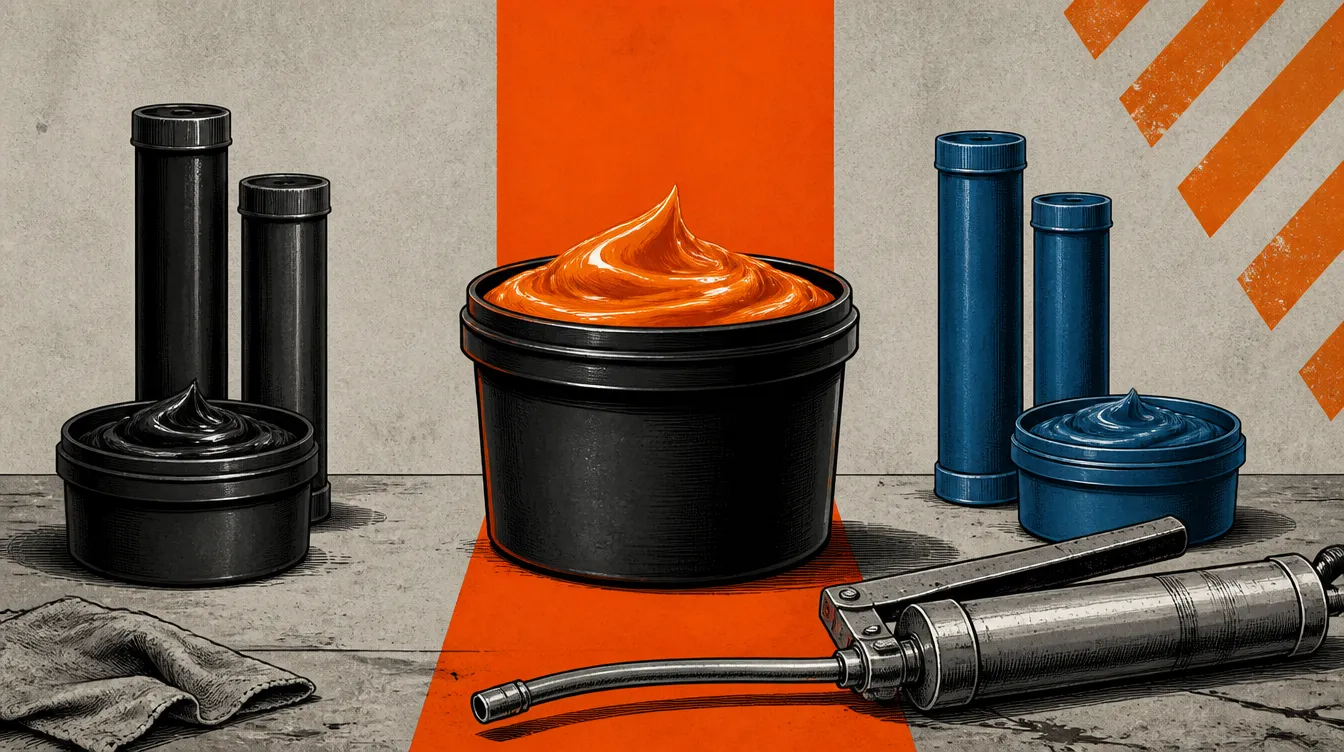
Which Lubricating Grease Brand Wins?
In our test we compared 2 lubricating grease options head to head. MAG 1 Lithium Grease came out on top. See the measured results, the runner-up, the budget pick, and a link to the full test video.

MAG 1 Lithium Grease
Affiliate link. We may earn a commission at no extra cost to you.
Conoco (vintage 1940s grease)
Affiliate link. We may earn a commission at no extra cost to you.
The quick take
The short version of why each pick lands where it does, built straight from the measured results.
“but it's mag 1 for the win”
The measured results
Every number below is read straight from the test. Products are listed in the order they finished.
All measurements (7 more)+
Tackiness/adhesion (disc pull test)
- 1MAG 1 Lithium Grease46 lb
of force to separate discs
- 2Conoco Pressure Lubricant Medium (vintage, circa 1940s)55.42 lb
of force to separate discs, the win in this test
Film strength / wear (lubricity tester)
- 1MAG 1 Lithium Grease
bearing showed noticeable wear damage, but far less than the vintage grease's bearing (described as the most damage seen on this test, referring to the Conoco sample)
- 2Conoco Pressure Lubricant Medium (vintage, circa 1940s)
the most bearing wear damage the narrator says he has seen on this test; described as not offering good wear protection
Corrosion resistance (24hr oxidizer test)
- 1MAG 1 Lithium Grease
described as doing very good preventing oxidation, called the best of the three (control bolt, Conoco bolt, MAG 1 bolt)
- 2Conoco Pressure Lubricant Medium (vintage, circa 1940s)
quite a bit of oxidation after 24 hours, especially around the base of the bolt; better than the ungreased control bolt but worse than the MAG 1 bolt
Cold temperature torque test
- 1MAG 1 Lithium Grease24.36 lb
of force to rotate the frozen bearing
- 2Conoco Pressure Lubricant Medium (vintage, circa 1940s)just over25 lb
of force to rotate the frozen bearing, nearly beating MAG 1's 24.36 lb but did not
Water spray-off test
- 1MAG 1 Lithium Grease
started at 214.22 g, ended at 212.26 g, loss of 1.96 g; crater approximately 67mm long by 41mm wide
- 2Conoco Pressure Lubricant Medium (vintage, circa 1940s)
started at 213.95 g, ended at 211.42 g, loss of 2.53 g; crater approximately 75mm long by 53mm wide, described as huge
Water immersion / rotation washout
- 1MAG 1 Lithium Grease
some grease washaway after submerged rotation, but retained noticeably more than the vintage grease
- 2Conoco Pressure Lubricant Medium (vintage, circa 1940s)
washed away noticeably more than MAG 1 after submerged rotation
Heat tolerance (dropping point slide test)
- 1MAG 1 Lithium Grease
held up under direct burner heat until roughly 400F before starting to liquefy and slide; packaging claims a dropping point over 500F
- 2Conoco Pressure Lubricant Medium (vintage, circa 1940s)
first to liquefy and go up in smoke, at approximately 200F; no dropping point information was printed on the original packaging
How it was tested
- tackiness/adhesive strength: two metal discs pulled apart, force to separate measured
- film strength / wear protection: lubricity tester, bearing wear scar compared visually
- corrosion resistance: aggressive oxidizer applied to wheel stud bolts (bare control, Conoco, MAG 1), checked after 24 hours
- cold temperature torque resistance: bearings packed and frozen at -20F for 24 hours, force to rotate measured
- water spray-off resistance: weight loss and crater size measured after water jet spray on a test plate
- water immersion / bearing rotation washout: bearings submerged and rotated, visually inspected for grease loss
- heat tolerance / dropping point: grease heated on a metal slide until it liquefies and smokes
- compatibility when the two greases are mixed together
“but it's mag 1 for the win”
Data notes and caveats
No chapters in metadata. Several non-brand phrases were garbled by auto-captions and resolved by context rather than taken at face value: 'kana coat' and 'eggwin' during the 30-second corrosion check almost certainly refer to the Conoco and MAG 1 greased bolts respectively (both were reported as fine at that point, no numeric distinction given, so not attributed to a specific brand's results); 'an advantage grease' in the cold-temp test is the vintage Conoco grease (confirmed by the just-over-25-lb figure matching the surrounding narrative); 'the fifties Greece' in the water spray-off test is also the vintage Conoco grease (confirmed because its stated starting weight of 213.95g exactly matches the weight given one sentence earlier for 'vendors Conoco,' itself a mangle of 'vintage Conoco'); the closing line 'Myra grease is definitely a whole lot better' likely means 'modern grease is definitely a whole lot better' (there is no third brand called Myra in this two-product test) but was not used as the verdictQuote given the ambiguity, in favor of a clean unambiguous quote from the cold-temp test. The compatibility test (mixing the two greases) found no separation issue and is not a competitive result. Only two products in this video, both purchased by the narrator, no prices mentioned for either.
More Shop Chemicals & Lubricants
Which Brake Parts Cleaner Brand Wins?
Gunk (Chlorinated)
See the results
Which Oil Spill Absorbent Brand Wins?
16 products tested
See the results
Which Hand Cleaners Brand Wins?
Permatex Fast Orange Extreme
See the results