Which Lawn Mower Blade Sharpeners Brand Wins?
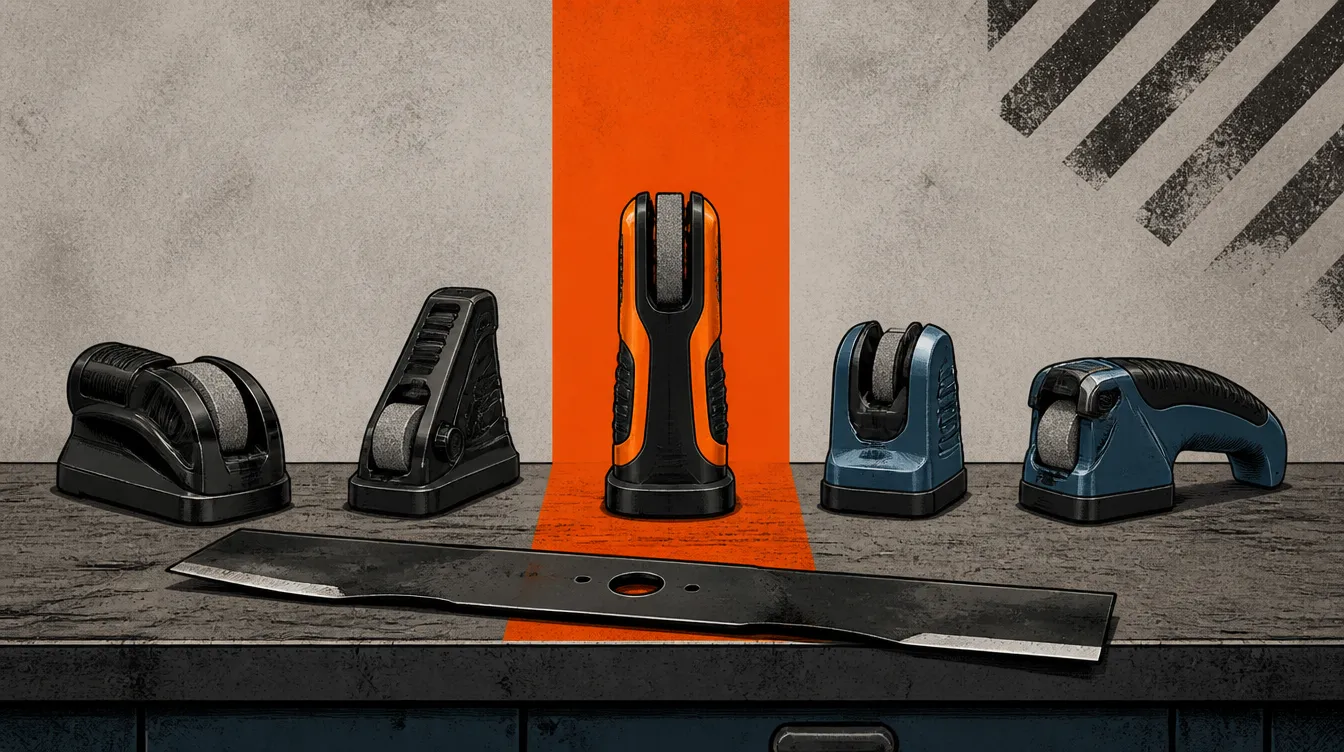
This head-to-head test of 6 lawn mower blade sharpeners options has the measured results for each. See how they ranked and watch the full test video.
Mercer Industries 10in double-cut hand file (with Universal File Holder handle purchased separately)
Price shown in test: $8
Affiliate link. We may earn a commission at no extra cost to you.
The measured results
Every number below is read straight from the test. Products are listed in the order they finished.
Made in
- 1Mercer Industries 10in double-cut hand file (with Universal File Holder handle purchased separately)
India
- 2Arnold Blade Sharpening and Balancing Kit (drill attachment)
China
- 3Taytools bench grinder sharpening jig (used with an 8in bench grinder already owned)
Taiwan
- 4Yellow Hornet mower blade sharpener (requires separately purchased angle grinder)
USA
- 5All American Model 5005 Generation 2 (requires separately purchased grinder)
USA
- 6RGB 950
USA
Initial new-blade test
- 1Mercer Industries 10in double-cut hand file (with Universal File Holder handle purchased separately)150 passes
in 2 minutes 30 seconds; blade edge angle 29.6 degrees (starting factory angle was 27.6 degrees); narrator notes freehand results likely vary a lot
- 2Arnold Blade Sharpening and Balancing Kit (drill attachment)3 minutes 30 seconds
(1 minute longer than the hand file); angle 32.5 degrees, narrator says he did not do a good job forming the correct angle
- 3Taytools bench grinder sharpening jig (used with an 8in bench grinder already owned)53 seconds
more than twice as fast as the hand file and the Arnold drill attachment; angle 23.5 degrees, narrator says the jig angle needs adjusting before the next test
- 4Yellow Hornet mower blade sharpener (requires separately purchased angle grinder)
finished in very close to 20 seconds, more than twice as fast as the bench grinder and jig; angle 29.6 degrees, very good and close to 30
- 5All American Model 5005 Generation 2 (requires separately purchased grinder)8 seconds
by far the fastest sharpener of the initial round; angle 29.3 degrees, very good and close to 30
- 6RGB 95017 seconds
angle 29.2 degrees, very close to the Yellow Hornet and All American
Mildly dull blade re-sharpen test (weight tracked)
- 1Mercer Industries 10in double-cut hand file (with Universal File Holder handle purchased separately)about7 minutes
angle 32.2 degrees; weight 802g down to 798g (4g removed); left behind quite a few metal filings
- 2Arnold Blade Sharpening and Balancing Kit (drill attachment)9 minutes
(2 minutes longer than the hand file); angle 38.3 degrees; weight 803g down to 800g (3g removed)
- 3Taytools bench grinder sharpening jig (used with an 8in bench grinder already owned)3 minutes 30 seconds
angle 25 degrees (narrator: 'not an improvement, but I still need to adjust the angle of the jig'); weight 800g down to 795g (5g removed)
- 4Yellow Hornet mower blade sharpener (requires separately purchased angle grinder)just over2 minutes
angle 29.3 degrees; weight 801g down to 794g (7g removed)
- 5All American Model 5005 Generation 2 (requires separately purchased grinder)14 passes
about 30 seconds; angle just over 30 degrees, described as pretty close to perfect; weight 800g down to 792g (8g removed)
- 6RGB 950about1 minute 15 seconds
angle 30.3 degrees, described as just about perfect; weight 795g down to 787g (8g removed, same as the All American)
Blunt 3/16 flat iron test (10 min cap)
- 1Mercer Industries 10in double-cut hand file (with Universal File Holder handle purchased separately)
did not finish in the 10 minute limit, only half of the blade edge formed; angle 24.4 degrees; weight 682g down to 679g (only 3g of metal removed)
- 2Arnold Blade Sharpening and Balancing Kit (drill attachment)
made better progress than the hand file, about 60% of blade thickness formed; angle around 38.3 degrees (narrator says he did not do well here); weight 870g starting, 4g of metal removed total
- 3Taytools bench grinder sharpening jig (used with an 8in bench grinder already owned)5 minutes 15 seconds
angle 26 degrees (closest to the 30 degree target of the systems tested up to that point in the video); weight 829g starting, 17g of metal removed
- 4Yellow Hornet mower blade sharpener (requires separately purchased angle grinder)2 minutes 45 seconds
angle 29.4 degrees, very good and close to 30; weight 865g starting, 19g of metal removed (2g more than the bench grinder and jig)
- 5All American Model 5005 Generation 2 (requires separately purchased grinder)
less than a minute, the fastest of all systems; angle 29.2 degrees, very good; weight 679g starting, 28g of metal removed; metal removal rate of 31.1 g per minute, the fastest of all systems tested
- 6RGB 950just under2 minutes
angle 30.4 degrees, the best (most accurate) result of any system tested; weight 745g starting, 21g of metal removed; metal removal rate of 11.1 g per minute, very fast but second to the All American
Mulching blade test
- 1Mercer Industries 10in double-cut hand file (with Universal File Holder handle purchased separately)
will work but described as more art than science, difficult and time consuming to get a consistently sharp edge
- 2Arnold Blade Sharpening and Balancing Kit (drill attachment)
the plastic guard grabs the edge of the blade when working around the mulching blade's contours, but sharpening it is possible with patience
- 3Taytools bench grinder sharpening jig (used with an 8in bench grinder already owned)
can sharpen the outer 3 inches of a mulching blade with the jig, but the rest of the blade must be freehanded
- 4Yellow Hornet mower blade sharpener (requires separately purchased angle grinder)
designed for a flat blade like the jig; the mulching blade's angle varies a lot, requiring several sharpening-angle changes; narrator likes being able to see the blade edge while sharpening
- 5All American Model 5005 Generation 2 (requires separately purchased grinder)
unlike the other powered systems, the operator holds the blade itself during sharpening (rather than the sharpener holding the blade), which the narrator says gives better control and lets him see the blade face while sharpening
- 6RGB 950
the outer portion of the blade cannot be reached by the sharpener's grinding wheel, requiring the flap disc plus freehand sharpening for the rest, but narrator says it is very easy to work with on a mulching blade
All measurements (3 more)+
Construction
- 4Yellow Hornet mower blade sharpener (requires separately purchased angle grinder)1/4in
plate steel, all joints welded; includes a blade balancer
- 1Mercer Industries 10in double-cut hand file (with Universal File Holder handle purchased separately)not tested
- 2Arnold Blade Sharpening and Balancing Kit (drill attachment)not tested
- 3Taytools bench grinder sharpening jig (used with an 8in bench grinder already owned)not tested
- 5All American Model 5005 Generation 2 (requires separately purchased grinder)not tested
- 6RGB 950not tested
Adjustable range
- 5All American Model 5005 Generation 2 (requires separately purchased grinder)15
to 45 degrees; includes four adapter pins to fit most grinders
- 1Mercer Industries 10in double-cut hand file (with Universal File Holder handle purchased separately)not tested
- 2Arnold Blade Sharpening and Balancing Kit (drill attachment)not tested
- 3Taytools bench grinder sharpening jig (used with an 8in bench grinder already owned)not tested
- 4Yellow Hornet mower blade sharpener (requires separately purchased angle grinder)not tested
- 6RGB 950not tested
Spec
- 6RGB 9503/4
horsepower continuous duty motor; includes a 9in fast grind wheel and a 7in flap wheel; designed to also sharpen mulching blades
- 1Mercer Industries 10in double-cut hand file (with Universal File Holder handle purchased separately)not tested
- 2Arnold Blade Sharpening and Balancing Kit (drill attachment)not tested
- 3Taytools bench grinder sharpening jig (used with an 8in bench grinder already owned)not tested
- 4Yellow Hornet mower blade sharpener (requires separately purchased angle grinder)not tested
- 5All American Model 5005 Generation 2 (requires separately purchased grinder)not tested
How it was tested
- initial sharpening speed and angle accuracy on brand-new factory-edge blades
- sharpening speed and angle accuracy re-sharpening freshly dulled and repainted blades (weight loss tracked in grams)
- sharpening speed, angle accuracy, and metal removal rate (g/min) on a blunted 3/16in flat iron with no existing edge, capped at 10 minutes
- qualitative capability sharpening a contoured mulching blade
Data notes and caveats
The video runs each of the 6 systems through 4 distinct rounds: (1) an initial pass on brand-new factory blades (speed + angle, used partly to calibrate/practice each tool), (2) a controlled weight-tracked re-sharpen of freshly dulled and spray-painted blades (speed + angle + grams removed), (3) a 10-minute-capped sharpen of a blunt 3/16in flat iron with no existing edge (speed + angle + grams removed + rate for the two fastest), and (4) a qualitative-only mulching blade capability check. No single winner is declared: the closing summary names three favorites without ranking them against each other ('I really like three of the brands, including the RGB 950, the Yellow Hornet, as well as the All American'), each with its own caveat (RGB 950 too expensive and large for most consumers; Yellow Hornet's welded blade rest can't be repositioned to fit more grinders; All American praised without a stated downside beyond needing a separate grinder). Quantitatively the All American was fastest in every single timed test (8 sec, ~30 sec, <1 min, 31.1 g/min removal rate) and had strong angle accuracy throughout, making it the closest thing to a clear top performer even though the transcript never states this in a single declarative winner sentence; per the extraction rule requiring a verdictQuote to name a winner, this was left as winner:null rather than inferred. The hand file (Mercer) and Arnold drill attachment were consistently the slowest and least accurate of the six, with the hand file the only system that failed to complete the blunt flat-iron test within its 10-minute cap. Chapters map cleanly 1:1 to each brand's individual test section in the order tested (Mercer file, Arnold, Taytools/bench grinder, Yellow Hornet, All American, RGB 950), with a final combined 'Testing' chapter covering the dulled-blade, flat-iron, and mulching-blade tests across all six systems together.