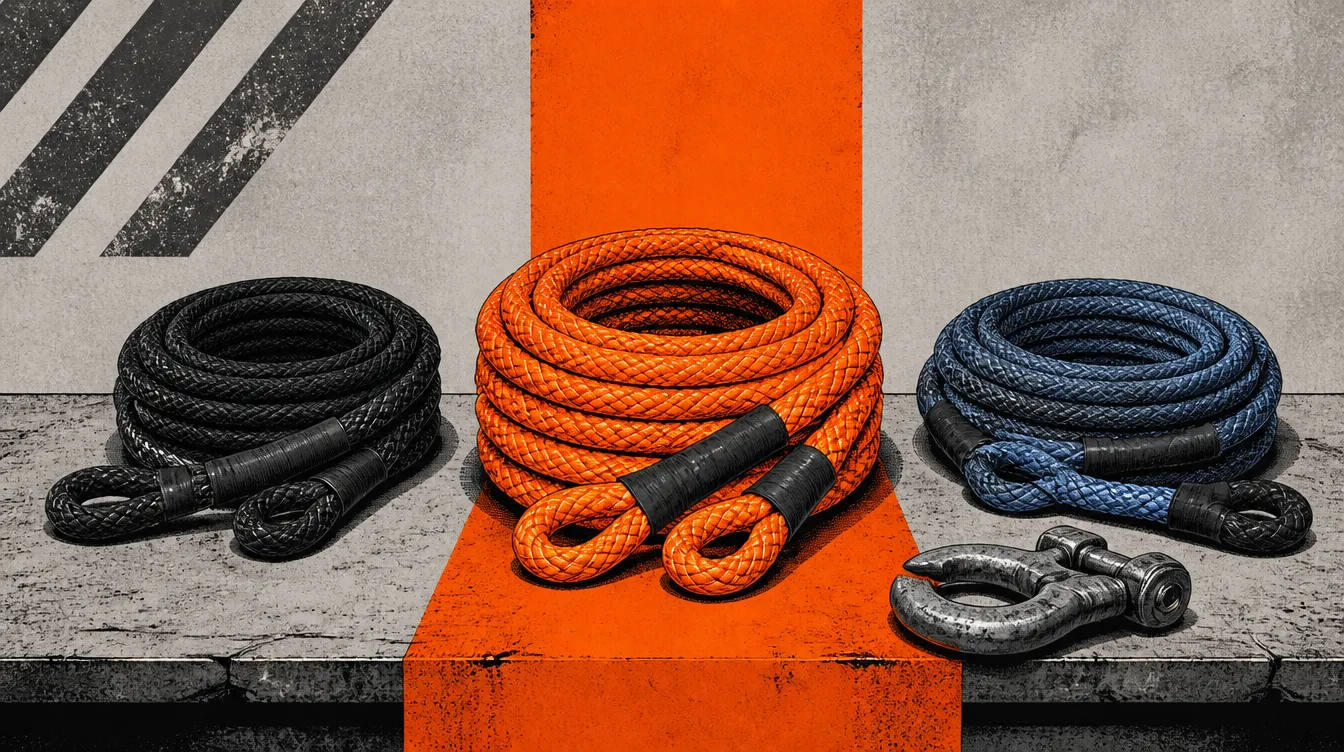
Which Kinetic Recovery Rope Brand Wins?
This head-to-head test of 7 kinetic recovery rope options has the measured results for each. See how they ranked and watch the full test video.
Sgt Knots
Price shown in test: $50, the least expensive rope tested
Affiliate link. We may earn a commission at no extra cost to you.
The measured results
Every number below is read straight from the test. Products are listed in the order they finished.
Weight
- 1Sgt Knotsjust over8 lb
- 2Inclake8.67 lb
- 3FieryRed6.98 lb
the lightest rope tested
- 4Rhino USA10.6 lb
the heaviest rope tested
- 5Smittybilt8.87 lb
- 6Bubba Rope Power Stretch Recovery Ropejust over9 lb
(also stated as 9.02 lb later in the video)
- 7Yankum Rope8.175 lb
Claimed Capacity
- 1Sgt Knotsup to30,000 lb
of tensile force
- 2Inclakeup to28,660 lb
stretches up to 30% under load
- 3FieryRed
minimum breaking strength of 29,300 lb; comes with two soft shackles rated for 43,000 lb; made of 100% nylon 66
- 4Rhino USA
breaking strength of 34,370 lb; claims to stretch and store four times more energy than a tow strap
- 5Smittybilt
breaking strength of 30,000 lb; 12 woven strands for better elasticity and strength; max elongation 30%
- 6Bubba Rope Power Stretch Recovery Rope
elongation from 30 to 35%; eyes spliced to military spec
- 7Yankum Rope
not separately stated in the transcript beyond it being the diameter rope used by Matt's Off-Road Recovery
Length New
- 1Sgt Knots
very close to 31 ft 4 in
- 2Inclake29 ft
2 in at introduction; later in the elasticity section the transcript instead states 'the In Clake is at 20 ft 2 in under a small amount of tension' - kept verbatim as a likely caption digit error (9 misheard as 2) rather than silently corrected, since the 29 ft 2 in figure is consistent with the later permanent-stretch math (30 ft 4.5 in after 25 pulls being 14.5 in more than 29 ft 2 in) while 20 ft 2 in is not
- 3FieryRed30 ft
9 in, starting off a little long
- 4Rhino USA30 ft
8 in, a little long
- 5Smittybilt29 ft
9 in
- 6Bubba Rope Power Stretch Recovery Rope30 ft
7 in, a little too long
- 7Yankum Roperight at30 ft
ElasticityNew (force vs. stretch distance)
- 1Sgt Knots980 lb
at 1 ft, 1,875 lb at 2 ft, 3,220 lb at 3 ft, 4,860 lb at 4 ft, reached 7,000 lb at very close to 5 ft (about 17% stretch at 7,000 lb)
- 2Inclake926 lb
at 1 ft, 2,264 lb at 2 ft, 3,705 lb at 3 ft, 5,800 lb at 4 ft, reached 7,000 lb at 54 in
- 3FieryRed1,436 lb
at 1 ft (most force required yet at that point), 2,462 lb at 2 ft, 4,172 lb at 3 ft (least elastic yet), 6,355 lb at 4 ft, reached 7,000 lb at 51 in
- 4Rhino USA1,016 lb
at 1 ft, 2,598 lb at 2 ft (most force yet at that point), 4,319 lb at 3 ft (least stretch yet at that point), reached 7,000 lb at 4 ft (48 in)
- 5Smittybilt1,601 lb
at 1 ft, 3,541 lb at 2 ft, 5,746 lb at 3 ft (most force yet at that point), reached 7,000 lb at 41 in
- 6Bubba Rope Power Stretch Recovery Rope400 lb
at 1 ft, 1,130 lb at 2 ft (by far the most stretch yet at that point), 1,931 lb at 3 ft, 2,887 lb at 4 ft, 4,682 lb at 5 ft, first rope in the lineup to reach 6 ft (72 in) before hitting 7,000 lb; the stretchiest rope tested when new
- 7Yankum Rope1,585 lb
at 1 ft (about the same as the Smittybilt), 3,370 lb at 2 ft (less than 200 lb apart from Smittybilt), 5,798 lb at 3 ft, reached 7,000 lb at 41 in, tied with the Smittybilt
Length After 25 Pulls
- 1Sgt Knots32 ft
3.5 in
- 2Inclake30 ft
4.5 in
- 3FieryRed31 ft
6 in
- 4Rhino USA
grew 10 in from its starting length
- 5Smittybilt30 ft
5.75 in
- 6Bubba Rope Power Stretch Recovery Rope
stretched the most of any rope
- 7Yankum Rope30 ft
9 in
Permanent Stretch
- 1Sgt Knots11.5 in
- 2Inclake14.5 in
(stated in the transcript as 3 in more than the Sgt Knots' 11.5 in)
- 3FieryRed9 in
briefly the best (least) result at that point
- 4Rhino USA10 in2nd
second best result at that point, behind the Fiery Red's 9 in
- 5Smittybilt8.75 in
the least permanent stretch of any rope tested
- 6Bubba Rope Power Stretch Recovery Rope17 in
the most permanent stretch of any rope tested
- 7Yankum Rope9 in2nd
tied for second best with FieryRed
ElasticityAfter25Pulls (7,000 lb)
- 1Sgt Knots1,297 lb
at 1 ft, 2,558 lb at 2 ft, 4,547 lb at 3 ft, reached 7,000 lb at 4 ft (48 in)
- 2Inclake
reached 7,000 lb at 41 in
- 3FieryRed
reached 7,000 lb at 46 in
- 4Rhino USA
reached 7,000 lb at 42.5 in
- 5Smittybilt
reached 7,000 lb at 36 in
- 6Bubba Rope Power Stretch Recovery Rope
still the stretchiest rope, reaching 7,000 lb at 56 in; no explicit inch-loss or percent-loss figure is stated for this brand in the transcript, unlike the other six ropes
- 7Yankum Rope
reached 7,000 lb at 36 in
Coating Wear
- 1Sgt Knots
rubberized end coating showed some wear and tear but remained serviceable
- 2Inclake
fabric sleeve did a great job protecting the rope
- 3FieryRed
rubberized coating showed more wear and tear than the Sgt Knots and Inclake, but the rope remained safe to use
- 4Rhino USA
fabric sleeve did a great job protecting the rope end, like the Inclake
- 5Smittybilt
rubberized coating held up by far the best of any rope with a rubberized coating; some paint stains but very good overall condition
- 6Bubba Rope Power Stretch Recovery Rope
rubberized coating looked to be in the best shape of any rope tested, with very little wear and tear
- 7Yankum Rope
rubberized coating wear was about the same as the FieryRed, with quite a bit of wear and tear
All measurements (4 more)+
Elasticity Loss In (in)
- 1Sgt Knots12 in
of elasticity lost (from about 60 in new to 48 in after 25 pulls)
- 2Inclake13 in
of elasticity lost (from 54 in new to 41 in after 25 pulls)
- 3FieryRed5 in
of elasticity lost, by far the best (least loss) result at that point, tied for best overall with Smittybilt and Yankum
- 4Rhino USA5.5 in
of elasticity lost
- 5Smittybilt5 in
of elasticity lost, tied for the two-way best result with FieryRed
- 7Yankum Rope5 in
of elasticity lost, tied for the best result with FieryRed and Smittybilt
- 6Bubba Rope Power Stretch Recovery Ropenot tested
Elasticity Loss (%)
- 3FieryRed9.8%%
the best (lowest) percentage loss of any rope tested
- 4Rhino USA11.5%%2nd
second best percentage loss
- 5Smittybilt12.2%%3rd
tied for third best with the Yankum Rope
- 7Yankum Rope12.2%%3rd
tied for third best with Smittybilt
- 1Sgt Knotsnot tested
- 2Inclakenot tested
- 6Bubba Rope Power Stretch Recovery Ropenot tested
Diameter
- 4Rhino USA1 in
thicker than most of the other ropes tested (7/8 in)
- 5Smittybilt1 in
like the Rhino USA
- 1Sgt Knotsnot tested
- 2Inclakenot tested
- 3FieryRednot tested
- 6Bubba Rope Power Stretch Recovery Ropenot tested
- 7Yankum Ropenot tested
Construction Cut Open
- 1Sgt Knots
cutting the rope open revealed a woven inner rope inside the outer jacket; the outer jacket appeared to have gotten hot enough that it melted onto the inner rope
- 2Inclakenot tested
- 3FieryRednot tested
- 4Rhino USAnot tested
- 5Smittybiltnot tested
- 6Bubba Rope Power Stretch Recovery Ropenot tested
- 7Yankum Ropenot tested
How it was tested
- baseline pulling force comparison using a tow chain with a Suburban (2WD and 4WD) and a tractor, to establish how much force is available before testing the ropes (not a rope product test)
- rope length measurement when new, straightened with about 150 lb of force
- elasticity test: force required to stretch each rope to 7,000 lb of load, measured at 1 ft intervals
- 25-pull torture test using a Suburban with 7 ft of slack
- permanent stretch: rope length measured again after the 25-pull torture test
- elasticity retest: force required to stretch each rope to 7,000 lb of load after the 25 pulls, and the resulting loss of elasticity in inches and percent
- rubberized end coating wear/durability, visually assessed after testing
- internal rope construction, one rope cut open to inspect
“So, which rope is best? I think that really depends on what you're looking for. If you plan to use a recovery rope several times each week, the fiery red, Smittybilt, and Yank'em ropes experience less stretch after 25 pulls compared to Sergeant Knot's and the Bubba Rope. Having made 177 pulls with seven different brands, I much prefer the Bubba Rope over all the other brands.”
Data notes and caveats
No single winner is declared; the reviewer explicitly frames the choice as depending on use case. For frequent weekly use, FieryRed, Smittybilt, and Yankum are named as retaining the most elasticity/least permanent stretch after 25 pulls. Separately, the reviewer states a clear personal preference for the Bubba Rope specifically for its gradual windup/wind-down feel, despite the Bubba Rope objectively having the most permanent stretch (17 in) and remaining the stretchiest rope of the group after 25 pulls; the Bubba Rope is also the one actually used to pull the RV out of the pond in the closing segment. Because these are two separate, non-overlapping favorites rather than one clear overall verdict, winner/runnerUp/budgetPick are left null per spec and both framings are preserved in videoNotes and the relevant products' own notes. The Inclake's starting length is stated two different ways in the transcript (29 ft 2 in at introduction, 20 ft 2 in later in the elasticity section); kept both verbatim and flagged as a likely caption digit error rather than silently corrected, since only the 29 ft 2 in figure is consistent with the later permanent-stretch math. Meta chapters (Baseline Testing, Length Testing, Elasticity Testing, Torture Testing, Stress Testing, Elasticity Loss, Conclusion) align cleanly with the transcript's test structure.