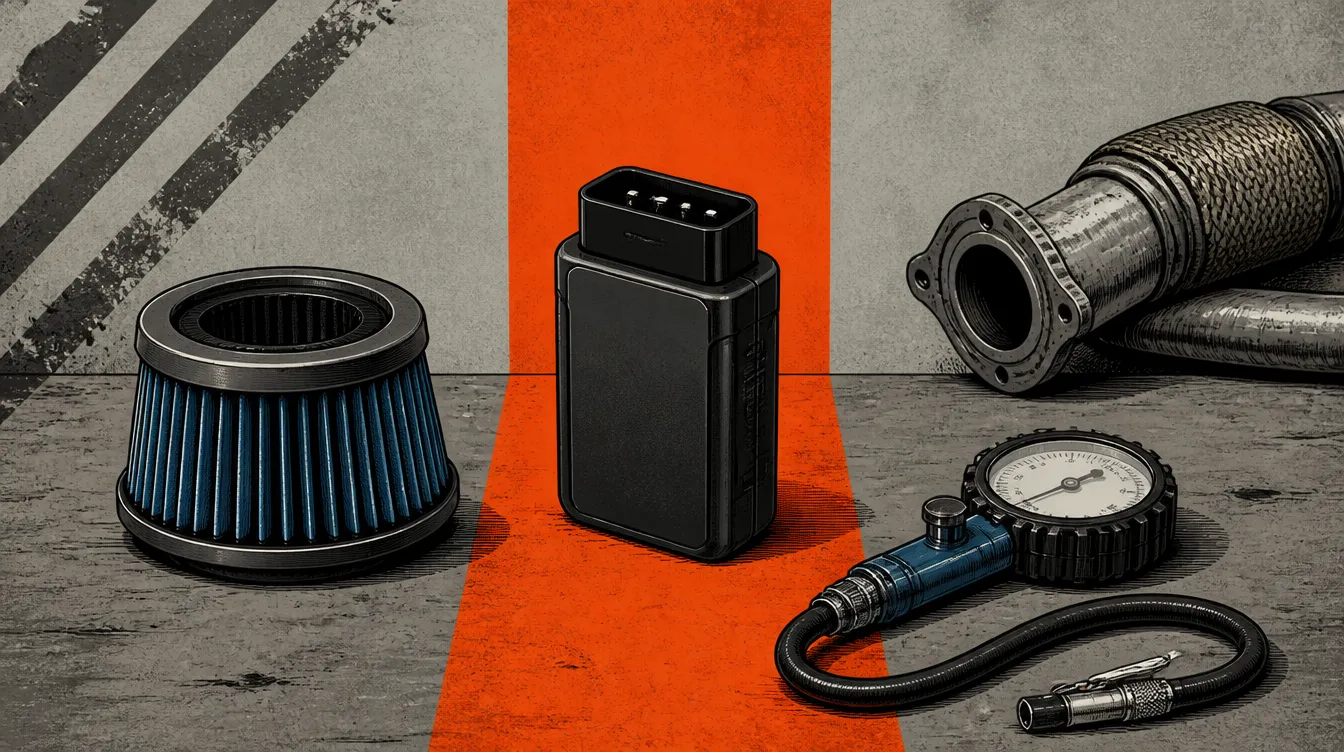
Which Fuel Saving Devices Brand Wins?
In our test we compared 10 fuel saving devices options head to head. Reduced speed plus increased tire pressure came out on top. See the measured results, the runner-up, the budget pick, and a link to the full test video.
Reduced speed plus increased tire pressure
Affiliate link. We may earn a commission at no extra cost to you.
Cold air intake plus MBRP high flow exhaust plus SUPERCHIPS FLASHPAQ tuner combined
Affiliate link. We may earn a commission at no extra cost to you.
The quick take
The short version of why each pick lands where it does, built straight from the measured results.
“The only three things that seem to work are the cold air intake, the high flow exhaust system, as well as the programmer. Better than that. Just slow down a little bit. That really saves the most fuel.”
The measured results
Every number below is read straight from the test. Products are listed in the order they finished.
0 To 60
- 1Reduced speed plus increased tire pressure no product purchased, driving technique7.52 seconds
the slowest time yet because the traction control held the vehicle back
- 3Obdiicats8.32 seconds
- 4nitroOBD28.5 seconds
slower than the 8.32 second baseline, meaning it lost horsepower and torque rather than gaining it
- 52G Fuel Saver8.76 seconds
the worst 0 to 60 time in that test series
- 8ecoOBD27.39 seconds
- 9NeoSocket Fuel Shark Neojust under7 seconds
- 10No device baseline 2020 Chevrolet Suburban, second vehicle7.41 seconds
- 2Cold Air Intake plus MBRP High-Flow Exhaust plus SUPERCHIPS FLASHPAQ Tuner combined install, tested togethernot tested
- 6Ferox fuel treatment tabletsnot tested
- 7Turbonator dual propeller intake devicenot tested
Mpg
- 1Reduced speed plus increased tire pressure no product purchased, driving technique26.23 mpg
actual refuel calculation, computer showed 28.5 mpg; 12.5 percent better than any of the previous attempts
- 3Obdiicats16.7 mpg
over the 77 mile test loop
- 4nitroOBD216.45 mpg
a little worse than the Obdiicats' 16.7 mpg
- 52G Fuel Saver16.39 mpg
worse than the previous two gadgets
- 8ecoOBD222.38 mpg
over 77 miles on a 2020 Chevrolet Suburban 5.3L, described as pretty impressive for such a large SUV
- 9NeoSocket Fuel Shark Neo23.36 mpg
over 77 miles, less than 1 mile per gallon different from the ecoOBD2
- 2Cold Air Intake plus MBRP High-Flow Exhaust plus SUPERCHIPS FLASHPAQ Tuner combined install, tested togethernot tested
- 6Ferox fuel treatment tabletsnot tested
- 7Turbonator dual propeller intake devicenot tested
- 10No device baseline 2020 Chevrolet Suburban, second vehiclenot tested
Claim
- 4nitroOBD235 percent
more power and 25 percent more torque
- 52G Fuel Saver
five years of testing have shown improvement of fuel economy by 8 percent in SUVs
- 6Ferox fuel treatment tablets
high performance treatment that improves engine performance and combustion efficiency, extends oil life, and removes engine deposits
- 7Turbonator dual propeller intake device
dual propeller mechanism boosts horsepower and significantly improves fuel mileage
- 8ecoOBD2
save 15 percent on fuel; plug and drive OBD2 economy chip tuning box; requires about 150 miles or 200 km to learn driving habits
- 9NeoSocket Fuel Shark Neoup to30 percent
fuel savings, cleaner emissions, more horsepower, longer battery life
- 1Reduced speed plus increased tire pressure no product purchased, driving techniquenot tested
- 2Cold Air Intake plus MBRP High-Flow Exhaust plus SUPERCHIPS FLASHPAQ Tuner combined install, tested togethernot tested
- 3Obdiicatsnot tested
- 10No device baseline 2020 Chevrolet Suburban, second vehiclenot tested
All measurements (11 more)+
Generator Runtime
- 6Ferox fuel treatment tablets22 minutes 16 seconds
on a fuel injected generator, versus 22 minutes 48 seconds on straight gasoline, close to 30 seconds less run time
- 7Turbonator dual propeller intake deviceabout22 minutes
plus a 23 second penalty added for setup time, performed about the same as the Ferox
- 1Reduced speed plus increased tire pressure no product purchased, driving techniquenot tested
- 2Cold Air Intake plus MBRP High-Flow Exhaust plus SUPERCHIPS FLASHPAQ Tuner combined install, tested togethernot tested
- 3Obdiicatsnot tested
- 4nitroOBD2not tested
- 52G Fuel Savernot tested
- 8ecoOBD2not tested
- 9NeoSocket Fuel Shark Neonot tested
- 10No device baseline 2020 Chevrolet Suburban, second vehiclenot tested
Method
- 1Reduced speed plus increased tire pressure no product purchased, driving technique
tire pressure raised to 50 PSI (near max for the tires) and speed reduced from 70 mph to 63 mph
- 2Cold Air Intake plus MBRP High-Flow Exhaust plus SUPERCHIPS FLASHPAQ Tuner combined install, tested togethernot tested
- 3Obdiicatsnot tested
- 4nitroOBD2not tested
- 52G Fuel Savernot tested
- 6Ferox fuel treatment tabletsnot tested
- 7Turbonator dual propeller intake devicenot tested
- 8ecoOBD2not tested
- 9NeoSocket Fuel Shark Neonot tested
- 10No device baseline 2020 Chevrolet Suburban, second vehiclenot tested
Airflow Bench
- 2Cold Air Intake plus MBRP High-Flow Exhaust plus SUPERCHIPS FLASHPAQ Tuner combined install, tested together
new MBRP exhaust measured 101 CFM on a 750 CFM blower versus 74 CFM for the stock exhaust it replaced
- 1Reduced speed plus increased tire pressure no product purchased, driving techniquenot tested
- 3Obdiicatsnot tested
- 4nitroOBD2not tested
- 52G Fuel Savernot tested
- 6Ferox fuel treatment tabletsnot tested
- 7Turbonator dual propeller intake devicenot tested
- 8ecoOBD2not tested
- 9NeoSocket Fuel Shark Neonot tested
- 10No device baseline 2020 Chevrolet Suburban, second vehiclenot tested
Mpg With Intake And Exhaust Only
- 2Cold Air Intake plus MBRP High-Flow Exhaust plus SUPERCHIPS FLASHPAQ Tuner combined install, tested together17.74 mpg
about 3/4 of 1 mile per gallon better than the factory setup
- 1Reduced speed plus increased tire pressure no product purchased, driving techniquenot tested
- 3Obdiicatsnot tested
- 4nitroOBD2not tested
- 52G Fuel Savernot tested
- 6Ferox fuel treatment tabletsnot tested
- 7Turbonator dual propeller intake devicenot tested
- 8ecoOBD2not tested
- 9NeoSocket Fuel Shark Neonot tested
- 10No device baseline 2020 Chevrolet Suburban, second vehiclenot tested
Mpg With Tuner Added
- 2Cold Air Intake plus MBRP High-Flow Exhaust plus SUPERCHIPS FLASHPAQ Tuner combined install, tested together18.78 mpg
almost 2 miles per gallon over the factory setup
- 1Reduced speed plus increased tire pressure no product purchased, driving techniquenot tested
- 3Obdiicatsnot tested
- 4nitroOBD2not tested
- 52G Fuel Savernot tested
- 6Ferox fuel treatment tabletsnot tested
- 7Turbonator dual propeller intake devicenot tested
- 8ecoOBD2not tested
- 9NeoSocket Fuel Shark Neonot tested
- 10No device baseline 2020 Chevrolet Suburban, second vehiclenot tested
Mpg With Tire And Speed Change
- 2Cold Air Intake plus MBRP High-Flow Exhaust plus SUPERCHIPS FLASHPAQ Tuner combined install, tested together20.39 mpg
at 60 mph with high tire pressure
- 1Reduced speed plus increased tire pressure no product purchased, driving techniquenot tested
- 3Obdiicatsnot tested
- 4nitroOBD2not tested
- 52G Fuel Savernot tested
- 6Ferox fuel treatment tabletsnot tested
- 7Turbonator dual propeller intake devicenot tested
- 8ecoOBD2not tested
- 9NeoSocket Fuel Shark Neonot tested
- 10No device baseline 2020 Chevrolet Suburban, second vehiclenot tested
0 To 60 Improvement
- 2Cold Air Intake plus MBRP High-Flow Exhaust plus SUPERCHIPS FLASHPAQ Tuner combined install, tested together
fastest time of the whole first-vehicle test series at 8.01 seconds, versus an 8.32 second factory baseline
- 1Reduced speed plus increased tire pressure no product purchased, driving techniquenot tested
- 3Obdiicatsnot tested
- 4nitroOBD2not tested
- 52G Fuel Savernot tested
- 6Ferox fuel treatment tabletsnot tested
- 7Turbonator dual propeller intake devicenot tested
- 8ecoOBD2not tested
- 9NeoSocket Fuel Shark Neonot tested
- 10No device baseline 2020 Chevrolet Suburban, second vehiclenot tested
Overall Improvement
- 2Cold Air Intake plus MBRP High-Flow Exhaust plus SUPERCHIPS FLASHPAQ Tuner combined install, tested together22.39 percent
fuel efficiency improvement averaged across the first four round trips at 70 mph before the intake, exhaust, and tune; 12.73 percent improvement specifically at 70 mph with intake, exhaust, and tune installed
- 1Reduced speed plus increased tire pressure no product purchased, driving techniquenot tested
- 3Obdiicatsnot tested
- 4nitroOBD2not tested
- 52G Fuel Savernot tested
- 6Ferox fuel treatment tabletsnot tested
- 7Turbonator dual propeller intake devicenot tested
- 8ecoOBD2not tested
- 9NeoSocket Fuel Shark Neonot tested
- 10No device baseline 2020 Chevrolet Suburban, second vehiclenot tested
Carbon Inspection
- 6Ferox fuel treatment tablets
spark plug and combustion chamber looked pretty much the same before and after other than the spark plug turning orange
- 1Reduced speed plus increased tire pressure no product purchased, driving techniquenot tested
- 2Cold Air Intake plus MBRP High-Flow Exhaust plus SUPERCHIPS FLASHPAQ Tuner combined install, tested togethernot tested
- 3Obdiicatsnot tested
- 4nitroOBD2not tested
- 52G Fuel Savernot tested
- 7Turbonator dual propeller intake devicenot tested
- 8ecoOBD2not tested
- 9NeoSocket Fuel Shark Neonot tested
- 10No device baseline 2020 Chevrolet Suburban, second vehiclenot tested
Mpg Computer
- 10No device baseline 2020 Chevrolet Suburban, second vehicle24.66 mpg
on the instrument cluster
- 1Reduced speed plus increased tire pressure no product purchased, driving techniquenot tested
- 2Cold Air Intake plus MBRP High-Flow Exhaust plus SUPERCHIPS FLASHPAQ Tuner combined install, tested togethernot tested
- 3Obdiicatsnot tested
- 4nitroOBD2not tested
- 52G Fuel Savernot tested
- 6Ferox fuel treatment tabletsnot tested
- 7Turbonator dual propeller intake devicenot tested
- 8ecoOBD2not tested
- 9NeoSocket Fuel Shark Neonot tested
Mpg Actual
- 10No device baseline 2020 Chevrolet Suburban, second vehicle21.9 mpg
from the actual refuel calculation, worse than the Fuel Shark's 23.36 mpg
- 1Reduced speed plus increased tire pressure no product purchased, driving techniquenot tested
- 2Cold Air Intake plus MBRP High-Flow Exhaust plus SUPERCHIPS FLASHPAQ Tuner combined install, tested togethernot tested
- 3Obdiicatsnot tested
- 4nitroOBD2not tested
- 52G Fuel Savernot tested
- 6Ferox fuel treatment tabletsnot tested
- 7Turbonator dual propeller intake devicenot tested
- 8ecoOBD2not tested
- 9NeoSocket Fuel Shark Neonot tested
How it was tested
- 77 mile round trip fuel economy at 70 mph with consistent refueling procedure
- 0 to 60 mph acceleration test
- exhaust airflow bench test at 750 CFM
- fuel injected generator runtime test until out of fuel
- spark plug and combustion chamber carbon inspection with borescope
- tire pressure increase to 50 PSI plus reduced highway speed
“The only three things that seem to work are the cold air intake, the high flow exhaust system, as well as the programmer. Better than that. Just slow down a little bit. That really saves the most fuel.”
More Myths & Experiments
Which Diesel Fuel Alternative Brand Wins?
5 products tested
See the results
Which Turpentine As Engine Fuel Additive Brand Wins?
2 products tested
See the results
Emergency Gasoline Substitutes: The Test Results
1 products tested
See the results